 Nadia Mohamed
Technical SEO
FAQ Schema in 2026: The Rich Result Is Gone — Here's Where It Still Helps
I used to add FAQPage schema to almost every article I shipped, for the same reason everyone did: the expandable Q&A drop-downs it earned in Google’s results took up more vertical space and pulled in clicks. That reason is gone. As of May 2026, Google shows FAQ rich results to no one — and it had already withdrawn them from the vast majority of sites nearly three years earlier. So the honest starting point for any FAQ schema decision in 2026 is that you are no longer marking up content for a Google SERP feature, because that feature no longer exists.
That does not make the markup worthless. It changes what you are optimizing for. A block of clearly structured questions and answers is one of the most extractable, quotable formats a page can offer the AI answer engines that now sit on top of search. This is the crawlable-to-citable shift applied to one specific schema type: the SERP payoff is dead, the extraction payoff is very much alive, and the decision comes down to knowing which one you were ever chasing.
FAQ schema (
FAQPagestructured data) is JSON-LD markup that labels a page’s questions and their answers so machines can parse them as discrete question-answer pairs. It once produced expandable rich results in Google Search; since May 2026 it produces none, but it remains a valid Schema.org type that AI answer engines can use to extract and cite individual answers.
Key takeaways
- The FAQ rich result is fully retired. Google stopped showing FAQ rich results in Search on May 7, 2026 — for every site, including the government and health domains that kept them after 2023.
- This finished a withdrawal that started in 2023. In August 2023 Google had already limited FAQ rich results to “well-known, authoritative government and health websites”, removing them from the SERP for essentially all typical sites.
FAQPageis still a valid Schema.org type. schema.org still defines it, Google says leaving the markup in place causes no problems, and other engines may still parse it.- The value moved from SERP stars to AI extraction. Structured Q&A pairs map cleanly onto the passage-level chunks that ChatGPT, Perplexity, and AI Overviews lift and cite — the same crawlable-to-citable arc that structured data for AI search is built on.
- Don’t add
FAQPagefor the rich result — that decision is obsolete. Add it (or keep it) only if your goal is machine-extractable answers, and never bloat a page with fake FAQs to justify the schema.
What FAQ schema actually is
FAQPage is a Schema.org type, usually implemented as JSON-LD in the page’s HTML, that wraps a list of Question items, each containing exactly one acceptedAnswer. It tells a parser: this string is a question, and this specific block of text is its answer. Schema.org defines a FAQPage as “a WebPage presenting one or more ‘Frequently asked questions’”, and the type is still in wide use — its markup appears across a million-plus domains in Google’s index as of mid-2026.
Structurally it is simple. A minimal, valid block looks like this:
<script type="application/ld+json">
{
  "@context": "https://schema.org",
  "@type": "FAQPage",
  "mainEntity": [{
    "@type": "Question",
    "name": "Does FAQ schema still produce rich results in Google?",
    "acceptedAnswer": {
      "@type": "Answer",
      "text": "No. Google retired FAQ rich results for all sites on May 7, 2026."
    }
  }]
}
</script>
The important property is that each Question/acceptedAnswer pair is self-contained. That was always true, but it used to be in service of a visual SERP feature. Now that the feature is gone, that same self-containment is the entire reason the markup can still be worth shipping — a point I’ll come back to.
Why Google retired the FAQ rich result
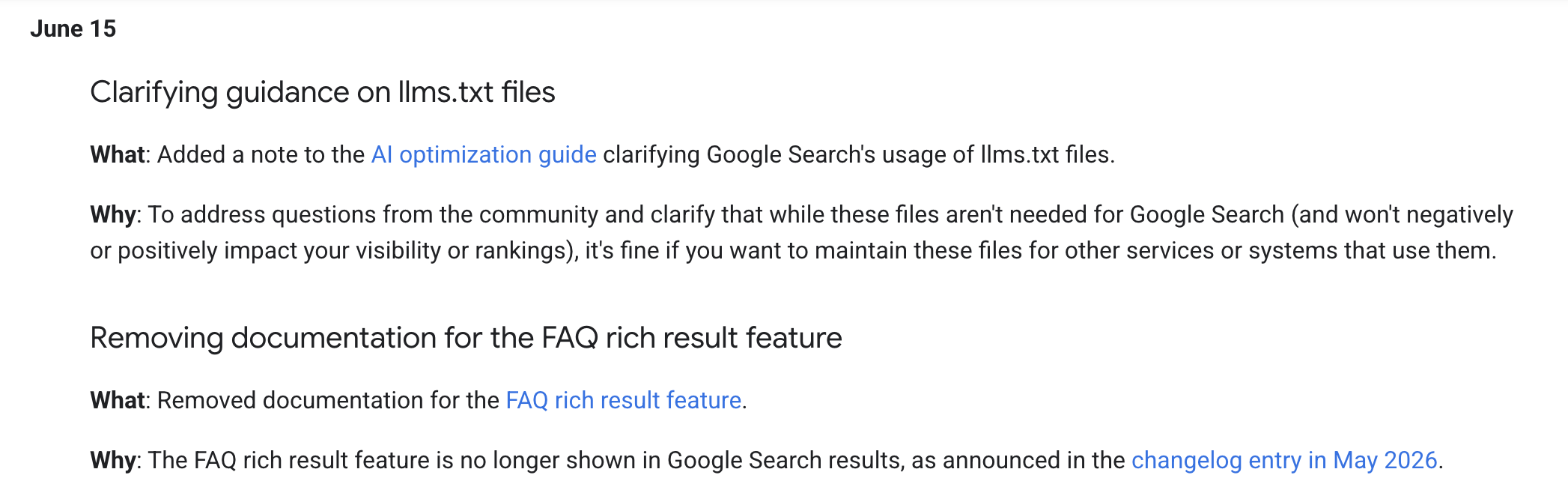
/assets/screenshots/faq-schema/google-faq-deprecation-notice.png Get the timeline right, because the whole decision hinges on it, and most of the advice still circulating online is describing a feature that no longer exists. There were two distinct events, three years apart.
The first was in August 2023. Google announced changes to HowTo and FAQ rich results, stating that FAQ rich results would only be shown for well-known, authoritative government and health websites — a change that rolled out globally within about a week. Search Engine Journal reported the same restriction to “well-known, authoritative government and health websites” at the time. For every ordinary business, blog, or SaaS site, that was the moment the FAQ rich result died. If you added FAQPage schema after late 2023 expecting drop-downs in your listing, you were marking up for a feature you were never eligible for.
The second event finished the job. On May 7, 2026, Google stopped showing FAQ rich results in Search entirely, including for the government and health sites that had retained them. Google added a deprecation notice to the FAQ documentation, and its own changelog dated May 8, 2026 states the feature would no longer appear in Search starting May 7. Search Engine Land documented the rollout: the FAQ search-appearance filter, the rich result report, and Rich Results Test support were dropped in June 2026, with the Search Console API support scheduled to follow in August 2026. In June, Google removed the FAQ rich result documentation altogether.
Google did not publish a blog post explaining the 2026 reasoning, but the direction is consistent with its broader cleanup of rich result types (HowTo was pulled back on the same 2023 announcement and fully deprecated shortly after). The practical upshot is unambiguous: there is no version of “add FAQ schema to get rich results in Google” that is true in 2026. Review stars survived the cleanup, but on narrower terms than most guides suggest; review schema covers which item types still qualify.
Where FAQPage markup still earns its place
Here is the part the deprecation headlines miss. The reason to consider FAQPage markup now has nothing to do with Google’s SERP and everything to do with what happens after a crawler reads your page.
AI answer engines — ChatGPT, Perplexity, Google’s AI Overviews — do not lift whole articles. They retrieve and quote passages: a short, self-contained span of text that directly answers a query. A FAQPage block is, structurally, a pre-cut set of exactly those passages. Each Question/acceptedAnswer pair is a labeled, standalone question-and-answer with no surrounding context needed to make sense of it. That is the same inverted-pyramid, one-answer-per-block shape I deliberately write toward for extraction, except the schema states the boundaries explicitly rather than leaving a parser to infer them.
So the markup’s value migrated intact. It used to help a visual feature chunk your content; now it helps a retrieval pipeline chunk your content. A page that ships six genuine FAQ entries is offering six independently quotable, independently citable answers — which is exactly the unit these engines cite. This is FAQPage’s specific instance of the crawlable-to-citable logic that underpins structured data for AI search: get the answer into clean, machine-parseable form in the raw HTML, and you have made it eligible to be extracted and attributed.
Two conditions have to hold for this to actually pay off, and both are within your control:
- The answers must be real and self-contained. An
acceptedAnswerthat says “it depends, see above” is useless to an engine that quotes it in isolation. Write each answer to stand completely on its own — that is what gets lifted. - The markup must be in the server-rendered HTML. If your JSON-LD is injected client-side after hydration, the AI crawlers that don’t run JavaScript never see it. The schema has to survive a raw fetch, the same constraint that governs every other structural move that makes a page citable by ChatGPT.
Note that other, non-Google engines and tools may still parse FAQPage for their own features, which is part of why Google explicitly says there’s no need to rip the markup out. Leaving valid, accurate schema in place costs nothing and keeps that optionality open.
Where FAQPage schema does not help
Being honest about the upside means being honest about the limits, because the biggest mistake I see now is people over-crediting the markup to compensate for the lost rich result.
FAQPage schema does not give you any visible enhancement in Google Search. No drop-downs, no extra SERP real estate, no reporting in the FAQ appearance filter (that filter is gone). It does not, on its own, make Google rank you higher — structured data is an eligibility and understanding signal, not a ranking boost, and the eligibility it used to unlock has been withdrawn.
It also does not rescue thin content. If a page has to invent questions nobody asks in order to have an FAQ block, the schema is decorating filler. AI engines are choosing which answer to cite; a padded FAQ full of restated marketing copy competes poorly against a genuinely useful one, schema or not. Adding FAQPage markup to questions that don’t reflect real user intent is effort spent on the wrong layer.
And it is not a substitute for the answer being good. The markup labels the boundaries of your answer; it does not improve the answer inside them. If the extractable passage is vague, hedged, or wrong, clean schema just helps an engine find a weak answer faster.
How to decide: keep, add, or drop
Strip away the obsolete rich-result reasoning and the decision is straightforward. Ask what you’re optimizing for.
Keep existing FAQPage markup if the answers are genuine, self-contained, and accurate. It’s valid, Google confirms it causes no harm, and it may help AI extraction and non-Google parsers. There is no upside to removing it and a small cost to doing so.
Add FAQPage markup if the page already has — or genuinely warrants — a real FAQ section answering questions users actually ask, and you want those answers cleanly delimited for AI retrieval. Write the answers to stand alone, and make sure the JSON-LD renders server-side.
Don’t add it if your only motivation was the Google rich result (that’s gone), or if you’d have to manufacture questions to justify it. In that case the effort belongs upstream — in writing genuinely extractable answers in the body copy, with or without the schema wrapper.
Consider removing it only if the markup is inaccurate, out of sync with the visible content, or points at questions the page no longer answers. Stale schema is worse than none, because it misrepresents the page to every parser that reads it.
The through-line is that FAQ schema in 2026 is a machine-extraction tactic, not a SERP tactic. Judge it by whether it helps an answer engine cite you — never by a rich result that no longer exists.
FAQ
Does FAQ schema still work in 2026?
Not for its original purpose. Google fully retired FAQ rich results on May 7, 2026, so FAQPage markup produces no visible enhancement in Google Search for any site. It still “works” as a valid Schema.org type: it labels your questions and answers so machines — including AI answer engines and non-Google parsers — can extract them as discrete question-answer pairs. So the schema is functional; the Google SERP feature it used to unlock is gone.
Why did Google remove FAQ rich results?
Google withdrew them in two stages. In August 2023 it limited FAQ rich results to well-known, authoritative government and health websites, removing them from the SERP for essentially all other sites. Then on May 7, 2026 it stopped showing them entirely, including for those government and health domains. Google didn’t publish detailed reasoning for the 2026 change, but it’s consistent with its broader move to simplify the search results and reduce the number of rich result types (HowTo results were pulled back in the same 2023 announcement).
Should I remove FAQPage schema from my pages?
Generally no. Google states there’s no need to remove structured data that’s no longer used for a rich result — valid, accurate FAQPage markup causes no problems, and other engines may still parse it. Leave it in place if the answers are genuine and self-contained, since it can still help AI answer engines extract and cite them. The only time to remove it is when the markup is inaccurate or out of sync with the visible content, because stale schema misrepresents the page.
Does FAQ schema help you get cited by ChatGPT or Perplexity?
It can, indirectly. AI answer engines quote self-contained passages, and a FAQPage block is a set of pre-delimited, standalone question-answer pairs — the same unit these engines cite. The schema doesn’t force a citation, but by cleanly bounding each answer it makes your content easier to extract, provided the answers are genuinely useful and the JSON-LD renders in the server-side HTML that AI crawlers read. The answer quality still does the real work; the schema just helps the engine find it.
Is FAQPage still a valid schema type?
Yes. FAQPage remains a valid Schema.org type — schema.org still defines it as a WebPage presenting one or more frequently asked questions, and the markup appears across more than a million domains. Google’s deprecation removed the FAQ rich result, the reporting, and the testing-tool support, but it did not invalidate the schema itself. You can still author correct FAQPage JSON-LD; it simply no longer triggers a Google Search appearance.
What should I use instead of FAQ schema for SEO?
Reframe the goal rather than swapping in another schema. If you wanted the FAQ rich result, nothing replaces it — that class of visual enhancement is gone for FAQs. If you wanted machine-extractable answers, focus on writing genuinely self-contained answers in your body copy and, where a real FAQ section exists, keep the FAQPage markup to delimit it for AI retrieval. The higher-leverage work is structural: clear, standalone answers in server-rendered HTML, which is what makes a page eligible to be cited whether or not it carries schema.