 Nadia Mohamed
1 GEO fundamentals & definition
- what is generative engine optimization
- geo seo meaning
- geo vs seo
- generative engine optimization definition
- how does geo work
- + 37 more
Keyword clustering groups a keyword list into topic sets — one page per cluster, not one per keyword. Paste up to 1,000 keywords (one per line) and get back semantically tight named clusters, grouped by shared topic and intent, not matching words.
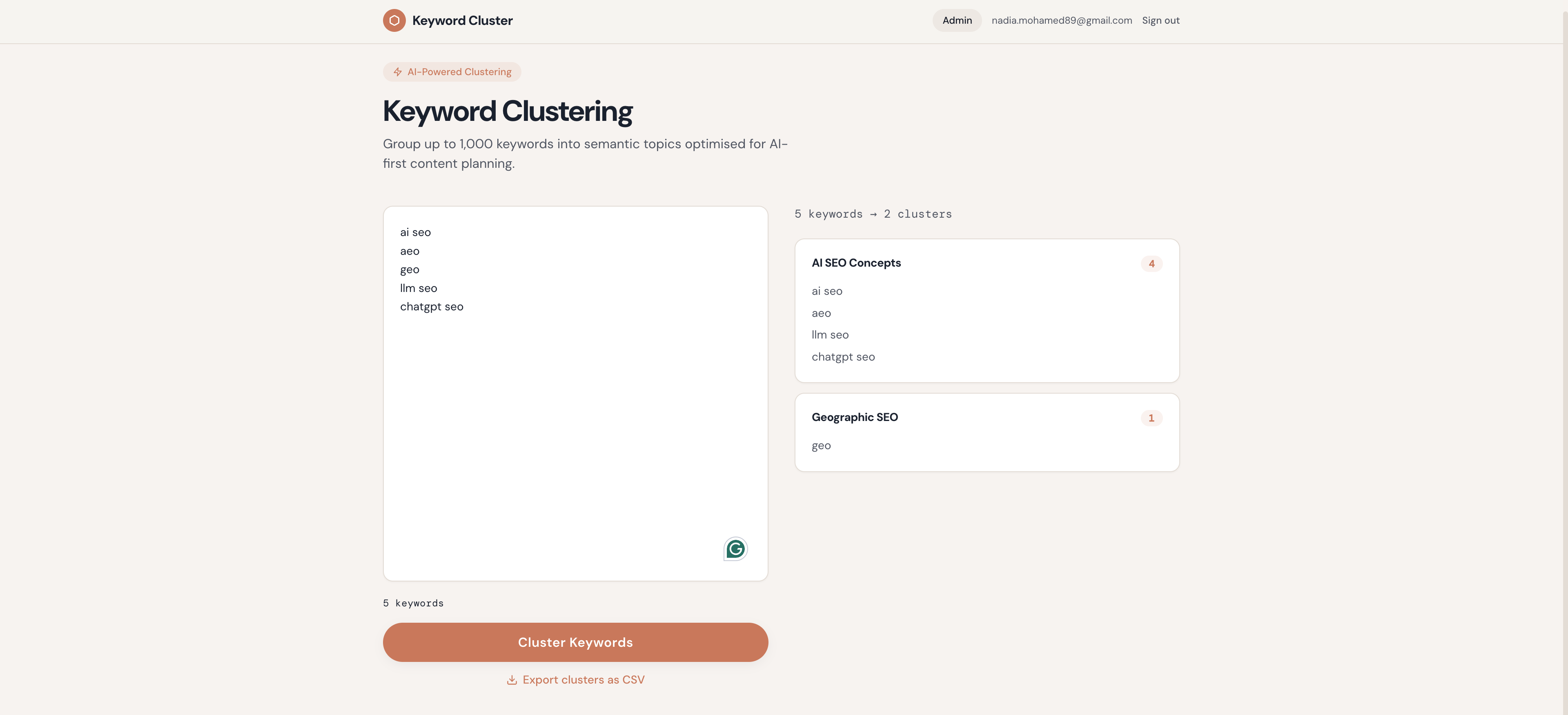
/assets/screenshots/keyword-clustering-ui.png The clustering tool lives on its own subdomain. Sign in, paste your keywords (up to 1,000, one per line), pick a granularity, and review the resulting named clusters on screen. A sample output is below so you can see the format first.
Open the clustering tool ↗︎Opens in a new tab · Sign-up required
Sample output · what clusters look like
Four steps, sequenced so each one feeds the next.
Each keyword becomes a high-dimensional vector — capturing semantic meaning, not just lexical similarity. This is what lets "how to get cited by chatgpt" and "perplexity citation sources" land in the same cluster.
Cosine similarity between every pair. The matrix is what the clustering algorithm walks.
The granularity setting controls the cut threshold — loose for fewer, larger groups; tight for more, more specific ones. Default produces useful chunks for most content plans.
Each cluster gets a representative label generated from its highest-similarity members. The on-screen result shows the cluster id, the label, the size count, and every keyword in it — ready to drop into your content planning workflow.
How semantic clustering works and how to use the output.
Keyword clustering is the process of grouping a list of keywords into topic-based sets, so each cluster maps to one page or section. It turns a flat keyword list into a content plan — one article per cluster, rather than one thin page per keyword.
SERP-overlap tools group keywords that share ranking URLs on Google. This tool clusters by meaning: it embeds each keyword as a vector and groups by semantic similarity, so it catches phrasings that belong together even when Google's results don't yet overlap — closer to how AI engines read intent.
Up to 1,000 keywords, one per line. Larger lists cluster in seconds, and you control the granularity — looser for fewer, broader groups, tighter for more specific ones.
Each keyword is embedded as a high-dimensional vector, pairwise cosine similarity is computed, and hierarchical clustering groups them at an adaptive threshold. Each cluster is then given a representative label drawn from its most central members.
Each cluster becomes a content target — typically one pillar or article per cluster, with the individual keywords as the sections to cover. It's the fastest way to turn a keyword export into a pillar-and-spoke plan. The tool is free; sign-up is required so your runs can be saved.
Larger lists, your taxonomy, integration with your existing content workflow — the same clustering engine powers custom tools I build for client teams. Same engineering, scoped to your needs.
Choose which categories you allow. Essential cookies are always on because the site won't work without them. You can change this any time from the "Cookie preferences" link in the footer.
Required for the site to function — navigation, form submission, security.
Anonymous usage data via Google Analytics 4 — pages viewed, time on site, traffic source. Used to improve the site.
Cookies that enable ad measurement and remarketing. Off by default; only relevant if Google Ads or similar campaigns are running.
Used to remember preferences like language or display mode across visits.