 Nadia Mohamed
1 Headless render diff checker High demand
Compare what Googlebot sees vs what a browser renders on a Next.js / Nuxt / Remix page. Surface the gap where SSR fails silently or client-side JS injects content too late.
Enter your niche and pick your primary goal — drive organic leads, build authority, or grow email list. Get back 5–8 tailored AI tool ideas, each with a demand tier and an estimated build budget. Designed to surface the under-served corners, not the obvious ones.
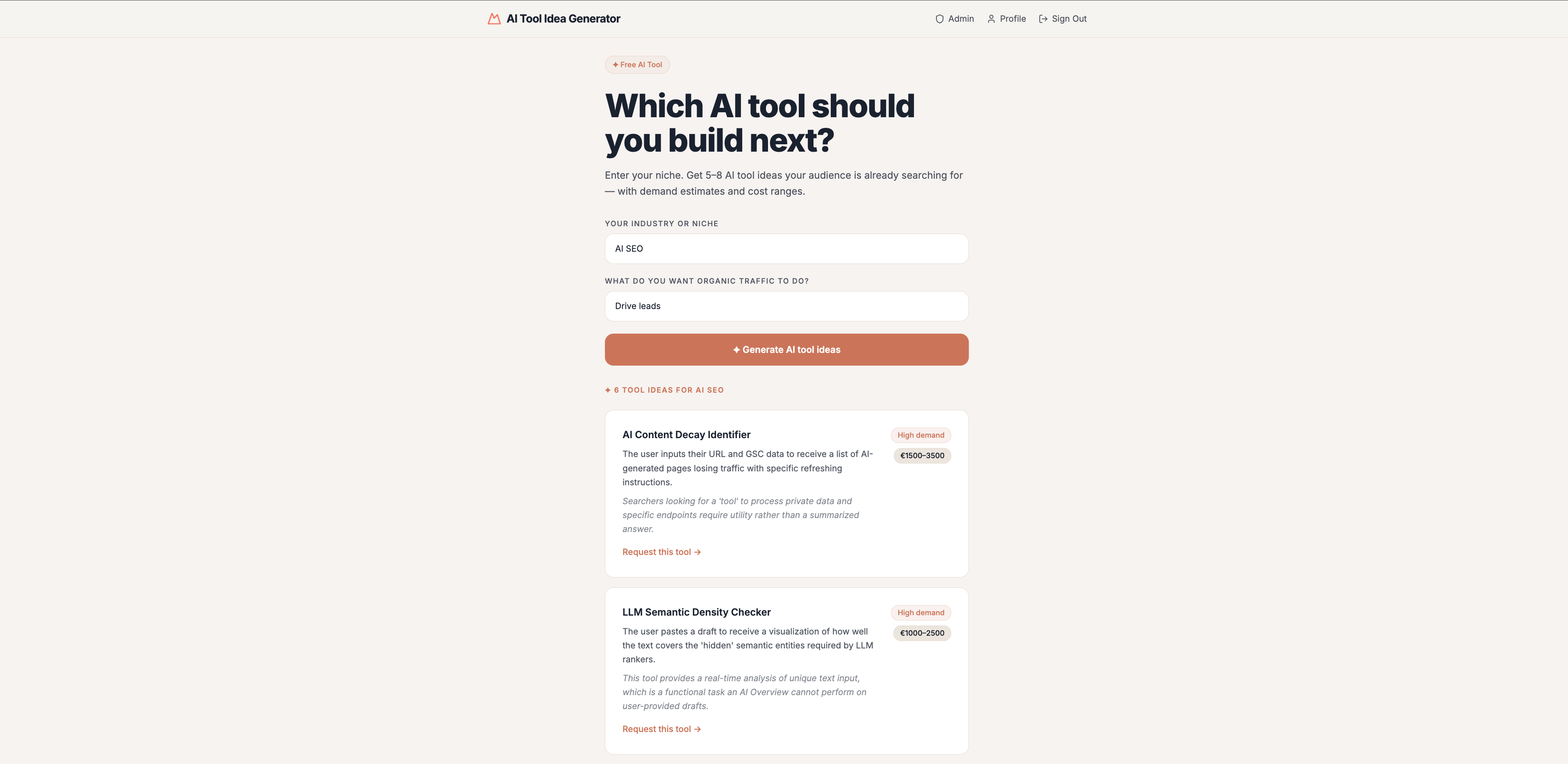
/assets/screenshots/tool-ideas-ui.png The generator lives on its own subdomain. Sign up, type your niche, choose your primary goal (drive organic leads, build authority, or grow email list) — get 5–8 tailored AI tool ideas back, each with a demand tier and an estimated build budget. A sample output for "technical SEO for headless sites" is below.
Open the generator ↗︎Opens in a new tab · Sign-up required
Sample output · for "technical SEO for headless sites"
Compare what Googlebot sees vs what a browser renders on a Next.js / Nuxt / Remix page. Surface the gap where SSR fails silently or client-side JS injects content too late.
Crawl a multilingual site and flag pages where the hreflang declaration isn't reciprocated correctly across locales. Existing tools handle simple cases; this one handles the headless+CDN edge cases.
Take a content type from Sanity / Contentful / Prismic and emit a clean JSON-LD template (Article, Product, FAQPage) ready to drop into the front-end. With the May 2026 FAQ-deprecation notes baked in.
Crawl a multi-locale site, map the canonical declarations, flag the cross-locale canonical bug that bites most headless multilingual stacks. Underserved by existing site-audit tools.
Hook into the deploy pipeline; run Lighthouse against a small set of pages before merge; block PRs that regress LCP / CLS / INP beyond a threshold. The marketing-team-friendly version of CWV gating.
Watch a site's sitemap.xml; alert on unexpected drops or surges in URL count. Catches CMS issues, accidental noindex flips, redirect-chain breakage — the things that quietly tank rankings.
Walk an existing JSON-LD graph on a site, visualise the @id relationships, and flag broken or missing references. Useful when entity authority is the GEO bottleneck and the team has no visibility into what they're emitting.
The tool is built to surface ideas in the gap between "what people are searching for" and "what already exists." Four steps.
Your input is expanded into 40–80 related queries using a combination of search-suggest data and semantic neighbours.
For each candidate query, a monthly search-volume estimate is attached. Estimates are directional, not precise.
For each query, the existing tool / SaaS landscape is sampled. Queries with high demand and weak existing supply rank highest — that's the gap the generator targets.
The top 5–8 are returned with a short description, a demand tier, and an estimated build budget — tuned to the primary goal you picked (organic leads, authority, or email list) so the ideas align with the outcome you're optimising for.
Where the ideas come from and how to read them.
It takes your niche and a primary goal — drive organic leads, build authority, or grow your email list — and returns 5–8 tailored AI or SEO tool ideas, each with a demand tier and an estimated build budget. It's built to surface the under-served ideas, not the obvious ones.
Your niche is expanded into 40–80 related queries, each gets a directional monthly-search estimate, and each is scored against the existing tool and SaaS supply. Ideas with high demand and weak existing supply rank highest — that's the gap the generator targets.
SaaS founders, product managers, and SEO leaders looking for a lead-generating free tool or internal utility to build. The ideas are tuned to the goal you pick, so they align with the outcome you're optimising for.
They're directional, not precise — enough to compare ideas against each other and spot the high-demand, low-supply gaps. Validate the volume for a specific idea before you commit engineering time to it.
Each idea includes a rough build difficulty and an estimated MVP timeline (typically 1–6 weeks) based on the data sources and engineering it would need — a starting point for scoping, not a fixed quote. The generator itself is free to use with a sign-up.
If one of the generated ideas (or your own) is worth shipping properly, the AI Tools & Software service builds it — design doc, working application, eval harness, source in your repo. Engineering-grade, not slide-deck-grade.
Choose which categories you allow. Essential cookies are always on because the site won't work without them. You can change this any time from the "Cookie preferences" link in the footer.
Required for the site to function — navigation, form submission, security.
Anonymous usage data via Google Analytics 4 — pages viewed, time on site, traffic source. Used to improve the site.
Cookies that enable ad measurement and remarketing. Off by default; only relevant if Google Ads or similar campaigns are running.
Used to remember preferences like language or display mode across visits.