 Nadia Mohamed
Technical SEO
Keyword Clustering by SERP Overlap: The Method That Maps to How Google Actually Ranks
What is keyword clustering?
Keyword clustering is the practice of grouping search terms that share the same intent so you can target the whole group with one page instead of scattering them across many. Semrush defines it as “an SEO technique centered on grouping search terms that share the same search intent… and targeting them together on a single page.” Ahrefs frames the mechanics more precisely: clustering is “typically done by grouping keywords with the same or similar search results,” on the logic that “if Google ranks the same pages for many keywords, they have the same or similar intent and should generally be targeted on the same page.”
That second definition is the one that matters, and it is the thread running through this guide. There are two broad ways to decide whether two keywords belong together: you can compare the words (“king size mattress” and “king mattress” look alike) or you can compare the search results Google already returns for each. The first is fast and wrong often enough to cost you rankings. The second — clustering by SERP overlap — is slower, defensible, and mirrors the only opinion that decides your rankings: Google’s.
This is a method guide. By the end you will know how to build a keyword list, group it by shared search results, set the overlap threshold that controls how tight your clusters are, classify the intent inside each group, and turn the finished clusters into a content plan.
TL;DR — Key takeaways
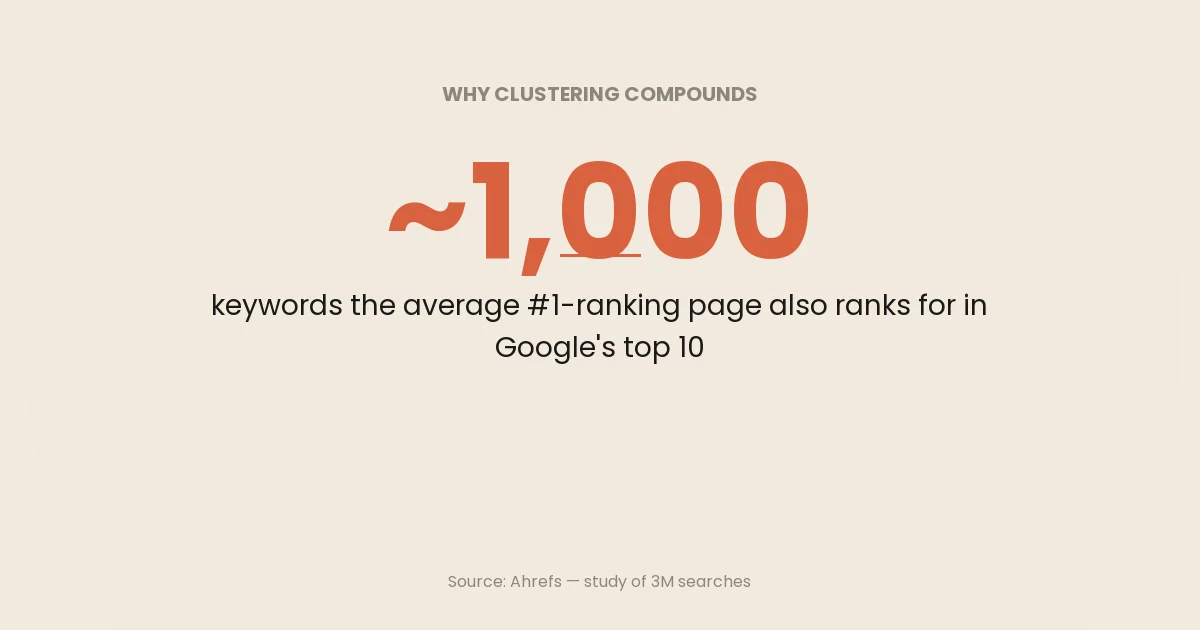
- Keyword clustering groups keywords by shared search intent so one page can rank for many terms. The efficiency case is large: “the average #1 ranking page will also rank in the top 10 for nearly 1,000 other relevant keywords,” according to Ahrefs’ study of 3 million searches.
- Cluster by SERP overlap, not string similarity. Group keywords when Google returns the same URLs for them — not when the words look alike.
- Set a clustering level (overlap threshold). The number of shared top-10 URLs required to merge two keywords controls how many clusters you get and how tight they are.
- Confirm borderline clusters with page metrics. Partial overlap can mislead; check the Domain Rating and referring domains of the ranking pages before merging.
- Classify intent inside each cluster — informational, navigational, commercial, or transactional — and never mix intents on one page.
- Clustering feeds AI search too. In AI SEO the secondary terms in a cluster are the “fan-out queries” an assistant expands your prompt into.
Why cluster at all? One page ranks for far more than one keyword
The instinct to build one page per keyword comes from a misreading of how ranking works. A page does not rank for a single term; it ranks for a topic, and topics span hundreds of queries. Ahrefs’ study of 3 million searches put a number on it: “the average #1 ranking page will also rank in the top 10 for nearly 1,000 other relevant keywords (while the median value is more than two times smaller — around 400 keywords).” The study looked at “3 million random search queries and how many other keywords they rank for,” so this is not a boutique finding — it is the baseline behaviour of Google’s index.
Semrush shows the same effect from the other direction with a live example: a single page that “ranks for about 2,200 keywords and attracts an estimated 183,100 organic visits per month from the U.S.” That traffic did not come from 2,200 separate pages. It came from one page that satisfied one intent thoroughly enough to earn the whole cluster.
The practical consequence is a change in your unit of work. Stop asking “what page do I build for this keyword?” and start asking “which keywords does Google already treat as the same page, and have I built that page yet?” Clustering is how you answer the second question at scale without guessing.
SERP overlap vs string similarity: the distinction that matters
Here is where most clustering goes wrong. The easy way to group keywords is by the words themselves — a process linguists call lemmatisation, where terms are reduced to their base forms and grouped by shared roots. Wikipedia calls this lemma-based keyword grouping: keywords are “broken down into lemmas” and “keywords with matching lemmas are grouped together.” Semantic keyword clustering — grouping by embedding similarity or shared meaning — is a more sophisticated version of the same idea, but it is still deciding relatedness from the keywords, not from the results.
The problem is that Google does not rank words; it ranks pages against intent, and intent does not always follow vocabulary. Two keywords can look nothing alike and still return an almost identical set of URLs, and two keywords that share every word can return completely different results. String and semantic methods miss both cases.
SERP-based clustering fixes this by asking the only source that decides your rankings. As Wikipedia puts it: “Compared to lemma-based keyword grouping, SERP-based keyword clustering produces groups of keywords that might reveal no morphological matches, but will have matches in the search results. It allows search engine professionals getting a keyword structure close to what a search engine dictates.” That last phrase is the whole argument. When you cluster by shared results, your content architecture is not your theory of how searchers think — it is a direct read of how Google has already decided to organise the topic.
You can sanity-check any single pair without a tool. Ahrefs exposes this as a “SERP similarity score out of 100” when you compare two keywords — “high = cluster, low = don’t, middle = take your best guess.” The score is just a count of how many of the top results the two keywords share. That count is the entire mechanism, and the next section turns it into a repeatable process.
How to cluster keywords by SERP overlap, step by step
1. Build a keyword list. Start with a few broad seed terms for your topic and expand them with a keyword tool until you have every realistic variation — questions, modifiers, long-tail phrasings, and near-synonyms. Breadth here is good; you are going to let the SERPs do the filtering, so it is fine to over-collect at this stage. This is also the moment to pull competitor rankings, since a rival’s keyword list surfaces terms your seed expansion missed.
2. Pull the top 10 results for each keyword. For every keyword, record the URLs Google returns on page one. This is the raw material of SERP-overlap clustering — Ahrefs notes that dedicated tools such as Keyword Insights work by “comparing the top 10 or 100 search results for your keywords.” Doing this by hand is only realistic for a few dozen keywords; beyond that you need a tool that fetches SERPs at volume.
3. Group keywords that share enough results. Two keywords join the same cluster when the same URLs appear in both their top-10 results. The more overlap, the more confident the grouping.
4. Set the clustering level (your overlap threshold). This is the single most important setting and the one beginners skip. The threshold is the minimum number of shared top-10 URLs required to merge two keywords — Wikipedia calls it the clustering level: “A minimum number of matches in the search results that trigger keyword clustering.” It is a dial, not a default. “The higher clustering level produces more groups with fewer keywords in every group” — stricter, cleaner, more pages. A lower level “will create a few groups with a lot of keywords in each of them” — broader, fewer pages, more risk of merging things that should stay apart. A threshold of 3 shared URLs is a sensible starting point for most sites; raise it when your clusters feel too loose.
5. Choose how strict the grouping has to be across the whole cluster. Overlap between two keywords is one thing; overlap across an entire group is another. Wikipedia documents three modes. Under Hard clustering, “all keywords within a group will be related to each other by having the same matching URLs” — every member shares results with every other member, which produces the tightest, safest clusters. Under Soft clustering, keywords only need to share results with the group’s highest-volume keyword, “but they will not necessarily be related to each other.” Moderate sits between the two. Use Hard clustering when you are planning money pages and cannot afford an intent mismatch; use Soft when you are exploring a topic and want to see the widest possible grouping before you prune.
The same SERP-scanning discipline underpins a good technical SEO pass, where you are already reading what Google returns and how it treats your pages — clustering just applies that habit to keyword strategy.
Classifying search intent inside a cluster
SERP overlap tells you which keywords Google treats alike; intent tells you what to do with the resulting page. Semrush works from four main types of search intent:
- Informational — the searcher wants to learn something (“what is keyword clustering”).
- Navigational — the searcher wants a specific page or brand.
- Commercial — the searcher is researching options before buying (“best keyword clustering tool”).
- Transactional — the searcher is ready to act (“free keyword clustering tool”).
Most of the time, keywords that share a SERP also share an intent — that is why they share a SERP. But the edges matter. The same words can carry different intent: “keyword clustering tool” leans commercial and transactional, while “how to do keyword clustering” is purely informational, and Google returns different pages for each. When a SERP-overlap cluster straddles two intents, split it. A page that tries to teach a method and sell a tool in the same breath satisfies neither searcher, and Google will rank a more focused competitor above it. Intent is the line you never cluster across, even when the overlap tempts you.
When SERP overlap misleads — confirm with page metrics
Overlap is strong evidence, not proof. Google sometimes returns a mixed SERP — partly one intent, partly another — and a naive tool will merge keywords that should stay apart. Ahrefs gives a clean example. Pages ranking for “chocolate cake recipe” averaged a Domain Rating of 74 with 318 referring domains; pages ranking for “chocolate cake recipe with coffee” averaged DR 33 with just 11 domains. The two keywords share enough results that clustering tools group them — yet the competitive reality is completely different, and, as Ahrefs concludes, “clustering, as the tools suggested, would probably be a mistake.”
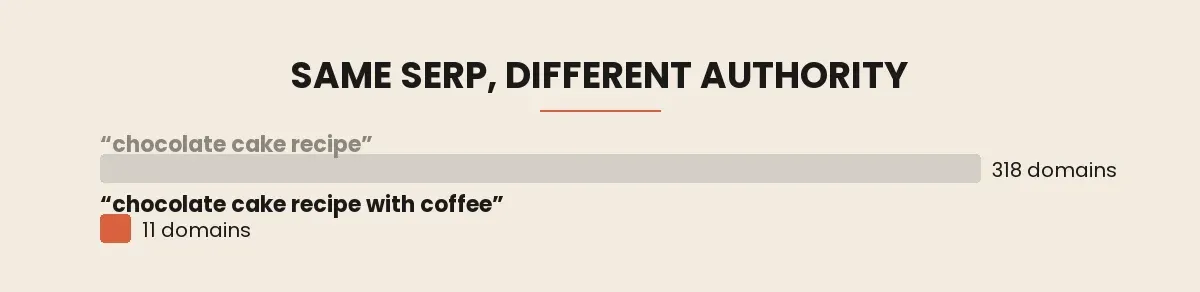
The lesson is a confirmation step for every borderline cluster: before you merge, look at the Domain Rating and referring-domain counts of the pages actually ranking. If the ranking pages for two keywords have wildly different authority profiles, the shallower keyword is a distinct, easier opportunity that deserves its own page — not a footnote on a page built for the harder term. Overlap gets you to a shortlist; page-level metrics decide the close calls.
From clusters to a content plan
Finished clusters are a content plan in disguise. Each cluster becomes one page: its highest-volume, best-fit term is the primary keyword, and the rest are secondary keywords you weave into the same page. Semrush offers three questions to pressure-test any grouping before you commit it to the plan: SERP similarity (“Do the same pages rank well for those keywords?”), content quality (would separate pages each be too thin to be worth it?), and user journey (would one reader want all of this at once?). If a cluster passes all three, it is a page.
Then prioritise. Rank your clusters by combined search volume against how winnable they are — a tight cluster of low-difficulty terms you can actually rank for beats a high-volume cluster dominated by DR 90 publishers. Clusters that reinforce one another compound into topical authority, which is what earns a domain the right to rank for the harder head terms over time. When a set of clusters shares a repeatable template — locations, comparisons, use cases — that is the seam where clustering feeds programmatic SEO, letting one validated structure scale into dozens of pages. For SaaS teams mapping this against a product, the cluster-to-page discipline is the backbone of SEO for SaaS: every feature and use case earns its own intent-matched page instead of one bloated “features” URL trying to rank for everything.
Where AI and automation fit (and the AI-search payoff)
Doing SERP-overlap clustering by hand caps out fast — pulling and comparing the top 10 for hundreds of keywords is exactly the kind of work you automate (it is the first stage I hand to a machine in SEO content automation). This is where AI keyword clustering and dedicated tooling earn their place: not to decide relatedness from vibes, but to fetch SERPs at scale and compute the overlap for you. A useful mental model is embeddings plus SERP validation — let a model propose candidate groups from meaning, then confirm each against real search results before you trust it. If you want the fetch-and-compare step handled for you, that is precisely what a keyword clustering tool is for.
The payoff now extends past traditional rankings. Semrush notes that “clustering like terms on the same page works well for improving your visibility in AI systems like ChatGPT as well. In AI SEO, the secondary terms in a cluster are called fan-out queries.” When an AI assistant answers a question, it expands the prompt into related sub-queries and pulls from pages that cover the whole cluster — so a page built around a complete SERP-overlap cluster is already shaped for how AI search retrieves and cites content. The same architecture that wins the top 10 wins the citation. Clustering by SERP overlap is not a trick for one channel; it is the closest thing to building your site the way search engines — old and new — have already decided to read it.
FAQ
What is keyword clustering in SEO?
Keyword clustering is grouping search terms that share the same intent so they can be targeted with a single page rather than many. In practice, the most reliable way to group them is by SERP overlap — putting keywords in the same cluster when Google returns the same pages for them, which signals that Google treats them as one intent.
What is the difference between keyword clustering and keyword grouping?
Keyword grouping usually means organising keywords by shared words or themes (a lemma- or term-based approach). Keyword clustering, in its stronger form, means grouping by shared search results — the SERP-overlap method. The distinction matters because keywords with different wording can share a SERP, and keywords with identical wording can return different results.
How do you cluster keywords by SERP overlap?
Build a broad keyword list, pull the top 10 Google results for each keyword, and group any keywords that share enough of those results. Set a clustering level (for example, three shared URLs) to control how strict the grouping is, and choose Soft, Moderate, or Hard clustering depending on whether you want the widest exploration or the tightest, safest groups.
Is SERP-based clustering better than semantic clustering?
For deciding page architecture, yes — because it reflects how Google actually ranks rather than how similar the words are. Semantic clustering is useful for discovery and for proposing candidate groups quickly, but those candidates should be validated against real search results before you build pages around them.
What is a clustering level or clustering threshold?
It is the minimum number of shared top-10 URLs required before two keywords are merged into the same cluster. A higher threshold produces more clusters with fewer keywords each (stricter); a lower threshold produces fewer, broader clusters. It is the main dial you tune to get clusters that match your appetite for pages.
Can AI do keyword clustering automatically?
Yes. AI and dedicated tools can fetch SERPs at scale and compute overlap far faster than manual work, and models can propose groupings from meaning. The strongest workflow combines both — AI to suggest candidate clusters, SERP overlap to validate them — so the final grouping still reflects live search results rather than the model’s assumptions.
How does keyword clustering help with AI search visibility?
AI systems answer a query by fanning it out into related sub-queries and drawing from pages that cover the whole set. The secondary terms in a keyword cluster are effectively those fan-out queries, so a page built around a complete SERP-overlap cluster already matches how AI assistants retrieve and cite content — meaning the same clustering work compounds across traditional and AI search.