 Nadia Mohamed
Technical SEO
The 12-Phase SEO & GEO Audit: What It Actually Covers and Why It Works
What is a 12-phase SEO & GEO audit?
A 12-phase SEO & GEO audit is a structured methodology that covers every layer of organic search and AI citation performance — technical health, entity signals, content architecture, GEO readiness, internal linking, off-page authority, and tracking — delivered as a sequenced action plan that can be executed immediately rather than as a static PDF.
Most SEO audits end the same way: someone hands over a spreadsheet of issues. It gets forwarded to the dev team. The dev team puts it in the backlog behind 47 other priorities. Three months later, nothing has shipped and the audit is a sunk cost.
The 12-phase audit is built to avoid that failure mode. The methodology comes from a full-stack engineering background applied to SEO and GEO — which means the structured data is written as JSON-LD ready to deploy, the tracking is configured in GA4 with the AI channel group already set up, and the dashboard is built in Looker Studio against the actual KPIs the engagement is measured by. No handoff to a separate implementation team, no interpretation layer, no deprioritised backlog.
Each of the 12 phases produces documented findings that feed the next phase. No phase is skipped. Every decision traces back to the primary conversion goal defined in Phase 1. Here is what each phase actually covers.
TL;DR — Key takeaways
- Most SEO audits ship a PDF that lands in a backlog behind 47 other priorities; this one ships deployed infrastructure instead — JSON-LD schema ready to paste, tracking configured in GA4, and a Looker Studio dashboard built against the client’s KPIs, with no handoff to a separate implementation team.
- The 12 phases run in sequence — Foundation, technical and crawl health, E-E-A-T entity signals, competitive intelligence, content inventory, content architecture, on-page, GEO, internal linking, off-page authority, tracking, and a prioritised P1–P4 action plan — and the sequence matters as much as the actions, because each phase feeds the next and every decision traces back to the Phase 1 conversion goal.
- Phase 8 (GEO & AI Search Optimisation) is the citation-readiness layer, built around a Prompt → Content Gap Matrix of 20+ real prompts tested across ChatGPT, Perplexity, Gemini, and Google AI Overviews. The empirical case: ChatGPT at 92.4% of standalone LLM referral share (excluding Google AI Overviews and AI Mode), LLM referrals converting to sign-ups at 1.66% versus 0.15% for search (an 11× differential, across publishers and news sites with a newsletter sign-up as the conversion event). The conversion figures come from a single client whose AI arm was roughly 11,000 sessions against 14 million for Google.
- Built for personal brands and service businesses — coaches, consultants, SaaS companies, speakers, agencies — where organic search and AI citation drive qualified leads. Priced in three tiers by site size: Personal Brand up to 30 indexed pages at €1,200, Mid-Size Business at €2,000, and Established Site 150+ pages at €3,200+.
- The audit stands alone (typically delivered in three weeks) but can extend into a 3-month implementation block, and it refreshes quarterly against live data so it stays a living document rather than a report that collects dust.
Phase 1: Foundation & Business Context
Nothing gets optimised until the goal organic traffic needs to deliver is defined. This phase establishes the entity (who the business is and how search and AI engines should understand it), the ideal client profile, the revenue goals, the primary conversion URL, and the baseline KPIs the engagement will be measured against.
Most audits skip this phase and jump straight to crawl data, which is how engagements end up optimising for traffic that does not convert. The Foundation phase is what makes every downstream decision evaluable: a recommendation either advances the defined conversion goal or it does not.
Delivered: entity definition, ICP documentation, conversion URL mapping, baseline KPI report.
Phase 2: Technical & Crawl Health Audit
A full site crawl identifying everything that prevents Google from properly accessing, understanding, and ranking the site. The audit covers indexing blockers, redirect chains, canonical errors, Core Web Vitals failures, mobile usability issues, broken structured data, and crawl budget waste — the same technical-health layer that governs a site migration without traffic loss.
Technical issues get fixed before any content or ranking work begins. Schema markup on a page Google cannot index achieves nothing, and AI engines cannot cite a page their crawlers cannot reach. The Phase 2 fixes are the prerequisite for every downstream phase to produce results. The working list for this phase is the technical SEO audit checklist: 47 pass/fail checks in the order crawlers meet them. The crawl methodology and AI bot accessibility checks overlap with the framework documented in the step-by-step GEO audit.
Delivered: crawl report with every issue categorised P1–P4, fix instructions specific enough for a developer to execute without follow-up questions.
Phase 3: E-E-A-T & Entity Signal Audit
Google and AI systems use trust signals to assess whether content deserves to rank and be cited. This phase audits those signals: Knowledge Panel status, Wikipedia and Wikidata presence, Person and Organization schema implementation, the sameAs array completeness, About page depth, media footprint, third-party citations, and the consistency of name representation across platforms.
For personal brands — coaches, consultants, speakers — Phase 3 is particularly high-leverage because Google’s trust signals map directly to individual credibility, and AI engines weight Person entity signals heavily when choosing sources for generated answers. The entity-layer mechanics, including which sameAs URLs carry the most weight for AI entity resolution, are covered in the E-E-A-T for AI search piece.
Delivered: entity signal scorecard, gap analysis versus competitors, specific actions to strengthen E-E-A-T at both the person and organisation level.
Phase 4: Competitive & Keyword Intelligence
Organic competitors are not always the businesses the client considers rivals. This phase identifies the sites that actually compete for the target keywords — the ones currently ranking and accumulating clicks.
We map the full keyword gap, audit competitor backlink profiles, and flag position 5–15 pages where a focused title rewrite, intro restructure, or schema deployment could move the page to page one. This is where the engagement finds the quick wins that generate measurable results before the deeper architecture and authority work compounds.
Delivered: competitor gap matrix, keyword opportunity list ranked by impact, quick-win page list.
Phase 5: Content Inventory & Thin Content Audit
Every indexed page is scored and assigned a decision: Keep, Improve, Consolidate, or Remove. Keyword cannibalisation is flagged — where multiple pages compete for the same queries and dilute each other. Content gaps are identified against competitor data and against the search behaviour of the defined ICP.
The goal of Phase 5 is a clean, purposeful content set where every page has a job and a measurable contribution to the conversion goal. Removed pages are redirected, not deleted, so accumulated authority is preserved.
Delivered: page-level scorecard with decisions, cannibalisation report, content gap list mapped to ICP search behaviour.
Phase 6: Content Architecture & Cluster Design
This is the structural layer most audits miss entirely. Phase 6 builds the topical cluster architecture that passes authority and guides users toward conversion. Every URL is mapped to a cluster, a funnel stage (TOFU, MOFU, BOFU), and a documented conversion path.
This means top-of-funnel blog posts actually feed into bottom-of-funnel service pages through deliberate linking — not random “related posts” widgets. The cluster architecture is what makes the internal linking system in Phase 9 effective rather than mechanical.
Delivered: cluster map (visual + spreadsheet), URL-to-funnel mapping, conversion path documentation.
Phase 7: On-Page SEO Optimisation
With the strategy and architecture set, Phase 7 optimises the priority pages. Title tags and meta descriptions are rewritten for priority URLs. H1s are audited. Definition blocks are added where AI citation readiness depends on a clean, extractable answer to a primary question. Word count is assessed against search intent rather than against an arbitrary target. CTAs are aligned to funnel stage: bottom-of-funnel pages get conversion-first treatment, top-of-funnel pages get engagement-first treatment.
The schema mechanics applied at this phase — Article, FAQPage, HowTo, BreadcrumbList — are documented in the schema markup foundation piece.
Delivered: optimised title tags and meta descriptions, H1 recommendations, per-page optimisation brief, JSON-LD schema blocks ready to deploy.
Phase 8: GEO & AI Search Optimisation
This is where most SEO audits stop and where the highest-leverage citation work happens. Phase 8 is the citation-readiness layer of the framework — the phase that determines whether ChatGPT, Perplexity, Google AI Overviews, and Gemini will cite the site when asked the questions that matter to the business.
The empirical case for Phase 8 sits in three cluster-verified data points:
- Previsible’s 6.77 million-session AI traffic study measured ChatGPT at 92.4% of LLM referral share across the analysed sites, with the rest split between Perplexity, Claude, and Gemini, a denominator that excludes Google AI Overviews and AI Mode. Citation eligibility on ChatGPT is where the largest share of the addressable AI traffic concentrates.
- AI-referred traffic converts above organic on both published measurements (the benchmarks and their limits). The visits Phase 8 unlocks convert at materially higher rates than equivalent Google visits.
- Microsoft Clarity data published via Digiday across 1,200+ sites measured LLM referrals converting to sign-ups at 1.66% versus 0.15% for search referrals — an 11× differential, across publisher and news sites, with a newsletter sign-up as the conversion event.
The mechanics of Phase 8 are built around a Prompt → Content Gap Matrix: 20+ real prompts the ideal client would ask AI, tested across ChatGPT, Perplexity, Gemini, and Google AI Overviews, with every gap between the AI’s current answer and what the site covers documented and prioritised. The matrix surfaces three categories of gap: prompts where the AI cites competitors and the site is invisible, prompts where the AI cites the site but with stale or incomplete information, and prompts where the AI returns an answer the site is positioned to dominate if the content is restructured for AI extraction.
The restructuring work in Phase 8 includes structured definition blocks, AI-ready FAQ blocks (the FAQ schema rich result was deprecated on 7 May 2026 but the schema continues to drive AI citation eligibility), Person entity attribution, and content restructuring against the AI extraction patterns surfaced in the GEO definitional piece. If an AI system cannot parse a page into a quotable answer, it will cite someone else.
Delivered: Prompt → Content Gap Matrix (20+ prompts × 4 platforms), AI readiness scorecard, page-by-page restructuring recommendations, JSON-LD blocks ready to deploy.
Phase 9: Internal Linking System
Internal links are architecture, not afterthought. Phase 9 builds a deliberate link structure that distributes PageRank and guides users toward conversion. Every middle-of-funnel and bottom-of-funnel page is linked to the primary conversion destination. Orphan pages — pages with no internal links pointing to them — are eliminated. Anchor text is optimised throughout, with the cluster architecture from Phase 6 determining which anchor text variants strengthen which topical authority signals.
Delivered: internal linking map, orphan page report, anchor text recommendations aligned to the cluster architecture.
Phase 10: Off-Page Authority & Link Building
Phase 10 closes the backlink gap with competitors and builds the external citation graph that reinforces the Phase 3 entity signals. The phase identifies unlinked brand mentions (places that mention the brand but do not link to it), journalist outreach opportunities, guest post targets aligned to the topical cluster, and broken backlinks to recover — all prioritised by domain authority and topical relevance.
The backlink strategy is specific: which sites to target, which pages to link to, and what angle to pitch. External citations from credible domains also strengthen E-E-A-T entity resolution for AI engines, which means Phase 10 has a dual function: traditional SEO authority and AI citation entity reinforcement.
Delivered: backlink gap analysis, unlinked mention list, outreach target list with pitch angles, broken link recovery list.
Phase 11: Tracking, Attribution & Dashboard
Measurement is a prerequisite, not an afterthought. Phase 11 covers GA4 key event implementation, GTM configuration, UTM parameters, cross-domain tracking, first-touch attribution, and a custom AI source channel group that isolates Perplexity, ChatGPT, Claude, and Gemini referral traffic into its own attribution bucket.
A dedicated client dashboard is built in Looker Studio, verified against the GA4 data, and handed over. It is designed around the specific KPIs defined in Phase 1, not assembled from a generic template. The dashboard typically shows organic sessions by content cluster, priority page ranking positions, CTA click rates, form submissions or purchases attributed to organic and AI sources, CTR trends from Search Console, and the AI referral segment isolated from the rest of the organic channel — designed for a 5-minute read on progress.
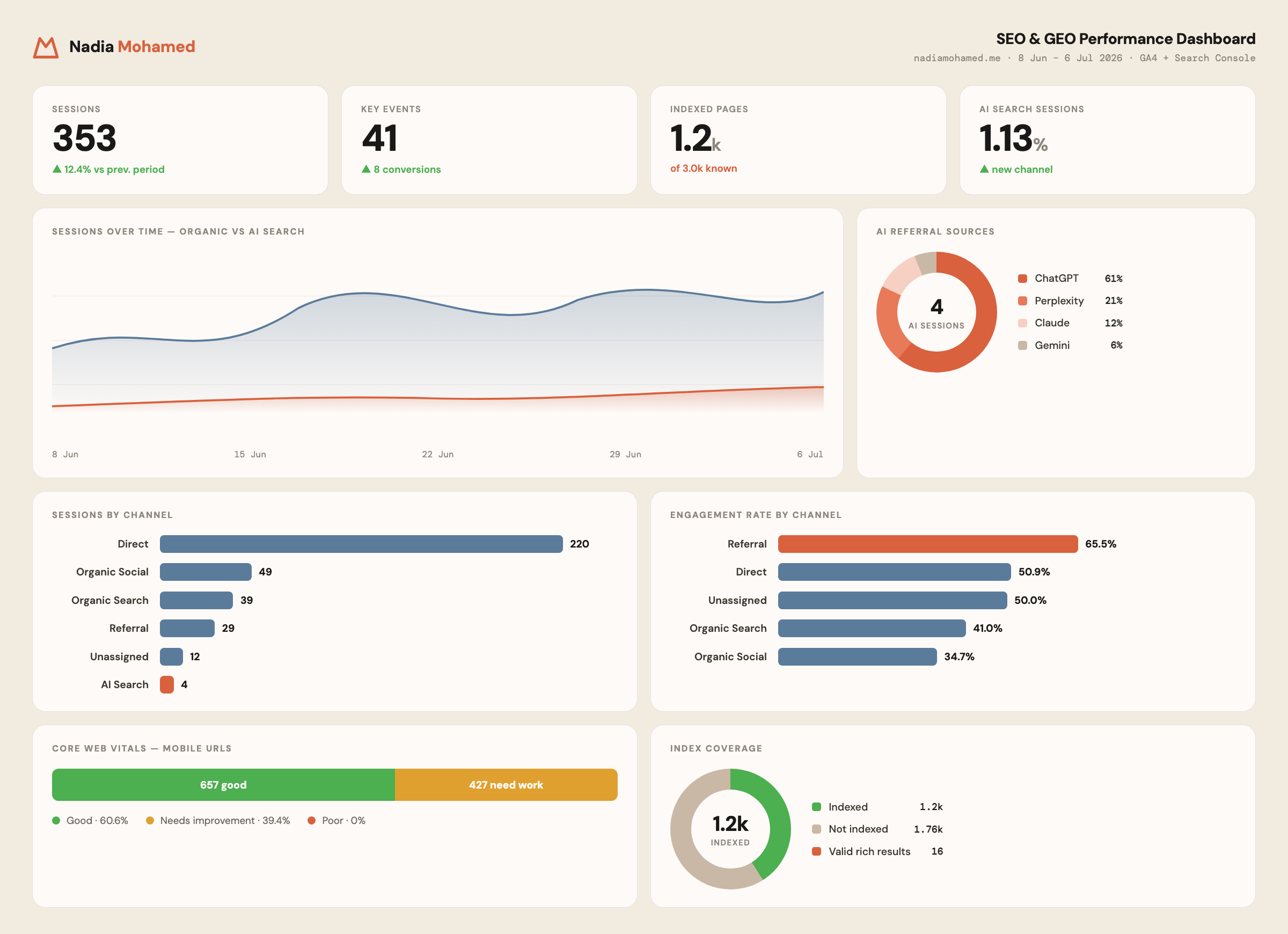
/assets/screenshots/looker-studio-ai-dashboard.png Delivered: GA4 + GTM implementation, AI source channel group, dedicated Looker Studio dashboard, attribution model documentation.
Phase 12: Prioritised Action Plan & Cadence
All findings from Phases 1–11 are synthesised into a P1–P4 action plan. Every item has an owner, a due date, and a specific expected impact tied to a KPI. Status is updated weekly. The plan becomes the roadmap for the implementation block — whether the client executes it independently or extends the engagement into the 3-month implementation period.
P1 items are blockers: things preventing Google or AI engines from accessing or trusting the site. P2 items are high-impact optimisations: title rewrites, schema deployment, GEO restructuring, the Phase 8 priority pages. P3 items are medium-impact improvements. P4 items are nice-to-haves that should not displace P1–P3 capacity.
Delivered: P1–P4 action plan with owners and dates, weekly status tracking system, implementation roadmap.
What happens after the audit?
The audit stands alone as a deliverable. The action plan is written to be self-sufficient — specific enough that a developer or writer can execute without follow-up questions. Clients who want implementation handled by the same person who designed the strategy extend the engagement into a 3-month implementation block. Each month has defined deliverables: P1 actions and tracking setup in Month 1, P2 execution and the first data review in Month 2, P3 work and a full before/after report in Month 3.
Every quarter, the audit refreshes with live data: rankings updated, competitor changes factored in, AI citation patterns re-tested against the Prompt → Content Gap Matrix from Phase 8, new priorities set. This quarterly re-test is what catches AI citation decay before it erodes rankings — citations degrade silently as content goes stale and competitors publish fresher answers. The audit becomes a living document rather than a report that collects dust.
Why this works differently
Most SEO and GEO audits fail at the handoff. A consultant writes a strategy document. The client’s dev team receives it. The dev team has 47 other priorities. The document sits in a shared drive. Months later, nothing has changed and the audit is a sunk cost.
This methodology is built to remove the handoff. The structured data the audit recommends is JSON-LD already written and ready to paste. The tracking the audit specifies is GA4 configuration already built. The dashboard the audit proposes is a Looker Studio build already designed against the client’s KPIs. The audit is not a set of recommendations — it is the first half of a deployed system, and the second half is either client-executed against the prescriptive action plan or extended into the implementation block.
Who this is built for
The 12-phase audit is designed for personal brands and service businesses — coaches, consultants, SaaS companies, speakers, agencies — where organic search and AI citation drive qualified leads and the difference between page 1 and page 3, or between AI citation and AI invisibility, is measurable in revenue.
Not ready for a full audit? Request a free 5-point visibility check — the most important page gets analysed and returned as a scored report. Or book a 30-minute fit call to walk through the framework against the current state of the site.
FAQ
How long does the 12-phase audit take to deliver?
Typically three weeks depending on site size and complexity. Larger sites (150+ pages) may take longer due to the crawl analysis in Phase 2 and the competitive intelligence in Phase 4.
Can I implement the audit findings myself?
Yes; the action plan is written to be self-sufficient with JSON-LD schema ready to paste and documented configuration steps.
What makes the GEO phase different from standard SEO?
Standard SEO optimises for Google’s traditional search results. GEO optimises for AI-generated answers — ChatGPT, Perplexity, Gemini, Google AI Overviews.
Do I need my own Ahrefs or SEO tools subscription?
No; all tool access is covered as part of the engagement.
How is this different from an SEO agency audit?
The audit is designed and implemented by the same person with no handoff interpretation layer.
What is explicitly excluded from the scope?
Content creation, copywriting, paid advertising, custom development beyond basic CMS edits, conversion rate optimisation beyond CTA placement, and brand design.
Does the framework apply to e-commerce, or is it only for service businesses?
The framework applies to both; phase weighting shifts based on business model.
How does Phase 8 measure success after the audit ships?
The Prompt → Content Gap Matrix is re-run monthly across platforms to measure citation frequency, position, and competing-source lists.