 Nadia Mohamed
AEO Article Analyzer
AEO — Answer Engine Optimization — is structuring content so AI engines can extract and cite it. This tool scores how ready any article is. Paste an article or a URL and get a 0–100 readiness score against 10 evidence-based criteria, with pass/fail and a 0–10 score per criterion, plus the three highest-impact fixes — each quoting the actual text it refers to. Runs in under 30 seconds.
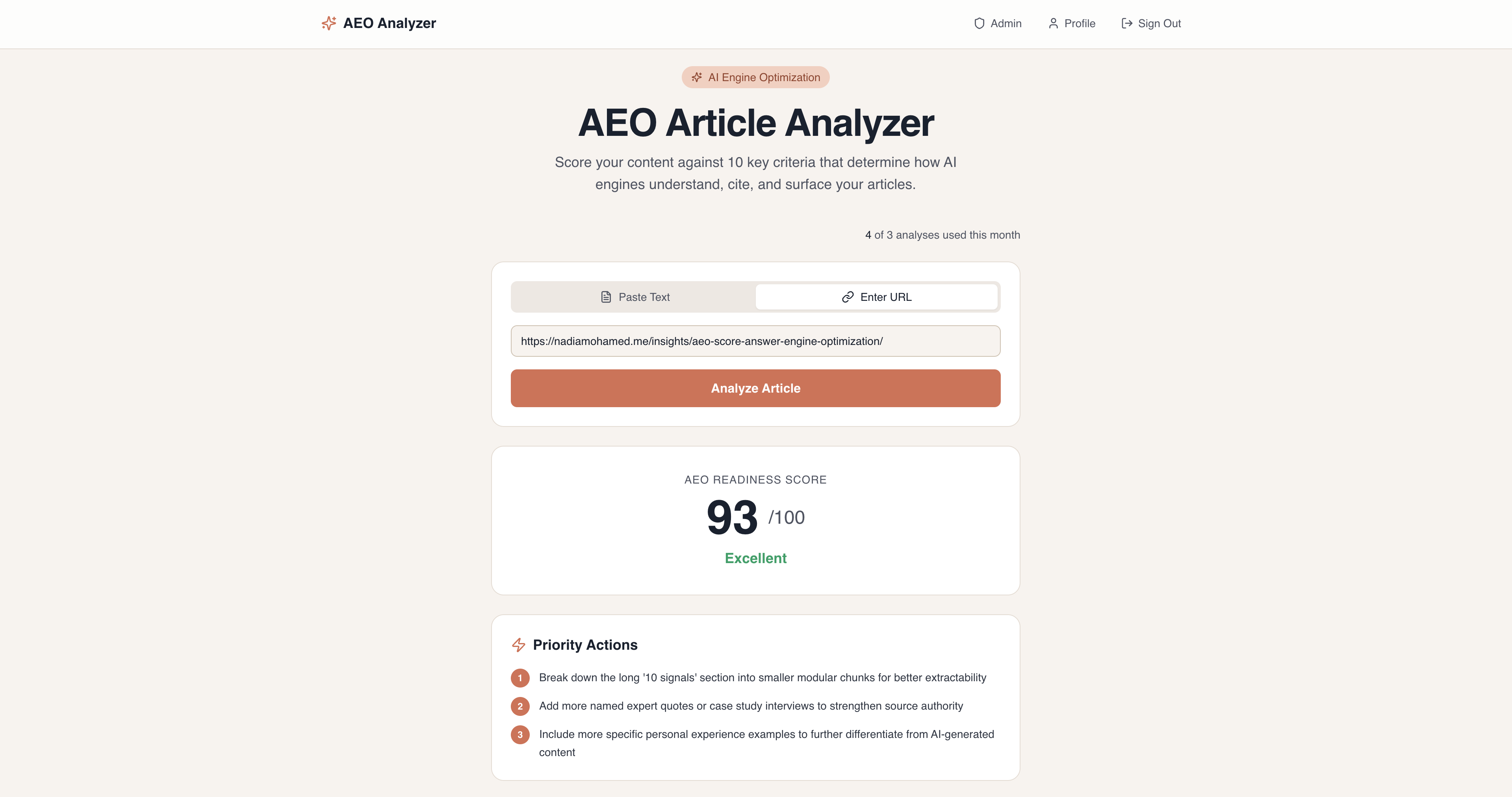
/assets/screenshots/aeo-analyzer-ui.png The analyzer lives on its own subdomain. Sign up once (no credit card), then paste an article or enter a URL — Claude AI scores it across the 10 criteria and returns the report you can preview below. Three free analyses per calendar month, resets on the 1st.
Open the analyzer ↗︎Opens in a new tab · Sign-up required · 3 free analyses / month
Sample output · what a result looks like
The 10 criteria — and what each one measures
Each criterion is based on how AI engines parse, evaluate, and cite content. Each receives pass/fail, a 0–10 score, and a specific improvement suggestion that quotes your actual text.
Question-based headlines
Headlines phrased to match how users actually prompt AI engines — questions, comparisons, "how to" framings — not internal taxonomy labels.
Direct answers up front
A clear TL;DR in the first 40–60 words. AI extraction is biased toward early-paragraph answers; bury the lead and you lose the citation.
Clear heading hierarchy
Logical H1 → H2 → H3 structure that AI parsers can walk. One H1, properly nested subheadings, no skipped levels.
Modular sections
75–300 word chunks per subheading, each self-contained enough to be extracted as a standalone passage. The size band that consistently surfaces in AI answers.
FAQ coverage
Five or more questions with concise 40–80 word answers. Match the phrasing users would actually type into ChatGPT or Perplexity, not internal headings.
Source attribution
Named experts with real credentials cited inline. AI systems are trained on source-rich content and preferentially cite content that itself cites named sources.
Data-backed claims
Concrete figures with attribution, not vague "studies show" or "experts say." Original or primary-sourced numbers materially raise extraction probability.
Original insight
Perspectives, frameworks, or experience-based observations AI can't generate on its own. The signal that makes a page worth citing instead of paraphrasing.
Zero filler content
Avoids vague "experts say" framing, generic takes without point of view, and word-padding. Density of useful content per paragraph.
Author credibility signals
Bio, credentials, and relevant experience clearly shown on the page or linked author profile. E-E-A-T signal that AI engines weight increasingly heavily.
AEO Analyzer FAQ
What the score means and how it differs from classic SEO.
What is AEO (Answer Engine Optimization)?
AEO, or Answer Engine Optimization, is the practice of structuring content so AI answer engines like ChatGPT, Perplexity and Google AI Overviews can extract and cite it. It overlaps with SEO but prioritises a clear answer up front, modular sections, and source-rich, quotable passages.
What does the AEO Article Analyzer score?
It scores an article from 0 to 100 against 10 evidence-based criteria — question-based headlines, a direct answer up front, heading hierarchy, modular sections, FAQ coverage, source attribution, data-backed claims, original insight, zero filler, and author credibility. Each gets a pass/fail, a 0–10 score, and a specific fix that quotes your actual text.
How is this different from a normal SEO audit?
A traditional SEO audit checks technical and keyword factors that affect ranking. The AEO Analyzer checks the structural patterns AI engines use to decide what to quote — like a 40–60 word answer up front and 75–300 word modular sections — which classic SEO tools don't measure.
Can I analyze a URL, or do I have to paste the text?
Both. Paste the article text directly, or enter a URL and the tool fetches and scores the live page. Either way the report returns in under 30 seconds.
How many analyses do I get, and is it free?
Three free analyses per calendar month, resetting on the 1st. No credit card — just a free sign-up. It's built for SaaS marketers and SEO teams to sanity-check content before publishing.
Want a full audit?
The AEO Analyzer scores one article. The free SEO + GEO Health Check scores your priority page across five dimensions including AI readiness — with a prioritised action list, in 48 hours.