 Nadia Mohamed
AI-SEO & GEO
The Best GEO Tools in 2026 (Generative Engine Optimization), Compared
What’s Generative Engine Optimization (GEO)?
Generative Engine Optimization is the practice of structuring content so that AI systems — ChatGPT, Perplexity, Google AI Overviews, and similar platforms — can extract, quote, and cite it in their responses. Unlike traditional SEO, which optimises for ranking position, GEO optimises for citation: whether your content appears as a source when someone asks an AI a question relevant to your business.
Why GEO Matters More Than Ever in 2026
The shift from search rankings to AI citations isn’t gradual — it’s already underway. Two data points illustrate the scale:
- 357% year-on-year growth in AI referral traffic — AI platforms generated 1.13 billion referral visits in June 2025 (Similarweb), across top websites only, and against 191 billion visits to Google over the same period.
- 65% of AI bot hits target content published within the past year — recency is a consistent citation signal across ChatGPT, Perplexity, and Google AI Overviews (Seer Interactive).
The commercial implication: most SEO tools still don’t measure whether your content is being cited at all, so the channel that is growing fastest is the one you have least visibility into. That gap is where GEO tooling earns its place.
Traditional SEO optimises for keywords and crawlers, aims for position #1, and measures traffic. GEO optimises for questions and AI comprehension, aims to be recommended as a source, and measures citations. Both matter — but the metrics and tactics are different enough that they require different tools. If you’re new to the discipline, start with what generative engine optimization is before choosing a stack; the tools below only earn their place once the underlying strategy is clear.
TL;DR — Key takeaways
- The shift is real and measurable. AI referral traffic grew 357% year-on-year to 1.13 billion visits in June 2025, measured across top websites only (Similarweb), and 65% of AI bot hits target content published within the past year — yet most SEO tools don’t measure citations at all.
- GEO checkers split into four categories: content AI-readiness auditing, schema validation, AI citation monitoring, and keyword/prompt-gap research. When people search for a “generative engine optimization checking tool” or a “GEO analysis tool,” they usually mean one of the first two — an article checker that scores extractability, or a schema validator. Treat monitoring as measurement, not strategy — the actionable work is in the auditing category.
- Free tools cover the foundation. A minimum viable stack is three free tools: an article scorer (AEO Article Analyzer, scoring against 10 criteria in under 30 seconds), Google Rich Results Test for schema, and manual monthly prompt testing across ChatGPT, Perplexity, and Google AI Overviews.
- Paid monitoring is priced by scale. Otterly.ai starts at $29/mo for solo consultants; Ahrefs Brand Radar runs $398–$699/mo for teams wanting AI visibility alongside existing SEO data; Profound spans $99/mo Starter to enterprise; Conductor is enterprise-tier.
- Structure and freshness are the heavy levers. Comprehensive JSON-LD schema helps AI systems parse and attribute content, and recently updated content earns more citations — so a 30-day refresh cycle on priority pages beats perfect first-publish quality.
- Match the tool to your usage. Evaluate any GEO tool on citation-detection accuracy, actionability, time saved, integration with your SEO stack, and price-to-value at your real query volume — SMBs are better served by 3–4 specialised tools than by one enterprise platform.
Quick comparison: GEO checkers and analysis tools — and what they cost
This is the shortlist of GEO checkers and analysis tools worth evaluating, grouped by what each one actually does — article-level checking, schema validation, AI-visibility tracking, and prompt-gap research. All prices below were verified from the vendor’s public pricing page in May 2026, with the AI-visibility trackers re-verified in July 2026. Prices in USD where the vendor publishes in USD; otherwise as shown. “Contact sales” means the vendor does not publish pricing.
| Tool | Category | Starting price | Free tier |
|---|---|---|---|
| AEO Article Analyzer | Per-article scoring across 10 AEO criteria | Free | Free to use |
| Keyword Clustering | Semantic clustering (up to 1,000 kw, CSV export) | Free | Free to use |
| AI Tool Ideas Generator | Tool-intent keyword discovery (5–8 ideas with demand + budget) | Free | Free to use |
| Google Rich Results Test | Schema validation | Free | ✓ |
| Schema.org Validator | Schema validation (stricter) | Free | ✓ |
| Screaming Frog (GEO config) | Site-wide GEO gap crawl | Free up to 500 URLs; €245/yr above | 500-URL free tier |
| Mangools AI Search Grader | Brand visibility scoring across AI models | Free | Free with sign-up |
| Ahrefs Brand Radar | AI citation tracking + brand mentions | $398/mo (Select platforms) · $699/mo (All platforms + custom prompts) | — |
| Otterly.ai | Daily prompt monitoring + alerts | $29/mo Lite (15 prompts) · $189/mo Standard (100) · $489/mo Premium (400) | Free trial |
| Profound | AI citation monitoring | $99/mo Starter · $399/mo Growth · Enterprise custom | — |
| SimilarWeb Gen AI Brand Visibility | Enterprise brand visibility | Custom (contact sales) | — |
| Semrush AI Visibility Toolkit | AI search visibility within Semrush | See vendor pricing page | 7-day Semrush trial |
| Conductor | Enterprise AEO + SEO platform | Custom (Essentials / Growth / Enterprise tiers) | Free trial of Essentials |
The 10 Criteria AI Engines Use to Evaluate Content
Before covering specific tools, it’s worth understanding what they’re measuring. AI systems evaluate content across roughly ten dimensions when deciding whether to cite it:
- Question-based headlines — whether headings match how users actually prompt AI engines.
- Direct answers up front — a clear TL;DR or definition in the first 40–60 words.
- Clear heading hierarchy — logical H1/H2/H3 structure that AI can parse. Sites with H2 → H3 → bullet point structures are more likely to be cited.
- Modular sections — content chunked into 75–300 word units that can be extracted independently.
- FAQ coverage — 5 or more questions with concise 40–80 word answers.
- Source attribution — named experts with real credentials cited within the content. Cited content frequently quotes recognised, credentialed experts.
- Data-backed claims — concrete figures, not vague assertions. Pages with original data are cited substantially more often than pages without.
- Original insight — perspectives AI can’t generate on its own, derived from experience or proprietary data.
- Zero filler content — no generic padding; every paragraph earns its place.
- Author credibility signals — bio, credentials, and relevant experience clearly shown.
Most content fails on three to five of these criteria without the author realising it. The right tools make these gaps visible.
The Content Formats AI Consistently Cites
- FAQs — direct Q&A format mirrors exactly how users prompt AI engines, making it the highest-citation format per word written.
- Ranked lists — numbered rankings of tools, companies, or options are easy for AI to extract and present as structured answers.
- Comparison pages — “X vs Y” content matches decision-stage queries that AI systems are frequently asked.
- Original research — proprietary data and survey results that AI cannot replicate or generate on its own.
- Expert interviews — named sources with verified credentials, quoted directly and attributed clearly.
- How-to guides — step-by-step instructions with clear outcomes, structured so individual steps can be extracted.
The principle running through all six: if AI can write it, AI won’t cite it. The citation value is in what only you can provide — your experience, your data, your point of view, your named sources. For real-world examples of GEO in practice, these formats are what consistently earn citations.
Schema markup is one of the strongest non-content signals. Comprehensive structured data (JSON-LD) across Article, FAQPage, HowTo, and Product schemas resolves the ambiguity that can keep a page from being cited, giving AI engines a cleaner signal to attribute. As Fabrice Canel of Microsoft Bing confirmed at SMX Munich 2025, schema markup helps Microsoft’s LLMs understand content — and he added that “Gen AIs value fresh content in particular, partly as a reference check of their LLM training data.” Structured content that AI can parse beats unstructured content that AI has to interpret — regardless of how well-written the underlying prose is.
Content freshness is the other heavy lever: fresh content is cited more than stale content, and AI engines favour pages refreshed within a short window. The implication for any GEO programme: a 30-day refresh cycle on priority pages matters more than perfect first-publish quality.
Category 1: Content AI-readiness auditing (GEO checkers)
These are the tools most people mean when they search for a “generative engine optimization checker” or a “GEO analysis tool”: you give them a page, and they score how ready it is to be cited. An AEO scorer like the one below is the closest thing to a dedicated GEO checker — it analyzes a single article against the criteria above and hands back a prioritized fix list. If you only adopt one category, make it this one.
AEO Article Analyzer (free)
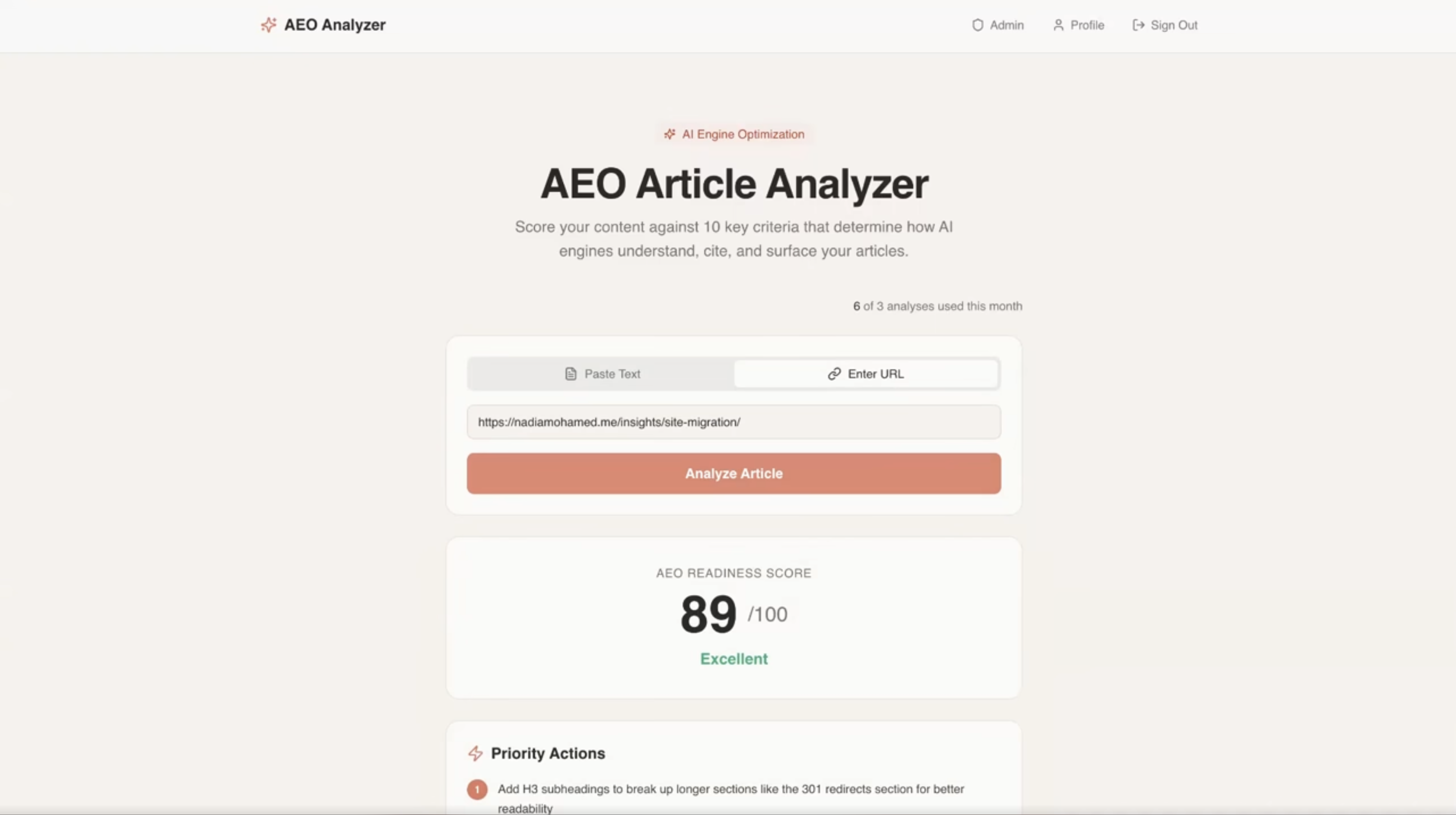
The AEO Article Analyzer scores any article against 10 evidence-based criteria — question-based headlines, direct answers in the first 40–60 words, modular 75–300 word sections, FAQ coverage, named source attribution, data-backed claims, original insight, zero filler, and author credibility signals. Paste an article or enter a URL; you get a 0–100 readiness score, pass/fail and 0–10 per criterion, and a prioritized list of the three highest-impact fixes — with each suggestion quoting the actual text it refers to. Full analysis runs in under 30 seconds.
It’s the fastest way to identify why existing content isn’t being cited, and to prioritise which pages to fix first. Start here before making any content changes. Best for: auditing existing blog posts and pillar pages before a GEO optimization sprint. Where it falls short: three free analyses per calendar month (resets on the 1st) — for site-wide audits of large content inventories, you’ll want to triage which pages to score first.
/assets/screenshots/aeo-analyzer-result.png Mangools AI Search Grader (free)
Mangools AI Search Grader evaluates how often your brand appears across multiple AI models (ChatGPT, DeepSeek, Claude, Gemini, Mistral, Llama, and more) and returns an AI Search Score (0–100) combining visibility, average ranking, and market-share weighting. Free with a sign-up.
Best for: brand-level cross-model visibility check. Where it falls short: brand-centric, not page-centric — pair with AEO Article Analyzer for per-URL guidance.
Screaming Frog (with GEO configuration)
Screaming Frog is primarily a technical SEO crawler, but configured correctly it surfaces several GEO-relevant signals: missing schema markup, pages without structured FAQ sections, H1/H2 hierarchy problems, and pages with word counts too low to be useful citation sources. Free up to 500 URLs; €245/year for unlimited.
Run a full crawl, then filter by word count under 500 and no FAQ schema. These are your highest-priority GEO gaps. Best for: site-wide GEO gap identification across large content inventories.
Category 2: Schema validation (schema checkers)
Schema validators are the second half of what a “GEO checking tool” does — they check the machine-readable layer AI systems read before they ever parse your prose. Pair one of these schema checkers with the article analyzer above and you have covered the two things a GEO analysis tool should verify: is the content extractable, and is the structured data valid.
Google Rich Results Test (free)
Schema markup is the most direct signal you can give AI systems about what a page is about. The Google Rich Results Test validates whether your Article, Person, and Organization schema is correctly implemented and eligible for rich results. (Google removed FAQ support from the tool in June 2026 after deprecating the FAQ rich result on 7 May 2026 — validate FAQPage markup with the Schema.org validator below instead. The FAQ schema still matters for AI citation; it just no longer produces a Google rich result.) Run every pillar page and BOFU page through this tool after adding schema. A schema error that passes a visual inspection will still fail to be read by AI systems. For the full technical breakdown, see Structured Data for AI Search.
Schema.org Validator (free)
For more granular validation — particularly for Article, BlogPosting, and Person schema with sameAs links — use the Schema.org validator. This catches issues the Rich Results Test misses, including missing required fields and incorrect property values. Best for: thorough schema auditing, especially for personal brand and entity-focused sites.
Category 3: AI citation monitoring (AI-visibility checkers)
These AI-visibility checkers tell you whether you’re being cited in AI-generated responses. They answer “are we showing up?” but most don’t answer “what do we do about it.” So while they’re the tools that most often get marketed as “GEO checkers,” they check outcomes, not pages — treat citation monitoring as measurement, not strategy. The strategy work happens in the content-analysis category above.
Ahrefs Brand Radar ($398–$699/mo)
Ahrefs Brand Radar tracks brand visibility across AI Overviews, AI Mode, ChatGPT, Copilot, Gemini, Perplexity, and Grok. The “Select platforms” tier at $398/mo covers individual platforms; the “All platforms” tier at $699/mo unlocks full access across all seven. Both tiers include 2,500 custom-prompt checks per month and bonus access to YouTube, TikTok, and Reddit visibility data.
The advantage over standalone tools: it sits alongside Ahrefs Site Explorer, so you can correlate AI mention activity with backlink changes, ranking movement, and content publish dates in the same view. Best for: teams already running Ahrefs who want AI visibility integrated with their existing SEO data. Where it falls short: the default prompt database is broad rather than bespoke — the value is in configuring custom prompts around your own priority queries.
Otterly.ai ($29–$489/mo)
Otterly.ai publishes the most transparent pricing in this category. Lite at $29/mo covers 15 search prompts; Standard at $189/mo covers 100 prompts; Premium at $489/mo covers 400 prompts. All tiers include daily tracking across ChatGPT, Google AI Overviews, Perplexity, and Microsoft Copilot, with Google AI Mode and Gemini available as add-ons. Annual billing is roughly 15% cheaper.
The $29 entry tier is the most defensible monitoring option for solo consultants and small agencies — Otterly does one thing (monitor prompts, alert on changes) well, without the dashboard overhead of larger platforms. Best for: solo consultants and small agencies tracking 15–100 client prompts. Where it falls short: doesn’t integrate with traditional SEO data, so combined analysis requires context-switching.
Profound ($99–$399/mo)
Profound now publishes public tiers: Starter at $99/month and Growth at $399/month, with custom enterprise pricing for larger deployments spanning multiple markets and languages. The platform monitors AI citations at prompt level, surfaces source URLs (not just brand mentions), and integrates with workflow tools.
Best for: mid-market and enterprise teams optimising at multi-language, multi-market scale. Where it falls short: no published pricing means the entry conversation is via sales — not workable for solo consultants or small agencies.
SimilarWeb Gen AI Brand Visibility (contact sales)
SimilarWeb Gen AI Brand Visibility tracks brand mentions across ChatGPT, Gemini, and Perplexity. Pricing isn’t published and reflects the enterprise positioning.
Best for: mid-market and enterprise teams that already pay for SimilarWeb. Where it falls short: expensive to add for visibility data alone if you’re not using the broader platform.
Manual prompt testing (free)
For non-Google AI platforms — and for solo consultants who can’t justify monitoring SaaS yet — the most reliable approach is still manual: run the 20 highest-priority prompts your ICP would use into ChatGPT, Perplexity, and Gemini, record which sources each cites, and repeat monthly.
Build a simple spreadsheet: prompt in column A, cited sources in columns B–D (one per platform). Over time, you’ll see whether your domain begins appearing and which content types trigger citations. Best for: solo consultants and teams starting out, before paying for monitoring tools.
Category 4: Keyword and prompt gap research
Keyword Clustering (free)
Keyword Clustering takes up to 1,000 keywords (one per line) and returns semantically tight, named clusters with per-cluster size counts and CSV export. The semantic grouping is by shared topic and intent, not matching words — so the output is usable directly as content architecture. Each cluster becomes a content hub: one pillar article per cluster, with supporting articles linked together. This is the planning structure AI engines use to determine topical authority.
Best for: mapping content architecture, planning content hubs, sense-checking large keyword exports, and turning raw keyword lists into briefs. Where it falls short: doesn’t auto-suggest cluster expansion — pair with traditional keyword research for discovery.
Ahrefs Keywords Explorer — Questions filter
AI prompts are longer and more conversational than traditional search queries. In Ahrefs Keywords Explorer, filter by “Questions” to surface the specific question-format queries your ICP is searching. These are structurally identical to how people prompt AI systems.
For each question, check whether you have content that answers it directly in the first 50 words. If not, that’s a GEO content gap. Best for: building the Prompt → Content Gap Matrix for systematic GEO planning.
AnswerThePublic / AlsoAsked
AnswerThePublic and AlsoAsked visualise the question graph around any topic — the related questions people ask and the relationships between them. For GEO, they’re useful for building out FAQ sections: take the top 10–15 questions, answer each directly in 50–80 words, and add them to your pillar pages as a structured FAQ.
AI Tool Ideas Generator (free)
The AI Tool Ideas Generator takes your niche and primary goal (drive organic leads, build authority, or grow email list) and returns 5–8 tailored AI tool ideas your audience is already searching for. Each idea includes a demand tier and an estimated build budget — so you can prioritise the highest-ROI tool to build first. The framing is specifically built around tool-intent keywords: queries where AI Overviews don’t fire (because there’s no definition to summarise), and where ranking is achievable at low keyword difficulty because the user has to click to use the tool.
Best for: finding under-served queries where building a free tool earns more organic traffic — and citations — than another listicle.
Enterprise option: Conductor
Conductor sits at the top of the GEO tooling stack for large content teams. Three published tiers — Essentials, Growth, Enterprise — with pricing on application. The platform combines content scoring (Conductor Creator), citation tracking and SEO data (Conductor Intelligence), site monitoring, and integrations for LLM workflows. The differentiator is workflow integration at scale: Essentials covers 1,000 pages and 500 keywords; Enterprise covers 125,000+ pages and 60,000+ keywords.
Best for: enterprise content teams (>20 writers, >100 priority queries) needing workflow integration. Where it falls short: overinvestment for small teams; SMBs are better served by 3–4 specialised tools from the categories above.
How to evaluate a GEO tool (framework)
The category is moving fast. Rather than locking in long contracts, evaluate any new GEO tool against five questions before committing:
- Citation detection accuracy across platforms. Does the tool correctly identify citations across ChatGPT, Perplexity, Claude, and Google AI Overviews? Cross-reference against manual prompt tests per platform before relying on a dashboard.
- Actionability of recommendations. Does the tool produce specific, implementation-ready fixes, or just dashboards showing the problem? Monitoring without action is the most common overinvestment in this category.
- Time saved vs manual work. A tool that saves a meaningful amount of audit time across your priority pages earns its place. A tool that produces dashboards no-one uses doesn’t.
- Integration with existing SEO stack. Does it pull from GSC, GA4, and traditional rank trackers? Isolated GEO dashboards force context-switching and reduce the chance the data drives action.
- Price-to-value at your real usage. Solo consultants tracking a handful of priority queries pay less per query with Otterly Lite. Enterprise teams tracking hundreds of prompts pay less per query with Ahrefs Brand Radar’s higher tier or Conductor. Map your actual usage before signing an annual contract.
How to use these tools together
The tools above aren’t useful in isolation. Here’s the sequence that produces results, ordered from highest leverage to lowest:
Before you start — check your entity signals. Google your brand or personal name and confirm whether a Knowledge Panel appears. If it doesn’t, this is a foundational GEO gap: AI systems have weaker entity confidence for unrecognised entities, which reduces citation probability regardless of how well your content is structured. The fix is Person or Organization schema with sameAs links pointing to LinkedIn, Wikidata, and Wikipedia — implement this before optimising content, not after.
- Audit existing content with the AEO Article Analyzer. Score your top 20 pages. Any page scoring below 60 is a priority fix.
- Validate schema on all pillar pages and BOFU pages using the Rich Results Test. Fix any errors before adding new schema.
- Build your prompt gap matrix using Ahrefs Questions filter and AlsoAsked. Map each prompt to an existing URL or flag it as a content gap.
- Run baseline citation tests manually across ChatGPT, Perplexity, and Google AI Overviews for your 20 priority prompts. Record results.
- Implement fixes in priority order: direct answer blocks first, FAQ schema second, entity schema third, content depth improvements last.
- Monitor monthly. Rerun citation tests. Track AI Overview appearances. Re-score improved pages in the AEO Article Analyzer to confirm changes registered.
Timeline for results varies by site size, content quality, and how frequently each AI platform recrawls. Schema and structural changes tend to register faster than content-depth improvements because they’re machine-readable signals that don’t require AI to re-evaluate prose. Recently updated content receives more AI citations than older content — so a 30-day refresh cadence on priority pages is a reasonable working assumption.
Common GEO mistakes these tools help you avoid
- Adding FAQs without direct answers. FAQ schema only helps if the answer starts with the answer. “Great question — there are many factors…” is not a direct answer.
- Schema without matching on-page content. FAQ schema that doesn’t match visible FAQ content on the page will fail validation and may be ignored by AI systems.
- Optimising for Google AI Overviews only. ChatGPT and Perplexity use different citation signals. Each platform has distinct source preferences.
- Over-optimising at the expense of depth. A 300-word page with perfect schema won’t be cited for complex queries. GEO requires both structure and substance.
If you want a complete review of your site’s structural readiness for AI citation — across content signals, schema implementation, and the underlying technical layer — a free GEO + Technical SEO audit covers all three together, and a full GEO & Technical SEO engagement turns those findings into implemented fixes. For a deeper look at what drives ChatGPT citations specifically, see How to Get Cited by ChatGPT. For Perplexity-specific patterns, see How to Get Cited by Perplexity. To track AI traffic from these citations, see How to Track AI Referral Traffic in GA4.
FAQ
What’s the minimum viable GEO tool stack?
Three free tools: the AEO Article Analyzer for scoring priority pages, Google Rich Results Test for validating schema, and manual prompt testing across ChatGPT, Perplexity, and Google AI Overviews documented monthly.
What are the best generative engine optimization checkers?
The best generative engine optimization checkers fall into three types, and most teams need one from each. For article-level checking, an AEO scorer like the AEO Article Analyzer grades a single page against 10 citation criteria and returns prioritized fixes. For schema checking, the Google Rich Results Test and Schema.org Validator confirm your structured data is valid. For AI-visibility checking, Ahrefs Brand Radar ($398–$699/mo) and Otterly.ai ($29–$489/mo) track whether AI platforms actually cite you. Start with a free article checker plus a schema validator; add a visibility tracker once you’re publishing at volume.
Is there a free GEO analysis tool?
Yes. Several capable GEO analysis tools are free. The AEO Article Analyzer scores any URL against 10 AI-readiness criteria in under 30 seconds (three free checks per month). The Google Rich Results Test and Schema.org Validator validate your structured data at no cost. Mangools AI Search Grader gives a free cross-model brand-visibility score with sign-up, and Screaming Frog crawls up to 500 URLs free for site-wide GEO gaps. A free article checker plus a free schema validator covers the two things that matter most — extractability and valid schema — before you pay for anything.
Can GEO tools simulate AI prompts to test how my content is cited?
Yes—citation monitoring tools like Ahrefs Brand Radar and Otterly.ai send prompts to AI platforms at regular intervals and record whether your domain appears as a cited source.
Which GEO tools detect missing context signals in my content?
Content auditing tools including AEO Article Analyzer and Mangools AI Search Grader flag missing definition blocks, weak author attribution, and FAQ coverage gaps.
Can GEO tools identify emerging prompt trends?
Partial yes. Enterprise tools surface aggregate prompt patterns; smaller budgets can pair Ahrefs Keywords Explorer Questions filter with manual testing.
How does GEO tool pricing compare across platforms?
Free tools cover content auditing and schema layers. Mid-market citation monitoring ranges from Otterly at $29–$489/mo to Ahrefs Brand Radar at $398–$699/mo.
What is the difference between GEO and AEO?
Both refer to optimizing content for AI-generated answers. GEO is common in academic/enterprise contexts; AEO in practitioner/agency contexts.
Which AI platform should I optimize for first?
Start with your ICP’s most-used platform. For uncertainty, optimize Google AI Overviews first—structural requirements overlap significantly with ChatGPT and Perplexity.
How long does it take to see results from GEO optimization?
Schema and structural changes register faster than content depth improvements. Fresh pages tend to out-cite stale ones.
Can GEO hurt my traditional SEO?
No. Structural GEO changes align with Google quality guidelines and “consistently improve featured snippet capture and click-through rates.”