 Nadia Mohamed
Measurement
Why Corporate AI Implementations Fail (And the 5 Things the Ones That Work Have in Common)
Corporate AI implementation failure is rarely a model problem. The studies that measure it keep finding the same thing: projects stall because nobody owns the output once the pilot ends, and because nobody checks that what the system produces is true before it reaches a customer, a report or a published page.
This piece reads the five studies behind the headline failure numbers, explains why those numbers disagree, and sets out my own view of the two causes the surveys undercount: ownership and source verification. It then lists the five things implementations that reach production have in common, a set of warning signs, and what a scoped first engagement looks like.
Key takeaways
- The headline failure rates (95%, “more than 80%”, 42%, 74%) measure different things. Read the definition of failure before you quote any of them.
- Every study that looks for causes lands on people and process rather than algorithms. BCG puts about 70% of implementation challenges in people and processes and only 10% in the algorithms.
- The two causes most surveys do not name directly are ownership (a line owner who answers for the output) and verification (a check that the output is correct before anyone relies on it).
- Implementations that work share five habits: one named problem, a line owner, verification built into the workflow, a redesigned workflow rather than a bolted-on tool, and a cost and value measure agreed before the build.
- A sensible first engagement is small: one workflow, a written definition of done, a verification step, and a handover the team can operate without you.
What “failure” means in the studies everyone quotes
There is no single AI failure rate. There are several, each measured in a different way, and the gap between them is the first useful thing to understand.
| Study | Headline | What it actually measured |
|---|---|---|
| MIT NANDA, The GenAI Divide (2025) | About 5% of pilots achieve rapid revenue acceleration | Measurable P&L impact from generative AI pilots, from interviews, a survey and public deployments |
| RAND (2024) | More than 80% of AI projects fail “by some estimates” | A figure RAND cites from other sources; its own work is 65 practitioner interviews on root causes |
| S&P Global Market Intelligence (2025) | 42% of companies abandoned most AI initiatives | Share of organisations abandoning the majority of initiatives before production |
| BCG (2024) | 74% have yet to show tangible value | Self-assessed maturity across 30 capabilities, 1,000 executives |
| Gartner (2024 and 2025) | 30% of GenAI projects abandoned after proof of concept; over 40% of agentic AI projects cancelled | Forecasts, not measurements |
MIT NANDA: the 95% figure
The number that went round in 2025 comes from MIT’s NANDA initiative. As Fortune reported, the report found that about 5% of AI pilot programmes achieve rapid revenue acceleration while the vast majority stall, “delivering little to no measurable impact on P&L”. The research was based on 150 interviews with leaders, a survey of 350 employees and an analysis of 300 public AI deployments.
The definition matters. “Failure” here means no measurable P&L impact, which is a high bar for a pilot. A project that saves a team ten hours a week without anyone booking the saving would count as a failure. The report’s own diagnosis, in Fortune’s summary, is that the core issue is “not the quality of the AI models, but the ‘learning gap’ for both tools and organizations”.
RAND: the “more than 80%” figure
RAND’s 2024 report on the root causes of AI project failure opens with the line that “by some estimates, more than 80 percent of AI projects fail”, twice the rate of IT projects that do not involve AI. That estimate is cited from elsewhere, not measured by RAND. RAND’s own contribution is qualitative: interviews with 65 data scientists and engineers with at least five years of experience.
RAND also excluded projects that only used pretrained language models through prompting. Most of what companies call an AI implementation in 2026 is exactly that, so its root causes transfer better than its percentage does.
S&P Global: abandonment before production
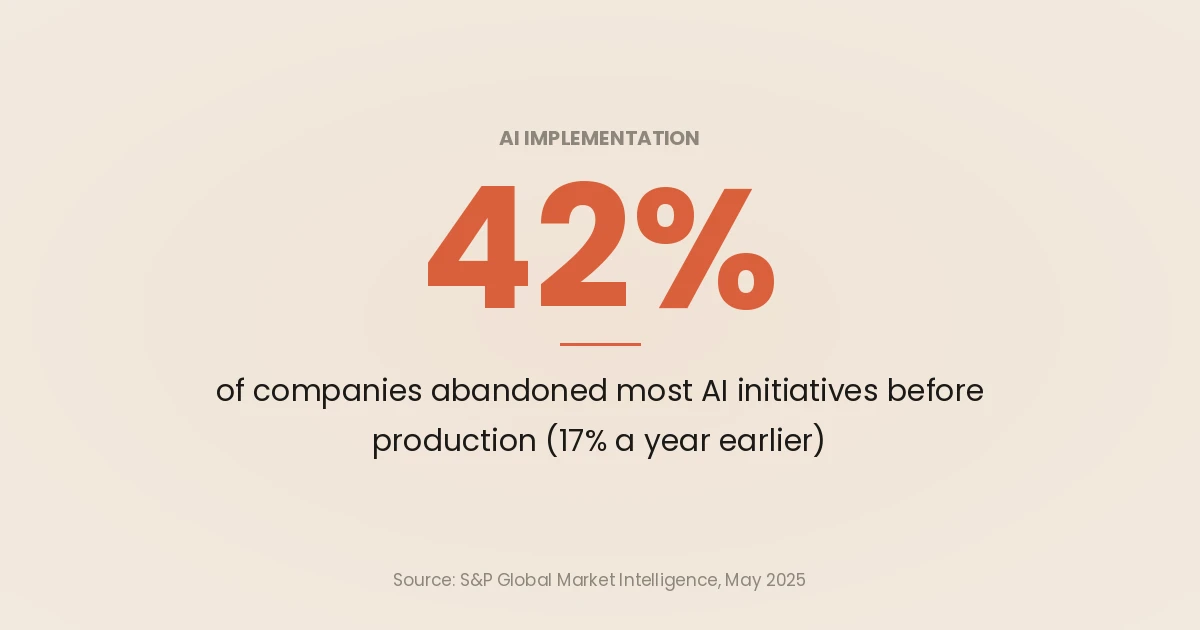
S&P Global Market Intelligence’s 2025 Voice of the Enterprise survey, of 1,006 IT and line-of-business professionals in North America and Europe, found the share of companies abandoning the majority of their AI initiatives before production rose from 17% to 42% year on year. On average, organisations reported that 46% of projects were scrapped between proof of concept and broad adoption.
This is the most useful of the five for a practitioner, because it measures a concrete event (the project stopped) rather than an outcome that depends on how finance books the value.
BCG and Gartner
BCG’s 2024 research, a survey of 1,000 executives across 59 countries, found that 74% of companies had yet to show tangible value from AI and only 26% had built the capabilities to move beyond proofs of concept.
Gartner’s figures are predictions. In July 2024 it predicted that at least 30% of generative AI projects would be abandoned after proof of concept by the end of 2025, citing poor data quality, inadequate risk controls, escalating costs or unclear business value. In June 2025 it predicted that over 40% of agentic AI projects would be cancelled by the end of 2027, for escalating costs, unclear business value or inadequate risk controls.
The honest summary: somewhere between a third and most corporate AI projects do not reach production or do not produce value anyone can show, depending on how you count.
What the studies agree on: it is not the model
Where the numbers disagree, the causes do not. Every study that looks for the reason points away from the technology.
BCG found that around 70% of the challenges companies face in implementing AI stem from people and process issues, 20% from technology and only 10% from the algorithms, “despite the latter often consuming a disproportionate amount of organizational time and resources”.
RAND’s five root causes are, in order: stakeholders misunderstand or miscommunicate the problem to be solved; the organisation lacks the data to train an effective model; the focus is on the latest technology rather than the users’ problem; the infrastructure to manage data and deploy models is missing; and the problem is too hard for AI. Only the last one is about what the technology can do.
MIT’s report, per Fortune, found executives often blame regulation or model performance, while the research points to flawed enterprise integration: generic tools “don’t learn from or adapt to workflows”.
So when a pilot stalls and the first proposal is a better model, the evidence says that is usually the wrong fix.
My view: ownership and verification are the causes the surveys undercount
The surveys ask about data, skills, cost and risk. From the implementation side, two causes sit underneath most of those answers, and neither usually appears as a survey option.
Nobody owns the output
A pilot has a sponsor. A production system needs an owner: one person in the team that uses it, who answers for what it produces, decides when it is wrong, and has the authority to change it. The common shape of a stalled project is a sponsor in leadership, a builder in IT or at a vendor, and nobody in between.
The research points the same way. Fortune’s summary of the MIT report lists empowering line managers, not just central AI labs, to drive adoption among the success factors. RAND recommends committing a product team to one problem for at least a year, and says that if a project is not worth that commitment, it is probably not worth doing at all.
Ownership is also what turns a failure into a fix. A system that produces a wrong answer with an owner gets corrected. A system without one gets quietly abandoned, which is the event the S&P Global survey counts.
Nobody verifies the output
Language models produce fluent text whether or not it is correct. That makes verification the cost most business cases leave out.
The early evidence was stark. Walters and Wilder analysed 636 bibliographic citations across 84 AI-generated literature reviews and found 18% of GPT-4 citations entirely fabricated, with 24% of the non-fabricated ones containing substantive errors, according to their study in Scientific Reports. That was measured on GPT-4 as of mid-2023, with the 24% covering the non-fabricated citations only.
Search-connected assistants have changed the failure rather than removed it. When I checked 80 figures from ChatGPT and Gemini against the pages they linked in the AI citation accuracy study, ChatGPT’s figure was on the linked page 37 times out of 40 and Gemini’s 25 times out of 40. A ten-prompt sample, but enough to show that a figure with a link is not yet a source.
Here is why that matters for failure rates. If every output has to be checked by hand, the time the system saves goes into checking, and the value never shows up. S&P Global’s survey found that content creation and information summarisation were associated with lower enterprise impact than application areas like internal system interaction and multi-step processes. Its data does not say why. My reading is that summaries and drafts are the outputs most expensive to verify, so they are where unverified output costs the most.
An implementation that builds verification in, as a closed source list, an automatic check or a gate before review, keeps the time it saves. One that leaves checking to whoever reads the output last gives it back.
The 5 things implementations that work have in common
These are the habits I look for when an implementation is going to reach production. Each is supported by at least one of the studies above; the framing is mine.
1. One named problem, with a definition of done
The working projects start with a problem, not a technology. RAND’s most common failure is a misunderstood problem, and its advice is to focus on the problem rather than the tool. BCG found that AI leaders pursue about half as many opportunities as their less advanced peers and scale more than twice as many products. In Fortune’s interview, the MIT report’s lead author describes the successful startups as ones that “pick one pain point, execute well, and partner smartly”.
In practice, “use AI in marketing” is not a problem. “Cut the time from approved brief to reviewable draft from three days to one, with every statistic linked to a page that carries it” is. The second one tells you when you are done and what to measure.
2. An owner in the line, not only a sponsor
Someone in the team that uses the system owns it: they sign off its output, they log its errors, and they decide what changes. This is the MIT line-manager finding in practice. It is also the difference between a system that improves after launch and one that decays.
The owner does not have to be technical. They need the authority to stop the system from shipping something wrong, and the time in their week to do it.
3. Verification designed in, before review
The system checks its own output against something outside the model before a human sees it. For content, that means a closed list of approved sources, a check that each figure appears on its source page, and a gate that fails the draft if it does not. The content approval workflow on this site is built on that gate, and LLM observability for content teams covers how to record the evidence so it can be rechecked.
The same pattern works outside content. A support assistant answers only from the knowledge base and cites the article. A reporting assistant runs the query rather than recalling the number. The principle is that the model drafts and something deterministic checks.
4. The workflow is redesigned, not bolted on
A tool dropped into an unchanged process adds a step. Gartner’s agentic AI release says integrating agents into legacy systems often disrupts workflows and that rethinking the workflow from the ground up is, in many cases, the better path. MIT’s diagnosis, again via Fortune, is that generic tools stall in enterprises because they do not adapt to workflows.
This is also where the build or buy question sits. Fortune’s summary of the MIT report says buying from specialised vendors and building partnerships succeeded about two-thirds of the time, while internal builds succeeded only a third as often. I read that less as “never build” and more as “do not build what you can configure”. Buy the model and the platform, and build the thin layer that fits them to your workflow and checks their output. The broader choice of what to automate at all is covered in SEO automation in 2026 and AI agents for marketing.
5. Cost and value are agreed before the build
Every Gartner release above names escalating costs and unclear business value. S&P Global found cost was the most commonly cited decision factor in AI project prioritisation and the worst-performing project KPI.
The implementations that survive agree two numbers before building: the running cost per unit of output (per article, per ticket, per report), and the value measure the owner will report. When the pilot ends, the question “was it worth it” already has a method. Without that, the project reaches the budget review with anecdotes and loses to whatever has a spreadsheet.
Warning signs an implementation is heading for the abandoned pile
Use this as a check on a live project. Two or more of these and the project is at risk, whatever the demo looks like.
| Warning sign | What it usually means | The fix |
|---|---|---|
| The goal is a technology (“roll out agents”) | No named problem | Rewrite as one workflow with a definition of done |
| The sponsor is a C-level name and nobody else | No owner in the line | Name the person who signs off the output |
| Reviewers “check everything” | No verification designed in | Add a source list and an automatic check before review |
| The tool sits beside the old process | Workflow not redesigned | Map the process and remove the step the tool replaces |
| Nobody can say what one output costs | No cost model | Measure cost per unit of output in the pilot |
| Success is “people like it” | No agreed value measure | Pick one number the owner reports monthly |
What a scoped first engagement looks like
If the studies agree on one thing, it is that the first project should be small, specific and owned. This is how I scope one with a content or growth team.
Map the workflow as it runs today. Where the hours go, where work waits, and where errors are caught (or are not). This is usually the most valuable deliverable, because it shows where AI would save time and where it would only add checking.
Pick one workflow. Usually the one with the most repeated effort and the cheapest verification. Brief preparation, internal link checks and reporting are good first candidates. Anything that publishes claims to customers without a check is not.
Write the definition of done and the verification step. The measure the owner will report, the cost ceiling per unit of output, and the check the output must pass before a human reads it.
Build the smallest version the team can use. Put it in front of the owner early, so the interaction is right before it is hardened, and keep the code, prompts and checks in the team’s own accounts.
Hand over. A runbook, the evaluation set, and an owner who can run it without the person who built it. If the system cannot survive the builder leaving, it will not survive the next budget review either.
This is the shape of my AI implementation service: an audit of the workflow first, then a build of the one or two things the audit says are worth building, with verification in the pipeline rather than left to the reviewer. The operating model around it is in content operations, and the pipeline I run on this site is described in Optix.
Frequently asked questions
What percentage of corporate AI implementations fail?
It depends on the definition. MIT’s NANDA report found about 5% of generative AI pilots achieved rapid revenue acceleration, S&P Global found 42% of companies abandoned most of their AI initiatives before production in 2025, and BCG found 74% of companies had yet to show tangible value. Each measures something different, so quote the definition with the number.
Is the 95% AI failure rate from MIT accurate?
It is an accurate report of what MIT’s NANDA study measured, which was measurable P&L impact from generative AI pilots, based on 150 interviews, a survey of 350 employees and an analysis of 300 public deployments. It is not a measure of whether the tools worked. A pilot that saves time without a booked financial return counts as a failure under that definition.
What is the most common reason AI projects fail?
RAND’s interviews found the most common cause is misunderstanding or miscommunicating the problem the project is meant to solve. BCG attributes about 70% of implementation challenges to people and process issues. Neither points at the model; both point at scoping and ownership.
Should we build our own AI tools or buy them?
MIT’s report found that buying from specialised vendors and building partnerships succeeded about two-thirds of the time, while internal builds succeeded a third as often. A practical middle path is to buy the model and platform and build only the thin layer that fits them to your workflow and verifies the output.
How do you stop an AI pilot stalling before production?
Name one problem and a definition of done, give the system an owner in the team that uses it, build verification in before human review, and agree the cost per output and the value measure before the build. Those four decisions answer the questions that usually end a pilot at the budget review.