 Nadia Mohamed
AI-SEO & GEO
AI Agents for Marketing: 9 Jobs They Do Well and 4 They Don't Yet
AI agents for marketing are language-model systems that decide their own next step and call tools (a search API, a crawler, an analytics export) to finish a marketing task, rather than answering a single prompt. They do well on jobs where the output can be checked against something outside the model, and badly on jobs where the only judge is taste, trust or money.
This article sorts marketing work by that test. It covers what counts as an agent, nine jobs agents handle well with the check that makes each one safe, the architecture of the pipeline that produces this site’s content as a worked example, the four jobs agents still get wrong, and how to start with one.
Key takeaways
- An agent is a model that directs its own tool use in a loop. Most things sold as “marketing agents” are fixed workflows with a model inside, and for most marketing work that is the better design.
- The sorting test for any agent job has three parts: can the output be checked mechanically, is a mistake reversible, and is a mistake cheap. Content QA, citation checking, brief generation, crawl triage and reporting pass all three.
- The strongest agent architectures constrain the model with verified inputs and check its outputs with code. Prompting a model to be accurate is not a control.
- Agents still fail at source verification without a registry, at brand voice, at anything with money attached, and at publishing or sending without a person in the path.
- Gartner predicts that over 40% of agentic AI projects will be cancelled by the end of 2027. Picking a checkable job first is the cheapest way not to be one of them.
What counts as an AI agent in marketing
The clearest working definition comes from Anthropic’s engineering guide to building effective agents, which separates two kinds of system. Workflows are “systems where LLMs and tools are orchestrated through predefined code paths”. Agents are “systems where LLMs dynamically direct their own processes and tool usage, maintaining control over how they accomplish tasks.”
The distinction matters because the marketing vendor pages blur it. IBM’s overview of AI agents in marketing describes agents that manage media buying and “adjust bids, targeting criteria and budget allocation” on their own. A tool that drafts five email variants from a template when you press a button is not that. It is a workflow, and calling it an agent does not change what it can safely do.
Gartner has a name for the blur. Its June 2025 release calls it “agent washing”, the rebranding of assistants, RPA and chatbots “without substantial agentic capabilities”, and estimates that only about 130 of the thousands of agentic AI vendors are real. The same release quotes a Gartner analyst: “Many use cases positioned as agentic today don’t require agentic implementations.”
That is not a reason to avoid agents. It is a reason to be precise about which part of a job needs a model that chooses its own next step, and which part is a fixed sequence you can write down.
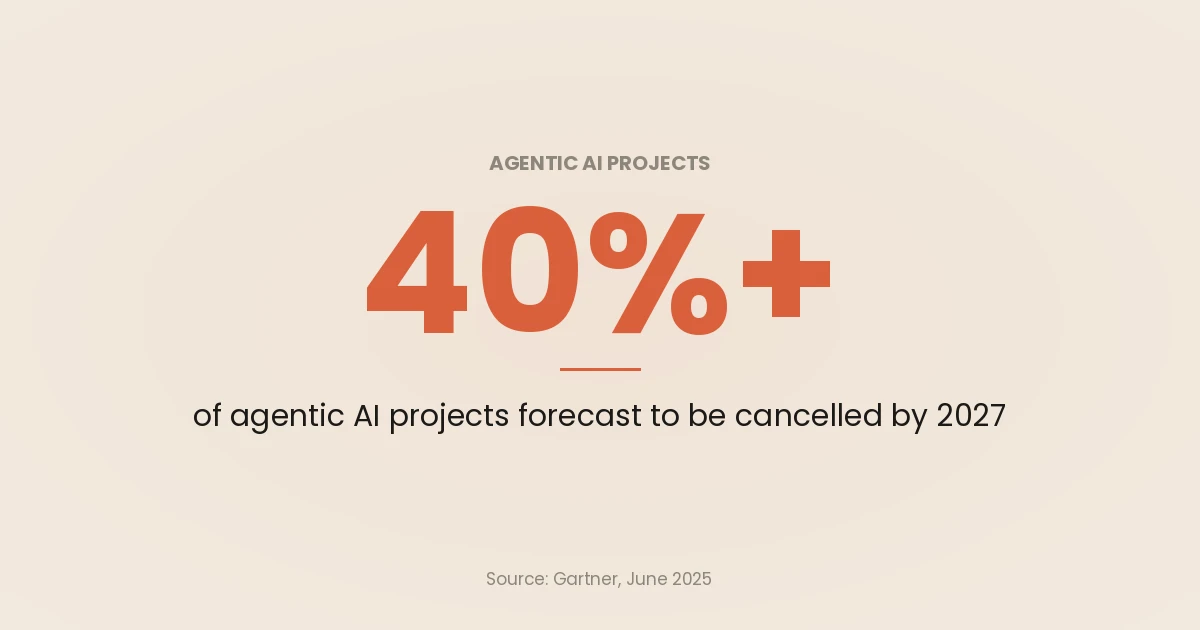
Gartner gives three reasons for its cancellation forecast: escalating costs, unclear business value or inadequate risk controls. It is a prediction made in June 2025, not a measurement, but the reasons map directly onto the test below.
The test that sorts good agent jobs from bad ones
Anthropic’s guide describes where it has seen agents add the most value: tasks that “have clear success criteria, enable feedback loops, and integrate meaningful human oversight.” Its reasoning for coding agents is the useful part for marketers: code solutions are verifiable through automated tests, and the agent can iterate using the test results as feedback.
Marketing has fewer automated tests than software, so the job of choosing agent work is mostly the job of finding the ones that exist. I use three questions.
| Question | Passes when | Fails when |
|---|---|---|
| Can the output be checked mechanically? | A script, an API or a fetched page can say right or wrong | Only a person’s judgement can say whether it is good |
| Is a mistake reversible? | The output is a draft, a report or a ticket | The output is sent, published, spent or refunded |
| Is a mistake cheap? | A wrong answer costs a re-run | A wrong answer costs money, trust or a legal position |
A job that passes all three can run as an agent with light review. A job that fails the first can still use a model, but a person decides. A job that fails the second or third needs a hard approval step outside the model, whatever the vendor says.
Nine jobs AI agents do well
Each of these passes the test because something outside the model can check the work. The check is the part to build first.
1. Content QA against a checklist
An agent reads a draft against a written checklist: primary keyword in the H1 and title, the question answered early, headings in order, every section doing its job, FAQ answers that start with the answer. Most of these are string or structure checks a script can confirm, and the model handles the ones that need reading, such as whether a section answers its heading.
The check is the checklist itself. If a rule cannot be written as a pass condition, it does not belong in the agent’s list. The SEO content brief template on this site is built that way, with a pass condition for every field.
2. Citation checking
The agent takes every statistic in a draft, fetches the page it links to, and confirms the figure is on that page with the meaning the draft gives it. This is the job agents are best at, because the ground truth is a web page the agent can read.
It matters because assistants attach the wrong number to the right page. The AI citation accuracy study on this site checked 80 figures from ChatGPT and Gemini against the pages they linked: ChatGPT’s figure was on the linked page 93% of the time and Gemini’s 63%, from a ten-prompt sample. A checking agent turns that failure rate into a list of claims to fix before review.
3. Brief generation
A brief agent pulls the current search results for a keyword, extracts the headings and figures from the ranking pages, runs a cannibalisation check against your own sitemap, and assembles a draft brief. Each step reads from a source the agent can cite, and the output is a document a person approves before anyone writes.
The decisions stay human: the angle, which existing page not to compete with, and which sources to trust.
4. Crawl triage
Crawlers produce thousands of rows of issues, and most of them are the same few problems repeated across templates. An agent groups the rows by template and root cause, checks a sample of URLs live, and writes a ranked ticket list with the evidence attached.
The check is the live fetch: an agent that says a URL returns a 404 can prove it. The order the tickets should go in is the order of the technical SEO audit checklist, and the Search Console side is covered in crawl errors explained.
5. Internal link suggestions and verification
An agent reads a new article, scores the site’s existing pages for relevance to each section, and proposes links with anchors. Then a script requests every link it placed. The suggestion is model work; the verification is not, and it is the part that stops a confident link to a page that does not exist.
The internal link graph tool and the internal linking audit are the site-level views of the same data.
6. Reporting
A reporting agent pulls the week’s numbers from Search Console, analytics and a rank tracker, compares them with last week, and writes the three sentences a stakeholder reads: what moved, by how much, and which pages drove it. Every figure in the summary comes from an API response the agent can show.
The check is to reconcile the summary against the raw export, which a script does. The data layer is the Search Console API and the vendor APIs compared in best SEO APIs; the dashboard it annotates can be the Looker Studio SEO dashboard.
7. Keyword research and clustering
An agent expands a seed list, pulls search results for each keyword, and groups keywords that share ranking URLs. The grouping rule is arithmetic on real search results, so the model’s job is to name the clusters and classify intent, both of which a person can check at a glance.
The keyword clustering tool on this site does the overlap step without a model at all, which is the right default for the arithmetic.
8. Source freshness monitoring
Every dated statistic on a site goes stale. An agent re-fetches each cited source on a schedule, checks whether the figure is still on the page, and flags pages whose claims have moved or disappeared. The output is a list of pages to review, not an edit.
9. Competitor and SERP change monitoring
An agent watches a set of competitor pages and search results, diffs them against the last snapshot, and reports what changed: a new section, a new page ranking, a changed price or claim. The diff is mechanical; the model’s contribution is a readable summary of it.
A real architecture: the pipeline behind this site
The worked example is the pipeline that produces the articles on this site, Optix. I built it, so read this with that in mind. Its structure matters more than its brand, because it shows where a model is allowed to choose and where code decides.
It runs in eight phases:
1. Research        live SERP + keyword data, page extraction, figures pulled
                   from ranking pages, full-sitemap cannibalisation check
2. Clustering      SERP-overlap grouping, intent classification
3. Brief           headings, keywords, questions, figures allocated to
                   sections  -> a person approves
4. Citation        every candidate figure fetched from its source page:
   registry        number present, in context, HTTP 200, snippet + timestamp
5. Internal links  inventory from the live sitemap, targets scored per section
6. Writing         section by section, from the allocated citations only
7. Audit           URL whitelist, citation format, structure, FAQ, code
                   blocks, claims ledger  -> failing sections regenerated
8. Export          MDX into the content collection; build checks links + meta
In Anthropic’s terms, most of this is a workflow, not an agent. Phases one to six are prompt chaining with gates between steps, and phase seven is an evaluator-optimizer loop: one pass generates a section, another evaluates it, and a failing section goes back with the reason attached. The model has freedom inside a phase (which pages to read, how to phrase a section), but the order of phases and the gates between them are code.
Three design choices do most of the work.
Verification comes before writing. The citation registry is built before a word of the article exists, and the writer receives only the verified figures for its section. A fabricated statistic has no route into the draft, because the writer is placing approved citations rather than generating them.
The writer cannot invent structure it cannot check. Early versions let the model write internal links freely, and it linked, confidently, to pages that did not exist. The fix was not a better prompt. It was handing the writer a list of real pages from the sitemap and requesting every link it placed.
A person signs off at the two points that are judgement. The brief (the angle and the sources) and the final approval. Everything between is checked by code, which is why the review takes minutes. The gates are described in the content approval workflow, and the trace each run leaves on disk is covered in LLM observability for content teams.
The general pattern is the one Anthropic recommends: start with the simplest system that works, and add model autonomy only where it measurably improves the result. For a content team that usually means a workflow with agentic steps inside it, not an autonomous agent running the whole job.
Four jobs AI agents don’t do well yet
These fail the test. Models can help with parts of each, but an agent should not own any of them.
1. Source verification without a registry
An agent asked to “use reliable sources” and left to find its own will produce citations that look right and are not. The failure is well measured. Walters and Wilder analysed 636 bibliographic citations across 84 AI-generated literature reviews and found 18% of GPT-4 citations entirely fabricated, with 24% of the non-fabricated ones containing substantive errors. That was measured on GPT-4 as of mid-2023, with the 24% covering the non-fabricated citations only, three model generations back.
Search-connected assistants invent fewer URLs, but they still attach figures to pages that do not carry them. The fix is structural: a registry of verified claims, each with its source URL, the quoted text and the caveat that must sit beside it, and a check that refuses any figure not in it. Without the registry, an agent’s “verified” means “I believe this”.
2. Brand voice
There is no automated test for whether a paragraph sounds like your brand. A model can match surface features (sentence length, banned words, British spelling) and those are worth checking with code. Whether the paragraph says something your brand would say, with the confidence your brand has earned, is a judgement.
At least one vendor building marketing agents treats it that way. Salesforce’s Campaign Agent page says the agent is grounded in approved assets and brand guidelines, and that marketers remain in the loop “with full control to review, refine, and approve content and guardrails before Campaign Agent launches and sends.” That is a product built to generate on-brand content, and it still keeps a person between the draft and the send.
3. Anything with money attached
Bids, budgets, discounts, refunds and prices fail the second and third questions at once: the mistake is not reversible and it is not cheap. They also fail in a way that is hard to see, because a wrong bid adjustment looks like any other.
The legal position is not in the agent’s favour either. In Moffatt v. Air Canada, the British Columbia Civil Resolution Tribunal found the airline liable after its website chatbot gave a customer wrong information about bereavement fares. Air Canada argued the chatbot was a separate legal entity responsible for its own actions; the Tribunal held the airline responsible for all the information on its website, whether it came from a static page or a chatbot. It was a small tribunal claim, not a court ruling, but the principle is the one to plan for: what your agent promises, you owe.
OWASP’s entry on excessive agency gives the controls. Its root causes are excessive functionality, excessive permissions and excessive autonomy, and its mitigations include limiting an agent’s tools and permissions to the minimum, and requiring a human to approve high-impact actions before they are taken. For money, that means the agent recommends and a person with budget authority approves, in a system the agent cannot bypass.
4. Publishing or sending without a person in the path
An agent that reads the open web and can also publish, post or email has two risks in one. It can be wrong on its own, and it can be steered by what it reads. OWASP lists indirect prompt injection among the common triggers for excessive agency: instructions hidden in content the agent processes, which it then acts on.
OWASP’s own example of the fix is a marketing one. An app that creates and posts social media content on a user’s behalf “should include a user approval routine within the extension that implements the ‘post’ operation.” Let the agent draft, schedule and queue. Keep the publish button, and the send button, human.
How to start: one agent, one job, one check
Most failed agent projects start with a platform and look for a job. Start the other way round.
- Pick one job from the nine above that your team does every week and dislikes. Citation checking and reporting are the usual first choices because the check already exists.
- Write the check before the agent. If you cannot say in one sentence how a script knows the output is right, pick a different job.
- Give the agent read-only tools. An agent that can read the analytics export but not change the property cannot break it. Add write access one tool at a time, and never for money.
- Log every run. Keep the inputs, the tool calls and the output, so a wrong result can be traced to the step that caused it.
- Measure against the manual version. Time saved and error rate, for four weeks, before extending the agent to a second job.
The tooling for step three is increasingly standard: a marketing-stack MCP server exposes your own data to an assistant as read-only tools, and the wider question of which SEO tasks to automate at all is covered in SEO automation. If you want the design and the build done for your team’s stack, that is what the AI implementation service covers.
Frequently asked questions
What are AI agents for marketing?
AI agents for marketing are language-model systems that choose their own next step and call tools, such as a search API, a crawler or an analytics export, to complete a marketing task. They differ from a chatbot or a template-driven writing tool because they run in a loop, reading the result of each tool call before deciding what to do next.
What is the difference between an AI agent and marketing automation?
Marketing automation follows rules a person wrote in advance: if a contact does X, send Y. An agent decides the steps itself based on what it finds. Most reliable marketing systems combine the two, with fixed workflows for the sequence and a model making bounded decisions inside each step.
Which marketing tasks should I give an AI agent first?
Start with a task whose output a script can check. Citation checking, content QA against a checklist, weekly reporting and crawl triage all qualify, because a fetched page, an API response or a written rule can confirm whether the agent got it right. Leave brand voice, spend and publishing decisions with a person.
Can AI agents manage ad budgets or bids?
They can recommend changes, but they should not apply them without human approval. Spend decisions are not reversible and a wrong one is expensive, and OWASP’s guidance on excessive agency recommends human approval for high-impact actions. Give the agent read access to performance data and route its recommendations to someone with budget authority.
Do AI agents replace a marketing team?
No. They replace specific, checkable tasks inside the team’s work, such as pulling reports, checking sources or triaging crawl output. The decisions that carry judgement, including the angle of a piece, the voice, what to spend and what to publish, stay with people, and even Salesforce’s own campaign agent keeps a marketer approval step before anything is sent.