 Nadia Mohamed
AI-SEO & GEO
SEO Content Brief: A Template a Writer, or a Model, Cannot Misread
An SEO content brief is the document that tells a writer what one page must target, claim and contain before it is drafted. It is usually treated as a form: keyword, word count, a few headings, a deadline. The writer fills the gaps with guesses, and the editor rewrites the guesses.
A brief that works is a contract, and every line in it is either a decision made before drafting starts or a condition the finished draft can be tested against.
This article covers what an SEO content brief is, why most briefs produce a rewrite, the fields that make a brief checkable, and a copy-paste template. It then shows the real brief behind this page, including the keyword the brief rejected, and what changes when a model writes the draft instead of a person.
Key takeaways
- An SEO content brief is a contract for one page: it records the decisions a writer cannot make alone and the conditions the draft must pass.
- A brief that fixes a word count is optimising for a target Google says it does not have; give a range taken from the pages that rank.
- The most expensive field is the one most briefs omit: a cannibalisation check against your own published pages, run before anyone writes.
- For AI drafting, the brief should close the source list. In Semrush’s 2026 AI search study, pages cited by AI assistants scored 25.45% higher for Q&A formatting than pages ranking in Google’s top 20 for related keywords.
- If more than one draft in five comes back for structural changes, the brief is broken, not the writer.
What an SEO content brief is, and what it is not
An SEO content brief is the document that sets the search target, the reader, the angle, the evidence and the output requirements for one page before it is drafted. It exists so that the person writing does not have to make strategic decisions they lack the information to make, and so that the person reviewing has something to review against.
It is not an outline. An outline is one field inside the brief: the proposed headings. A brief says why those headings, for whom, backed by which sources, and what else ships with the page.
It is also not a creative brief, which sets campaign messaging across channels. An SEO brief is narrower and more testable: one URL, one search intent, one set of pass conditions.
A quick test separates a brief from a form. Hand it to a writer who has never seen your site and ask whether they can draft without sending you a single question. If they cannot, the brief has moved a decision onto the writer.
That is the brief handoff in a content production workflow, and it is where most workflows break.
Why most briefs produce a rewrite
Most briefs fail in one of four ways:
- A fixed word count, so the draft pads to hit it.
- Keywords without a question, so the draft covers the words and misses the intent.
- No sources, so the writer finds their own and the editor has to check every one.
- No angle, so the draft restates what already ranks.
The word count problem is the most persistent, and it has the least support. Google’s helpful content guidance lists it as a warning sign: “Are you writing to a particular word count because you’ve heard or read that Google has a preferred word count? (No, we don’t.)”
A length range still has a job, which is to stop a draft being too thin to answer the question. It should come from the pages that rank for the query, not from a house rule.
The missing-question problem costs more. Ahrefs’ study of 14 billion pages found that 96.55% of all pages in its index get zero traffic from Google. It is a December 2023 snapshot of Ahrefs’ own index, not of the whole web.
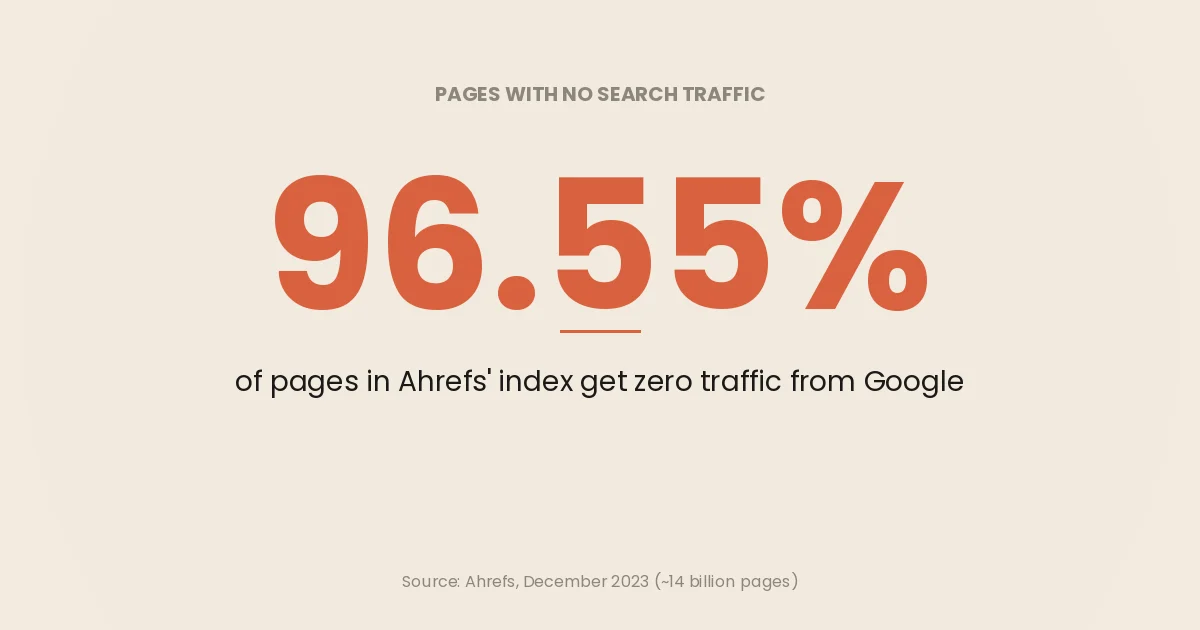
Two of the three reasons Ahrefs gives, no search demand and no match with search intent, are brief decisions. A writer cannot fix either of them in the draft.
The symptom is rework. Track the share of drafts that come back for structural changes rather than line edits. Above one in five, fix the brief stage before you fix anything else in your content operations.
The fields of a brief that can be checked
A useful brief has four groups of fields. Each field below has a pass condition: the test an editor, or a script, runs against the draft to confirm it was followed. A field with no pass condition is a suggestion, and suggestions are what get ignored under deadline.
Decision fields: before anyone writes
These are the fields a writer cannot fill in, because the answers depend on your site and your strategy.
- Primary keyword and cluster. The query the page targets and the variants that share its search results. Pass condition: the primary keyword appears in the H1 and the SEO title, and the page answers the cluster’s shared intent. Group keywords by the URLs that rank for them, not by how similar the words look; the method is in keyword clustering by SERP overlap.
- Cannibalisation check. The existing pages on your site that already target this intent, and the verdict: create, refresh or differentiate. Pass condition: no published page competes for the same cluster.
- Reader and question. Who is searching, what they already know, and the one question the page must answer. Pass condition: the answer appears in the first 150 words.
- Angle. What this page says that the ranking pages do not. Pass condition: an editor can point to the section that delivers it.
Evidence fields: what the draft is allowed to claim
- Required sources. The sources the draft must use, each with the URL and the exact sentence that supports the claim. Pass condition: every statistic in the draft links to a source on this list.
- Figures in scope. The specific numbers the draft may use, with any caveat that must stay beside them. Pass condition: no figure appears without its caveat in the same paragraph.
- Claims to avoid. Numbers the brief has already rejected, usually vendor self-reports with no method. Pass condition: none of them appears.
Structure fields: shape without a word count
- Section plan. H2s and H3s, each with a one-line job and a length range. Pass condition: each section does its job, and the section order matches the brief.
- Internal links. The pages this one must link to, chosen from pages that exist, with the section each belongs in. Pass condition: each link resolves and sits in its section.
- Length range. Taken from the pages that rank, as a range. Pass condition: the draft sits inside it without padding.
Output fields: what ships with the page
- SEO title and meta description. The title is the SERP version, around 60 characters with the keyword first. For the description, Google’s snippet documentation says there is no length limit but the snippet is truncated as needed, typically to fit the device width. Write 140 to 160 characters so the important part survives.
- FAQ questions. The questions to answer under their own headings, taken from People Also Ask and the cluster. Pass condition: each has a direct answer in the first sentence.
- Author and disclosure. Whose name goes on the page, and how the page says it was made. The same Google guidance notes that it helps readers understand E-E-A-T when it is clear who created the content.
The SEO content brief template
Copy this into your brief document or repository. It is written in YAML so that a person can fill it in and a script can check a draft against it. Delete the comments once you know the fields.
page:
  working_title: ""
  seo_title: ""            # ~60 characters, primary keyword first
  slug: ""                 # no dates, no stopwords
  meta_description: ""     # 140-160 characters, ends with a reason to click
decisions:
  primary_keyword: ""
  cluster: []              # keywords that share the ranking URLs
  cannibalisation:
    checked_against: ""    # sitemap or content inventory, with date
    conflicting_pages: []
    verdict: ""            # create | refresh | differentiate
  reader: ""               # role, what they already know
  question: ""             # the one question the page must answer
  angle: ""                # what this page says that the ranking pages do not
evidence:
  required_sources:
    - url: ""
      quote: ""            # exact sentence that supports the claim
      caveat: ""           # must sit beside the figure
  claims_to_avoid: []
structure:
  length_range: ""         # from the ranking pages, for example 1800-2500
  sections:
    - heading: ""
      job: ""              # one line: what this section must do
      words: ""
  internal_links:
    - url: ""
      section: ""
output:
  faq: []
  author: ""
  disclosure: ""           # how the page states it was produced
acceptance:
  - "Primary keyword in H1 and SEO title"
  - "Every statistic links to a required source"
  - "Every internal link resolves"
  - "Question answered in the first 150 words"
A filled-in example: the brief for this article
The brief behind this page was produced by Optix, the content pipeline I built for this site. Its most useful decision was a rejection.
The slot on my calendar was “content marketing operations”: 300 searches a month in the US at keyword difficulty 5, per Ahrefs.
The cannibalisation check pulled its search results and found five of its top ten organic URLs also rank for “content operations”, a query this site already answers on a page published on 8 September. Writing it would have put two of my pages in competition for one intent, so the brief replaced it.
The replacement was “seo content brief”, at 500 searches a month and keyword difficulty 7. The weakest page on the first page of results has a domain rating of 27; this site’s is 9. That verdict is “go, with effort”: the gap is closeable with a better page, not with authority I do not have.
The cluster came from the same overlap test. “seo brief” shares enough ranking URLs with the seed to belong on this page, and so does “seo content brief template”, which is why the template above exists. “Content brief” has twice the volume but a search results page of Facebook posts and PDFs, so it stays out of the cluster.
The angle came from the ten ranking pages. Seven list the elements of a brief, but none gives a pass condition for any element, and none shows a real brief filled in.
The evidence field came from the same pages: 48 figures, most of them vendor self-reports about time saved. The brief carried one of them forward, attributed by name, and traced the rest to primary sources or dropped them.
What changes when a model writes the draft
A human writer who cannot find a source says so. A model produces one.
Walters and Wilder analysed 636 bibliographic citations across 84 AI-generated literature reviews and found 18% of GPT-4 citations entirely fabricated, with 24% of the non-fabricated ones containing substantive errors. That was measured on GPT-4 as of mid-2023, with the 24% covering the non-fabricated citations only. The failure is in how the model is used, and the brief is where you fix it.
Three brief changes matter for AI drafting:
- Close the source list. The draft may cite only the URLs in the evidence field, each with its quote, and a check rejects any other link.
- Allocate sources to sections. Each section is drafted with only its own evidence, so it cannot repeat a figure from another.
- Write headings as questions. Phrase the FAQ and the section headings as the questions readers ask, because answer engines extract self-contained passages.
The structure field matters more than it used to. Semrush’s study compared 304,805 URLs cited by ChatGPT Search, Google AI Mode and Perplexity with 921,614 URLs ranking in Google’s top 20 for related keywords. Cited pages scored 25.45% higher for Q&A format and 22.91% higher for section structure.
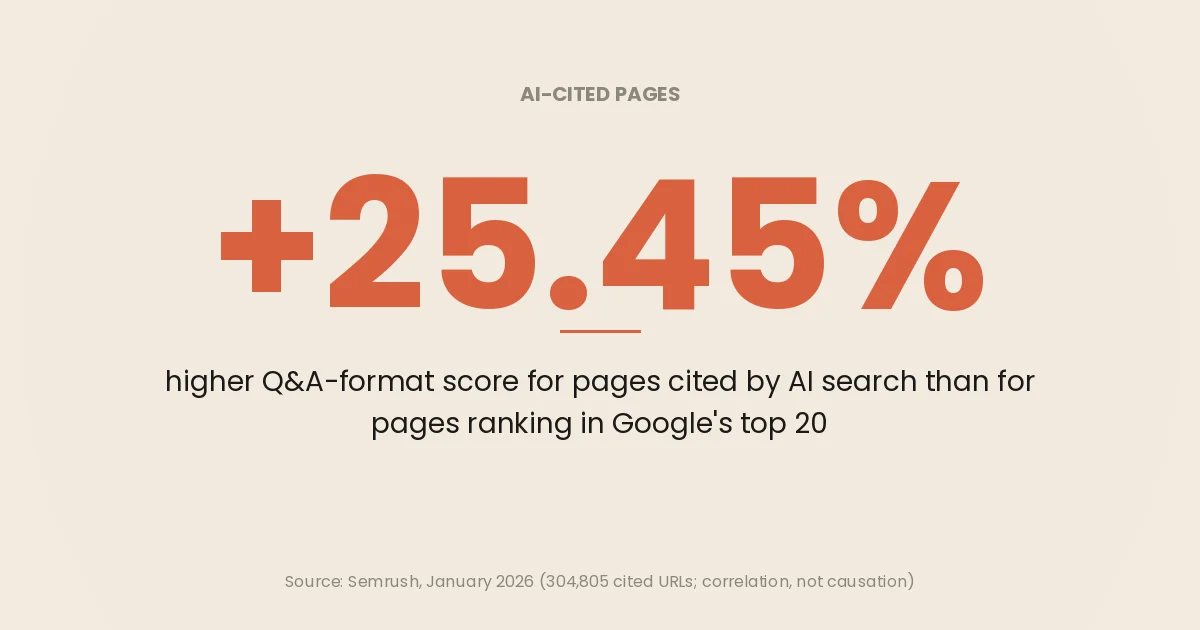
That is a difference between groups, not proof the format causes citation, but it points the same way as the GEO paper presented at KDD 2024. Its best methods, citing sources, adding quotations and adding statistics, improved visibility in generative engine responses by 30 to 40% on its position-adjusted word count measure.
Measured error rates are the case for putting verification before review, and the AI citation accuracy study on this site measures how often assistants’ cited figures appear on the pages they link to.
Checking the draft against the brief
The acceptance list at the bottom of the template is the review. Run the mechanical checks first: keyword placement, links against the source list, internal links resolving, the question answered early. A script does these in seconds.
Then an editor reads for the angle and the section jobs, which takes minutes because the correctness questions are already answered.
| Check | Who runs it | Fails when |
|---|---|---|
| Source list | Script | A link or figure is not in the evidence field |
| Internal links | Script | A link does not resolve or sits in the wrong section |
| Question answered | Editor | The answer is not in the first 150 words |
| Angle delivered | Editor | No section says what the ranking pages do not |
| Section jobs | Editor | A section does something other than its one-line job |
Time the brief as well as the draft. Content Harmony estimates that briefs which take one to two hours to build by hand can be completed in 10 to 30 minutes once the manual steps are optimised. That is a vendor’s estimate for its own workflow, but the direction holds.
Research and keyword data can be automated; the angle and the cannibalisation verdict cannot, and they are the fields that decide whether the page ranks.
Close the loop by asking writers which field they had to guess. Every guess is a field the next brief fills in. The gates that follow the brief, and what the human still signs off, are in the content approval workflow.
Frequently asked questions
What is an SEO content brief?
An SEO content brief is a document that sets the search target, reader, angle, sources, structure and output fields for one page before it is drafted. It exists so the writer does not have to guess at strategy, and so the finished draft can be checked against something specific.
What should an SEO content brief include?
Decision fields (primary keyword and cluster, a cannibalisation check, the reader and their question, the angle), evidence fields (required sources with quotes, figures in scope, claims to avoid), structure fields (section jobs, internal links, a length range) and output fields (SEO title, meta description, FAQ, author). Each needs a pass condition.
How long should an SEO content brief be?
One to two pages. Long enough to hold every decision the writer would otherwise guess, short enough that they read all of it. If a brief runs longer, it usually contains research the writer does not need; keep that in a separate file and link to it.
Should a content brief specify a word count?
Give a range taken from the pages that rank, not a fixed number. Google states it has no preferred word count. The range exists to stop a draft being too thin to answer the question, not to make it hit a target.
Can AI write an SEO content brief?
AI can assemble the inputs: search results, keyword data, competitor headings and candidate sources. The decisions still need a person who will answer for them, especially which existing page not to compete with, which sources to trust and what the page will say that the ranking pages do not.