 Nadia Mohamed
AI-SEO & GEO
What Are AI Overviews? How They Work and Who Gets Cited
AI Overviews are AI-generated summaries that Google Search shows at the top of some results pages, written by a Gemini model from web pages that it then links to as sources. Google describes them as “an AI-generated snapshot with key information and links to dig deeper”, and they sit above the classic list of results rather than replacing it.
This article is the definition: what an AI Overview is, what makes Google show one, how the pages inside it are chosen, what the citations look like on the page, and how the arrival of AI Mode changed the surface. It deliberately stops short of tactics. If you want the steps to earn a citation, that playbook is how to show up in AI Overviews.
Key takeaways
- An AI Overview is a generated summary with supporting links, shown only when Google’s systems judge it additive to classic Search. Most searches do not get one.
- Longer and question-shaped searches trigger them far more often than one- or two-word searches.
- Any page that is indexed and eligible for a snippet can be cited. Google says there are no extra requirements, no special schema and no AI text file to add.
- Sources are gathered through “query fan-out”, a set of related searches run behind the scenes, so the cited pages are often not the pages ranking for the query you typed.
- Since January 2026 an AI Overview is also the doorway into AI Mode: a follow-up question carries the context into a conversation.
What an AI Overview is
An AI Overview is a block of generated text at the top of a Google results page that answers the query directly and links to the web pages supporting that answer. It is a feature of the ordinary results page, like a featured snippet or a knowledge panel, not a separate product you visit.
Three details in Google’s own documentation define it more precisely than most explainers do:
- It is a core feature, not a setting. Google’s help page says AI Overviews “are a core Google Search feature, like knowledge panels. Features cannot be turned off.” The only way to see results without one is the Web filter, which shows text links without features.
- It is generative and fallible. The same page states that AI Overviews “can and will make mistakes” and asks users to check important information in more than one place.
- It runs on Gemini. In January 2026 Google made Gemini 3 the default model for AI Overviews globally. At launch Google described it as a Gemini model customised for Google Search.
Where AI Overviews came from
AI Overviews began as a Search Labs experiment called the Search Generative Experience. On 14 May 2024 Google announced that AI Overviews would begin rolling out to everyone in the U.S., and in August 2024 it added the United Kingdom, India, Japan, Indonesia, Mexico and Brazil.
The feature is now very large. At Google I/O 2026 (19 May 2026) Sundar Pichai said AI Overviews “now has over 2.5 billion monthly active users” and, of AI Mode, that “in just a year, it’s already surpassed 1 billion monthly active users”. Google’s help page lists the countries and languages where AI Overviews are available, which cover most of the world, and notes that they can also appear when someone searches with an image or uses Circle to Search.
What triggers an AI Overview
Google shows an AI Overview when its systems decide that generative AI will help more than the classic results alone. The help page puts it as appearing “when our systems determine that generative AI can be especially helpful”, for example when someone wants to understand information from a range of sources quickly.
The developer documentation is blunter. AI Overviews are “only shown when our systems determine that it is additive to classic Search, and as such, often don’t trigger.” A navigational query, a single-fact lookup or a query where the classic results already do the job usually gets no Overview.
Google does not publish the rules, so the best evidence on what triggers one is observational. Pew Research Center analysed 68,879 Google searches made by a panel of 900 US adults in March 2025, re-running each search in April 2025 to capture what appeared. It is panel browsing data from US adults, collected in March 2025, so treat the shares as a snapshot rather than a current rate.
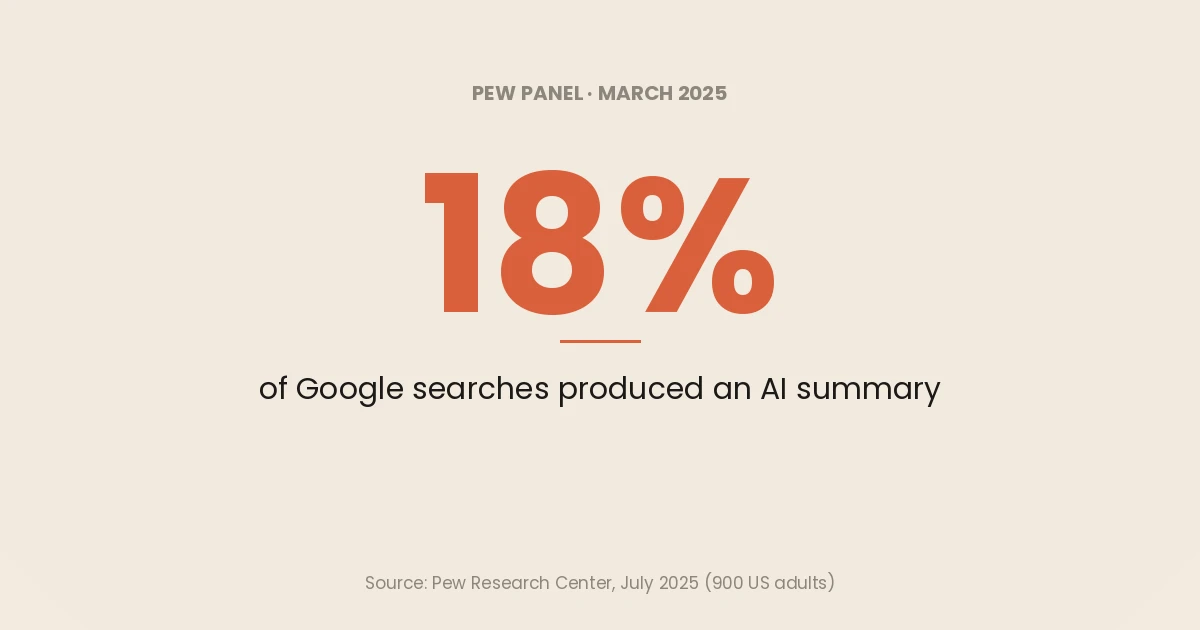
In that panel, 18% of all Google searches produced an AI summary. The share depended heavily on the shape of the query:
| Query shape (March 2025 panel) | Share that produced an AI summary |
|---|---|
| One or two words | 8% |
| Ten words or more | 53% |
| Starts with who, what, when or why | 60% |
| A full sentence (contains a noun and a verb) | 36% |
| All searches | 18% |
The pattern fits Google’s description. Short queries tend to be navigational or have one obvious answer, while long, question-shaped queries need information pulled from several places. Because presence is decided per search, the same keyword can show an Overview one day and not the next, so treat it as a property of a query at a moment, not a permanent label.
How AI Overviews choose which pages to cite
AI Overviews choose sources from Google’s normal index, using the same eligibility rules as the rest of Search, and then widen the pool with extra searches the user never sees. There is no separate submission process and no separate index.
Eligibility: the same bar as a snippet
The eligibility rule is one sentence in Google’s documentation: “To be eligible to be shown as a supporting link in AI Overviews or AI Mode, a page must be indexed and eligible to be shown in Google Search with a snippet”. Google adds that there are no additional technical requirements.
The same page rules out the shortcuts that circulate on social media. You “don’t need to create new machine readable files, AI text files, or markup to appear in these features”, and there is no special schema.org structured data to add. That is why this site treats llms.txt and structured data as helpful for other reasons, not as an AI Overview switch.
Eligibility is not selection. Google is explicit that meeting every requirement does not guarantee a page will be crawled, indexed or served.
Selection: query fan-out
Both AI Overviews and AI Mode may use a “query fan-out” technique, which Google describes as issuing multiple related searches across subtopics and data sources to develop a response. While the response is generated, Google’s models identify more supporting pages, which is why an Overview can show a wider and more varied set of links than a classic results page.
As an illustration, a query like “what are AI Overviews” could fan out into sub-questions about how they work, whether they can be turned off and how they differ from AI Mode, each with its own results. Google does not expose the sub-queries it generates. It has said AI Overviews are rooted in its core quality and safety systems, which suggests the signals behind classic rankings also shape which candidates are trusted.
The consequence shows up in citation studies. Ahrefs found in March 2026 that 37.9% of 4 million AI Overview citations across 863,000 SERPs also appeared in the first 10 SERP blocks, down from around 76% in July 2025, according to its updated study. That count uses SERP blocks, not organic positions 1-10: Ahrefs treated ads, featured snippets, People Also Ask boxes, video packs and organic listings as separate blocks, and a second test on blue links only gave 37.10%. The comparison window is July 2025 to March 2026.
Ahrefs also found that among cited pages that did not rank in the top 100 for the same keyword, 18.2% were YouTube URLs, which is 5.6% of all cited URLs. Video is a real source type, not an edge case, which is the argument of YouTube SEO for AI citations.
Who actually gets cited
The honest answer is: pages from Google’s index that answer the query or one of its fan-out sub-questions, from a wider range of sites than the classic top 10. Google says that with AI Overviews “people have been visiting a greater diversity of websites” for complex questions.
Pew’s panel adds the domain view. The most frequently linked sources were Wikipedia, YouTube and Reddit, which together made up 15% of the sources listed in the AI summaries it examined, against 17% of sources in standard results. Government sites were more common in the summaries, 6% of linked sources against 2% in standard results. Those shares describe US searches from spring 2025.
For a live example, the US results page for “what is ai overviews”, pulled through Ahrefs’ SERP data on 24 September 2026, carried an Overview that cited Wikipedia, Botify and a 9to5Google YouTube video. None of the three was in the organic top 10 below it. That is one query on one day, but it is the fan-out pattern in miniature.
What site owners control
Site owners control whether a page can be cited, not whether it will be. Google’s documentation names the controls: robots.txt rules for Googlebot decide crawling for Search as a whole, and nosnippet, data-nosnippet, max-snippet or noindex limit what is shown from a page.
Blocking the Google-Extended token does not do the same thing. Google describes it as a way to limit AI training and grounding “in some of Google’s other systems”, and it points site owners to the Googlebot and snippet controls for AI features in Search. The trade-offs of each directive are covered in robots.txt for developers.
What the citation display looks like
An AI Overview is a short block of text with its source links attached to the side or inline, and a way to expand it. The details have changed several times since launch, so it helps to know which parts are documented.
- Length. In Pew’s panel, which is panel browsing data from US adults collected in March 2025, the median AI summary was 67 words, with the shortest at 7 words and the longest at 369. In the same data, 88% of summaries cited three or more sources and only 1% cited a single source.
- Link display. In August 2024 Google introduced a right-hand link display on desktop, reachable on mobile by tapping the site icons at the top right, and began testing links placed directly within the text of the Overview.
- Expansion and follow-up. Selecting “Show more” at the bottom opens a detailed view, and on mobile a follow-up typed into the “Ask anything” bar continues the conversation in AI Mode with the original context carried over.
- Feedback. Each Overview has thumbs up and thumbs down controls, and a three-dot menu for reporting a problem.
How Search Console records a citation
Search Console has no separate AI Overview report. Google’s AI features page says traffic from AI Overviews and AI Mode is included in the Performance report under the “Web” search type.
The counting rules are on Search Console’s methodology page. An AI Overview occupies a single position in search results, and all links in the AI Overview are assigned that same position. A click on an external link counts as a click, and standard impression rules apply.
That single-position rule is why a cited page can show an improved average position alongside a falling click-through rate. Separating the two is the subject of measuring AI Overview CTR impact, and building the reporting around it is covered in how to track AI Overviews.
What changed with AI Mode
AI Mode turned the AI Overview from a standalone answer into the possible first step of a conversation.
AI Mode is a separate experience that Google describes as expanding “what AI Overviews can do with more advanced reasoning and ways of interacting”. It divides a question into subtopics, searches for each at the same time, and answers with links, with the option to keep asking. When Google is not confident enough in an AI response, AI Mode can show a set of web links instead.
Three changes matter for understanding AI Overviews today:
- The handoff. In January 2026 Google made it possible to ask a follow-up question right from an AI Overview and move into AI Mode, first on mobile. At I/O 2026 Google said this experience was live across desktop and mobile, worldwide.
- Different models, different links. Google’s documentation warns that “AI Mode and AI Overviews may use different models and techniques, so the set of responses and links they show will vary”. Since I/O 2026, Gemini 3.5 Flash has been the default model in AI Mode for everyone globally, while Gemini 3 has been the AI Overviews default since January. A page cited in one is not automatically cited in the other.
- New queries in the data. Search Console treats a follow-up question in AI Mode as a new query, with its own impressions, positions and clicks. The conversation after the Overview is recorded separately from the search that produced it.
| AI Overviews | AI Mode | |
|---|---|---|
| How it appears | Automatically, on the standard results page, when judged additive | When the user opens AI Mode or follows up from an Overview |
| Shape | One summary above the classic results | A conversation with follow-up questions |
| Source gathering | May use query fan-out | Divides the question into subtopics and searches each |
| Default model (Google’s 2026 announcements) | Gemini 3 | Gemini 3.5 Flash |
| Search Console position | One position for all links in the Overview | Same methodology as a results page; each follow-up is a new query |
The full comparison is in Google AI Mode vs AI Overviews, and what AI Mode visibility was worth in practice is measured in the AI Mode impressions study.
What AI Overviews mean for clicks
Google’s position is that clicks from results pages with AI Overviews are “higher quality”, meaning users are more likely to spend more time on the site. Pew’s data describes volume rather than quality. Pew Research found users clicked a traditional search result on 8% of visits where an AI summary appeared, against 15% where one did not, in its March 2025 panel. That compares query populations, not the same queries before and after, so it is not a clean estimate of what an Overview does to any one page’s click-through rate.
The same analysis found users clicked a link inside the summary itself on 1% of visits to pages with one. For the wider context of searches that end on Google, see zero-click searches.
Being cited is visibility, and it may or may not produce a visit, so citation and traffic need tracking as two separate things. It is also why AI Overviews sit inside the broader discipline of generative engine optimization, which is concerned with being the source an AI answer relies on, not only the link someone clicks.
Common misreadings of AI Overviews
Three claims come up repeatedly and do not survive a read of Google’s own documentation.
- “You need special markup or an AI file to appear.” Google says no special schema.org structured data, machine-readable file or AI text file is needed.
- “The Overview cites the top three results.” Fan-out means cited pages often rank for a related query rather than the one typed, and the Ahrefs data above puts the overlap with the first 10 SERP blocks at well under half.
- “Blocking Google-Extended removes you from AI Overviews.” Google points site owners to Googlebot and snippet controls for AI features in Search.
If you want these checks run against your own pages, eligibility, snippet controls and fan-out coverage are part of a GEO and technical SEO audit.
Frequently asked questions
What is an AI Overview in Google Search?
An AI Overview is an AI-generated summary shown at the top of some Google results pages, with links to the web pages that support it. Google generates it with a Gemini model when its systems judge that a summary adds something the classic results do not. It appears above the normal results, which remain on the page below it.
Can you turn off AI Overviews?
No. Google’s help page describes AI Overviews as a core Search feature, like knowledge panels, and says features cannot be turned off. You can select the Web filter after searching, which shows only text-based links without features such as AI Overviews.
How does Google decide which websites an AI Overview cites?
Any page that is indexed and eligible to show with a snippet can be cited, and there are no extra requirements. Google may run a query fan-out, a set of related searches across subtopics, and pick supporting pages from those results. That is why cited pages are often not the ones ranking for the exact query typed.
Is an AI Overview the same as ChatGPT?
No. ChatGPT is a standalone assistant, while an AI Overview is a feature inside Google’s results page, generated by Google’s Gemini models and grounded in Google’s search index. Google’s comparable conversational product is AI Mode, which you can reach by asking a follow-up question from an AI Overview.
Do AI Overviews show up in Google Search Console?
Yes, but not separately. Clicks and impressions from AI Overviews are included in the Performance report under the Web search type, with no filter that isolates them. An AI Overview occupies a single position, and every link inside it is assigned that same position.
What is the difference between an AI Overview and a featured snippet?
A featured snippet displays information extracted from a single web page and links to it. An AI Overview is generated text that usually draws on several pages: in a March 2025 panel of US adults’ browsing data, 88% of AI summaries cited three or more sources. Both are features above the organic results, and the same page can appear in either.