 Nadia Mohamed
AI-SEO & GEO
Google AI Mode vs AI Overviews: What's the Difference in 2026?
What is the difference between Google AI Mode and AI Overviews?
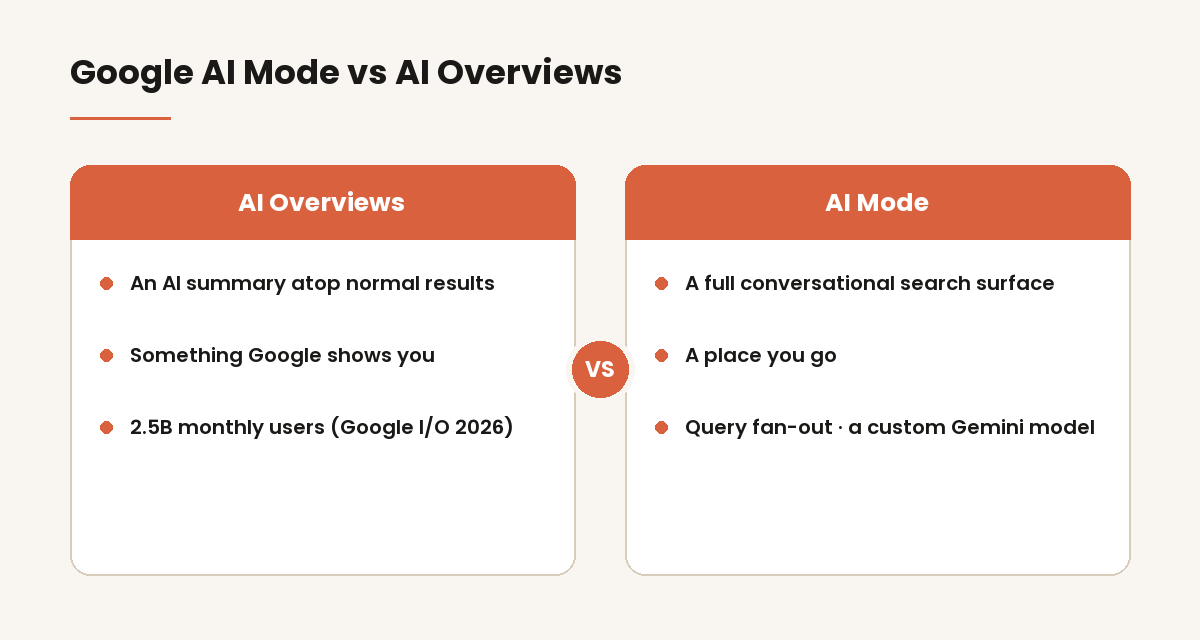
The difference is surface versus experience. AI Overviews are the AI-generated summaries that appear above your regular search results for informational and complex queries — you never ask for them, they simply show up on the standard results page. AI Mode is a separate, end-to-end conversational search experience you deliberately enter — its own tab where you ask a question, read an AI-generated answer, and keep going with follow-ups, all without returning to a traditional list of blue links. AI Overviews are a feature layered onto Search; AI Mode is a different way of searching entirely.
Both run on the same foundations — Google’s query fan-out technique and a custom version of Gemini — which is exactly why they get confused. The distinction that matters is how you arrive at each, how much of the page it occupies, and how conversational the interaction is. This guide defines both, contrasts them line by line, and explains when each one appears. For the tactics to earn citations in them, see how to rank in Google AI Overviews.
TL;DR — Key takeaways
- AI Overviews are passive; AI Mode is active. An AI Overview appears automatically at the top of the standard results page. AI Mode is a distinct destination you choose to open.
- They differ in scope of the interaction. AI Overviews answer a single query in place, with the organic results still beneath them. AI Mode is built for multi-turn, follow-up questioning — a conversation, not a summary.
- They share an engine. Both use Google’s query fan-out technique and a custom Gemini model. AI Mode applies more advanced reasoning and multimodal capabilities on top.
- Reach differs by an order of magnitude in adoption speed. AI Overviews reach 2.5 billion monthly active users; AI Mode surpassed 1 billion monthly users within a year of launch, with queries more than doubling every quarter.
- For content, the optimisation is largely shared. The same extractable, well-attributed content that gets cited in an AI Overview is what AI Mode’s fan-out surfaces — so this is one discipline, not two. The playbook lives in how to show up in AI Overviews.
/assets/screenshots/google-ai-mode-vs-ai-overviews.png What are AI Overviews?
AI Overviews are AI-generated summaries that appear at the top of Google’s standard search results page, above the traditional organic listings, for informational and complex queries. Google’s model synthesises information from multiple web sources into a single response and displays source links inline with the generated text. You do not opt in — for eligible queries, the overview simply renders as part of the results page you already searched. For the full definition, including what triggers one and how its sources are chosen, see what AI Overviews are and who gets cited.
AI Overviews are now available in more than 200 countries and territories and in more than 40 languages, and in Google’s biggest markets they are driving over a 10% increase in usage of Search for the types of queries that show an overview. In other words, AI Overviews expand how often people use Google for informational questions — they are additive to the existing results page, not a replacement for it.
The strategic consequence is that the standard results page is now split: an AI summary on top, organic links below. Your page is either cited inside that summary — earning prominent, attributed visibility — or it competes for the clicks that remain beneath it.
What is Google AI Mode?
AI Mode is a dedicated, conversational search experience — a separate tab you enter to ask a question and receive an AI-powered response, then “go further with follow-up questions and helpful web links,” in Google’s own framing. Where an AI Overview answers one query in place, AI Mode is designed for the whole exploratory session: comparisons, multi-part questions, and successive refinements that would take several separate searches in traditional Google.
Google introduced AI Mode as an experiment that “expands what AI Overviews can do with more advanced reasoning, thinking and multimodal capabilities,” and it began rolling out to everyone in the U.S. at Google I/O 2025. It has since expanded well beyond that: by I/O 2026 it had surpassed one billion monthly users and Google made Gemini 3.5 Flash the default model in AI Mode for everyone globally.
The mental model that keeps the two straight: an AI Overview is something Google shows you on the results page; AI Mode is a place you go to have a back-and-forth with Search.
AI Mode vs AI Overviews: the differences that matter
The two surfaces overlap in technology but diverge in almost every part of the user experience. Here is the line-by-line contrast.
| Dimension | AI Overviews | AI Mode |
|---|---|---|
| What it is | An AI summary layered onto the standard results page | A separate, end-to-end conversational search experience |
| How you reach it | Appears automatically for eligible queries | You deliberately open the AI Mode tab |
| Surface | Sits above the organic results, which remain below | Occupies its own destination — no traditional results list |
| Interaction | Single answer in place | Multi-turn conversation with follow-up questions |
| Underlying tech | Query fan-out + a custom Gemini model | Query fan-out + a custom Gemini, with deeper reasoning and multimodal capabilities |
| When it appears | Informational and complex queries on the normal SERP | Whenever you choose to search in AI Mode |
| Reach (I/O 2026) | 2.5B monthly active users | 1B+ monthly users |
The clearest way to hold the difference in mind is the trigger. AI Overviews are query-triggered — Google decides an overview is warranted and shows one. AI Mode is user-triggered — nothing appears until you choose that mode. Everything else (a fuller answer, a conversational thread, no blue-link list) follows from that one choice.
The shared engine: query fan-out and a custom Gemini
The reason these two surfaces are so easily conflated is that they are built on the same machinery. Both use what Google calls the query fan-out technique — “breaking down your question into subtopics and issuing a multitude of queries simultaneously on your behalf,” as Google describes AI Mode. Rather than matching a single query against the index, the system issues many related searches across subtopics and data sources at once, then assembles the results into one response.
Both surfaces are also powered by a custom Gemini model. At I/O 2025, Google brought “a custom version of Gemini 2.5” into Search “for both AI Mode and AI Overviews in the U.S.” — the same model family behind each surface. AI Mode simply applies more of Gemini’s reasoning and multimodal capability, because a conversational session demands deeper, multi-step thinking than a single inline summary does.
This shared foundation is the practical good news for anyone creating content: you are not optimising for two separate systems. Query fan-out means both surfaces reward the same thing — content with genuine topical depth that ranks across the sub-queries a topic generates, not just its head term. That is why this piece is a definition guide rather than a tactics guide: the “how to appear” work is identical to the AI Overviews playbook, covered in how to show up in AI Overviews.
When each one appears
AI Overviews appear on the standard results page, automatically, for a subset of queries. They skew heavily toward informational and complex questions — definitions, “how does X work,” multi-part comparisons — where synthesising several sources adds value over a single link. You do not request one; Google renders it when it judges the query a fit. That means the same keyword can show an overview for one user and not another, and coverage shifts over time.
AI Mode appears only when you enter it. There is no query that “triggers” AI Mode the way certain queries trigger an overview — you open the tab and every search within it is an AI-first, conversational one. The two can even nest conceptually: AI Mode is, in Google’s framing, an expansion of what AI Overviews can do, applied across an entire session rather than a single result.
For content strategy, this distinction changes where you’ll see impact more than what you do about it. AI Overviews influence the click-through behaviour on your existing informational rankings; AI Mode is a distinct exploratory channel that a growing share of users choose deliberately. Both are part of the wider shift toward generative engine optimization — and both sit inside the broader landscape of AI search engines reshaping discovery. If you’re weighing how this fits your existing search investment, GEO vs SEO unpacks where the two disciplines overlap and diverge.
What the distinction means for showing up
Because AI Mode and AI Overviews share the query fan-out engine and a common Gemini model, the work of earning citations is one discipline, not two. Content that is extractable (a direct answer in the opening sentence of each section), well-attributed (a clear, credentialed author entity), and topically deep (ranking across the sub-queries fan-out generates) is what surfaces in both. There is no separate “AI Mode optimisation” to bolt on.
That keeps the division of labour simple. This guide answers which is which. For the tactical execution — the technical eligibility checks, definition-first structure, FAQ sections in prompt language, and schema that drive selection — follow the companion playbooks: how to rank in Google AI Overviews for the conceptual selection model, and how to show up in AI Overviews for the ten data-backed strategies.
FAQ
What is the difference between AI Mode and AI Overviews?
AI Overviews are AI-generated summaries that appear automatically above your normal Google search results for informational and complex queries — a feature layered onto the standard results page. AI Mode is a separate, conversational search experience you deliberately open in its own tab, where you ask a question, get an AI answer, and continue with follow-ups instead of scrolling a list of links. The simplest distinction: an AI Overview is something Google shows you; AI Mode is a place you go.
Is AI Mode replacing AI Overviews?
No. Google positions AI Mode as an expansion of what AI Overviews can do, applied across a whole conversational session rather than a single result. AI Overviews continue to appear on the standard results page — they reached 2.5 billion monthly active users by I/O 2026 — while AI Mode is a distinct, opt-in destination that surpassed 1 billion monthly users in its first year. They coexist as two different surfaces.
Do AI Mode and AI Overviews use the same technology?
Largely, yes. Both are built on Google’s query fan-out technique, which breaks a question into subtopics and issues many searches simultaneously, and both are powered by a custom version of Gemini — at I/O 2025 Google brought a custom Gemini 2.5 into Search “for both AI Mode and AI Overviews.” AI Mode applies more advanced reasoning and multimodal capability because a conversation demands deeper, multi-step processing than a single inline summary.
When does Google show an AI Overview versus AI Mode?
An AI Overview appears automatically on the standard results page when Google judges a query — usually informational or complex — a good fit; you never request it. AI Mode never appears on its own: it only runs when you choose to search inside the AI Mode tab, and every query there is AI-first and conversational.
Which has more users, AI Mode or AI Overviews?
AI Overviews have far greater reach — 2.5 billion monthly active users as of Google I/O 2026 — because they appear inside the search experience billions of people already use. AI Mode is a newer, opt-in surface that reached 1 billion monthly users about a year after launch, with queries more than doubling every quarter, making it one of the fastest-growing search products despite the smaller base.
Do I need to optimise separately for AI Mode and AI Overviews?
No. Because both surfaces share the query fan-out engine and a common Gemini model, the content signals that earn citations are the same: direct, extractable answers, clear author attribution, and topical depth across the sub-queries a topic generates. Optimising well for AI Overview citation is, in practice, optimising for AI Mode as well — the tactics are covered in how to show up in AI Overviews.