 Nadia Mohamed
AI-SEO & GEO
Perplexity vs ChatGPT Search: A Head-to-Head Comparison (2026)
Perplexity vs ChatGPT search: what’s the actual difference?
Perplexity and ChatGPT search both answer questions by reading the live web and writing you a synthesised answer — but they are built around opposite defaults. Perplexity is an answer engine: it searches on nearly every query and cites its sources inline by default. ChatGPT is a general-purpose assistant that added web search: it retrieves the web when a question needs it, and cites sources when it decides to. That single difference — citation-first versus assistant-first — cascades into how each one retrieves, what it is trustworthy for, and which one you should open for a given task. This is the deep two-way comparison; if you want the wider field, this piece is a spoke of our guide to the best AI search engines.
Both matter now because both are enormous. ChatGPT reached roughly 800 million weekly active users by late 2025 (TechCrunch, Oct 2025), and Perplexity was reported handling around 780 million search queries a month in 2025 (Just Think AI). As of July 2026, choosing between them is no longer a novelty question — it is a workflow decision millions of people make several times a day.
TL;DR — Key takeaways
- Perplexity is citation-first. It searches in real time on nearly every query and returns inline numbered citations to the specific pages behind each claim, so its answers are auditable by design.
- ChatGPT search is assistant-first. Web retrieval is one capability inside a general model; it cites sources when browsing is active, but often answers without visible citations, so you cannot always trace a claim.
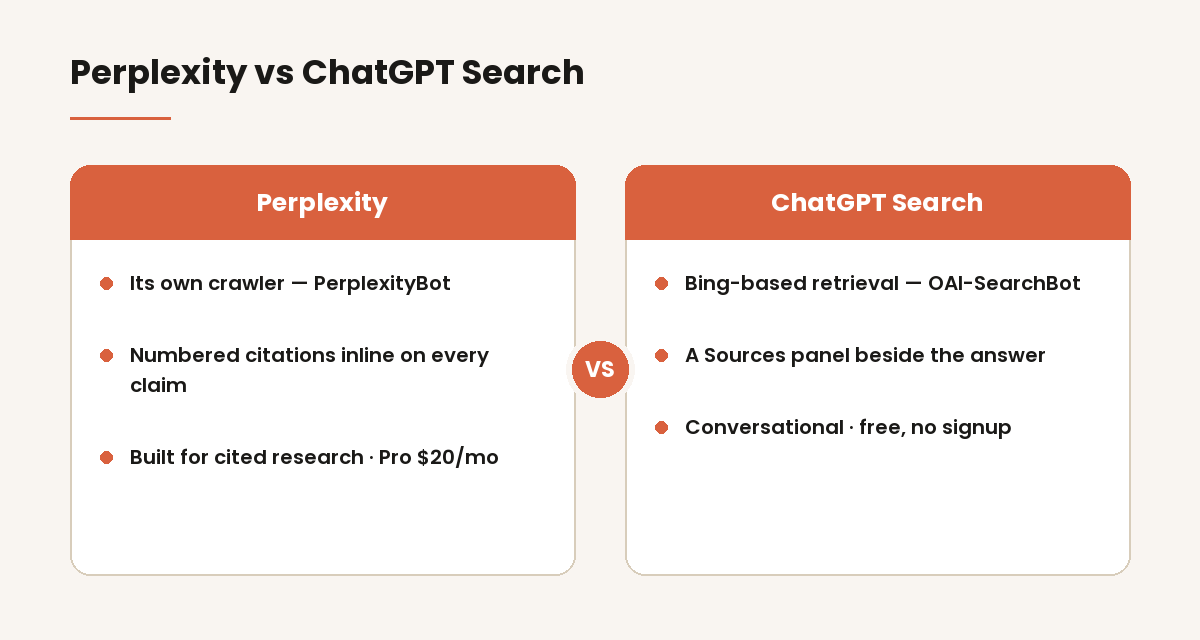
- They retrieve differently. Perplexity runs its own crawler (PerplexityBot) plus a live fetch agent (Perplexity-User) over a hybrid index. ChatGPT search blends OpenAI’s own index (built by the OAI-SearchBot crawler) with third-party search providers, including Microsoft Bing, and licensed media partners (CNBC).
- Pricing is identical, value is not. Perplexity Pro and ChatGPT Plus both cost $20/month — Perplexity buys you better cited search; ChatGPT Plus buys you a broader toolkit (image generation, voice, code, deep analysis).
- Access differs at the free tier. ChatGPT search has been usable without an account since February 2025 (TechCrunch); Perplexity’s core search is also free to use.
- The smart move is not to pick one. Reach for Perplexity when you need fast, cited facts you can verify; reach for ChatGPT when you need synthesis, creation or code built on top of research.
/assets/screenshots/perplexity-vs-chatgpt-search.png What each one actually is
The comparison only makes sense once you see that these are not the same category of tool wearing different logos.
Perplexity — a citation-first answer engine
Perplexity was built from the start as a search-and-answer product. Ask it anything and it searches the live web, reads the results, and writes a short synthesised answer with inline numbered citations pointing at the exact sources it used. There is no knowledge cutoff to speak of because it retrieves on almost every query rather than leaning on training data. Its paid tier, Perplexity Pro, costs $20/month or $200/year and adds unlimited Pro Search, a daily allotment of Deep Research runs, model switching, and access to premium sources such as Statista and PitchBook (Perplexity Help Center). The product’s entire personality is “here is the answer, and here is precisely where it came from.”
ChatGPT search — web retrieval inside a general assistant
ChatGPT is a general-purpose model that can write code, draft essays, generate images, hold a voice conversation, and analyse a spreadsheet. Search is one capability layered on top. OpenAI launched ChatGPT search on October 31, 2024, bringing “the best of the SearchGPT experience” into ChatGPT (Search Engine Land). ChatGPT decides when a question needs the web and searches automatically, or you can trigger it manually. When it browses, it shows source links; when it answers from the model alone, it may show none. ChatGPT Plus costs the same $20/month, but that fee buys the whole assistant, not just better search.
How each one retrieves and cites the web
For anyone doing generative engine optimization — or simply deciding which answer to trust — the retrieval mechanics are the whole game.
Perplexity runs its own retrieval stack. It operates a proprietary crawler, PerplexityBot, which builds and refreshes the index behind its cited answers, plus Perplexity-User, a live agent that fetches specific pages on demand when a user’s question needs real-time information (Perplexity crawler docs). Both are identifiable by the perplexity.ai domain in their user-agent string, and Perplexity publishes IP ranges so site owners can verify them. This hybrid of a proprietary crawl plus live retrieval is why Perplexity feels current and why its citations resolve to real, specific URLs.
ChatGPT search blends several sources. OpenAI maintains its own index, built by a crawler called OAI-SearchBot, and supplements it with third-party search providers — Microsoft Bing prominently among them — and licensed content from media partners (Semrush explainer). When asked directly whether Bing sat behind ChatGPT search, OpenAI’s engineering leadership put it as “we use a set of services and Bing is an important one” (CNBC). The practical consequence: what ChatGPT can find is shaped partly by an index it does not fully own, and its freshness inherits any lag in those upstream providers.
The citation behaviour is where the two diverge most sharply. Perplexity attaches a numbered citation to essentially every factual claim, so a reader can click straight through to the source. ChatGPT surfaces source links when browsing is active, but frequently answers without any visible citation at all — even on factual questions — which means you sometimes have to take the claim on trust or re-ask to force a search. If auditability is the thing you care about, that gap is the whole comparison.
Strengths and limits, head to head
Neither engine is strictly better — they are optimised for different failure modes.
Perplexity’s strengths: every answer is traceable, freshness is excellent because it searches on nearly every query, and the numbered-citation format makes fact-checking almost effortless. Its limits: answers are deliberately concise and can feel thin for open-ended, creative, or multi-step reasoning tasks; it is a search product, not a full creative suite; and like any retrieval engine it is only as good as the pages it can reach and rank.
ChatGPT’s strengths: it is a genuine all-rounder — the same session that answers a search query can then write the code, draft the email, build the table, or generate the image based on that answer. Its synthesis and reasoning on complex prompts are strong, and for many users the convenience of one tool for everything outweighs a purpose-built alternative. Its limits: inconsistent citation means you cannot always verify what it tells you; its web freshness depends on upstream providers; and because search is optional, it will sometimes answer from stale training data when it should have gone to the web.
Which should you use for what?
This is the decision that actually matters. Here is the honest task-by-task split as of July 2026.
For factual research and citations → Perplexity
If your output has to be verifiable — a report, a briefing, anything where a wrong fact is expensive — Perplexity’s citation-first design wins. You get the claim and the source in one view, and you can click through to confirm before you rely on it. For literature-style scans across many sources, Perplexity’s Deep Research (on Pro) is built for exactly this.
For everyday questions and quick lookups → either, slight edge Perplexity
For “what time does this close,” “summarise this news,” or “is this statistic current,” both work, and both are free at the entry tier. Perplexity edges it when you want to sanity-check the answer, because the source is right there. ChatGPT edges it when you are already mid-conversation and want to stay in one place.
For coding and building on an answer → ChatGPT
If the next step after getting information is doing something with it — writing a function, refactoring code, drafting the document, generating an asset — ChatGPT is the better home. Its code interpreter, broad tool integration, and stronger long-form synthesis mean you research and build in the same thread instead of copy-pasting between tools.
For anything you’ll publish or be held accountable for → Perplexity to verify, ChatGPT to draft
A workflow, not a winner: use Perplexity to gather and verify the facts (because you can audit every citation), then use ChatGPT to synthesise, structure and draft on top of them. Picking one tool for both jobs is the most common mistake; the two are complements far more than substitutes.
What this means if you want to be cited by either
If you publish content, the comparison flips: now you want to be the source these engines pull. The mechanics differ enough that the tactics do too. Perplexity rewards clean crawlability for PerplexityBot, sentence-level extractable claims, and verifiable statistics with primary sources — the full playbook is in how to get cited by Perplexity. ChatGPT rewards definition-first structure, prompt-language FAQs, and quotable standalone statements its retrieval can lift cleanly — covered in how to get cited by ChatGPT. Both sit inside the wider discipline of generative engine optimization: structuring content so answer engines can find, extract and attribute it. This comparison is decision-led on purpose — for the optimisation how-to, those two guides own that ground.
FAQ
Is Perplexity or ChatGPT better for research?
Perplexity is better when the research has to be verifiable, because it attaches inline numbered citations to nearly every claim and searches the live web on almost every query. ChatGPT is better when research is a step toward creating something — code, a document, an analysis — because it can do the downstream work in the same session. Many people use Perplexity to gather and check facts, then ChatGPT to build on them.
Does ChatGPT search use Bing?
Partly. ChatGPT search draws on OpenAI’s own index (built by its OAI-SearchBot crawler), third-party search providers, and licensed media partners. Microsoft Bing is one of those providers — OpenAI has described Bing as “an important one” among the set of services it uses (CNBC). Perplexity, by contrast, runs its own crawler and index rather than relying on a third-party search engine.
Do both Perplexity and ChatGPT show their sources?
Perplexity shows inline numbered citations on essentially every factual answer by default. ChatGPT shows source links when it browses the web, but it frequently answers without visible citations — including on factual questions — so you cannot always trace a claim back to a source. For auditability, Perplexity is the more reliable of the two.
How much do Perplexity Pro and ChatGPT Plus cost?
Both cost $20 per month. Perplexity Pro is also available at $200/year and adds unlimited Pro Search, Deep Research, model switching and premium sources (Perplexity Help Center). ChatGPT Plus at $20/month unlocks the broader assistant — advanced models, image generation, voice and code tools — not just better search.
Do I need an account to use ChatGPT search or Perplexity?
No account is required for either at the basic level. ChatGPT search has been usable without signing in since February 2025 via chatgpt.com (TechCrunch), though the mobile apps still require a login. Perplexity’s core search is also free to use. Paid tiers on both cost $20/month.
When did ChatGPT search launch?
OpenAI launched ChatGPT search on October 31, 2024, bringing the SearchGPT experience into ChatGPT for paying and waitlisted users first, then rolling it out to free users and, in February 2025, to users with no account at all (Search Engine Land).