 Nadia Mohamed
AI-SEO & GEO
How to Get Cited by Claude in 2026: Complete Guide
How do you get cited by Claude?
Getting cited by Claude is the process of structuring web content so Claude’s retrieval system selects it as a named source when Claude searches the web to answer a question. Since Anthropic added web search to Claude in 2025, Claude retrieves live pages, synthesises them, and — whenever it uses the web — provides direct citations back to the sources so users can fact-check the answer. The three determinants of a Claude citation are crawl access for Anthropic’s bots, content structured for sentence-level extraction, and entity signals that make your domain a resolvable, trustworthy source.
Claude web search launched in the United States in March 2025 and became available globally on all Claude plans on 27 May 2025. When Claude incorporates information from the web, it “provides direct citations so you can easily fact check sources” (Anthropic — Claude web search announcement). Claude’s citation footprint is smaller than ChatGPT’s and less visually aggressive than Perplexity’s — but it is the fastest-growing AI referral source measured, which is exactly why it belongs in your GEO strategy now rather than later.
TL;DR — Key takeaways
- Claude searches the web only when a query needs current, changing, or out-of-training-data information — so its citation footprint is smaller and higher-intent than platforms that search on every query (Anthropic developer docs).
- Anthropic runs three distinct crawlers —
ClaudeBot(training),Claude-User(user-directed retrieval), andClaude-SearchBot(search-quality indexing) — and each is controlled separately inrobots.txt. Blocking the wrong one can quietly remove you from citation eligibility. - Citations are always enabled for Claude web search — when Claude searches, every claim it draws from the web carries a source URL and title. Your job is to be the page it retrieves, not to hope for a link.
- Definition-first paragraph structure, FAQ sections in prompt language, and Person/Article schema are the same high-leverage content changes that earn citations across ChatGPT and Perplexity — Claude rewards them too.
- Claude referral traffic converts at 5% versus 1.76% for Google Organic in Seer Interactive’s single-client case study — lower than ChatGPT and Perplexity, but multiples above organic.
- Claude’s referral volume grew 64× between November 2024 and May 2026 and overtook Perplexity in March 2026 — the weakest-demand engine to optimise for today, and the fastest-rising.
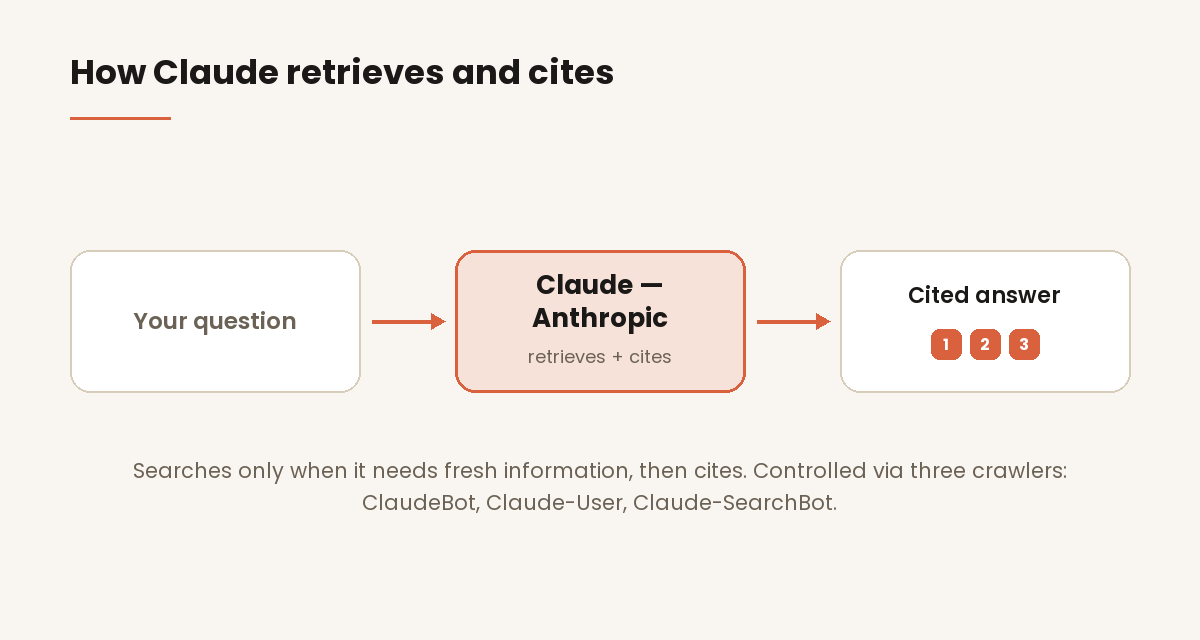
/assets/screenshots/how-to-get-cited-by-claude.png How Claude’s web search and citations actually work
The single most important thing to understand about Claude citation is that Claude decides when to search — it does not retrieve the web on every turn. Per Anthropic’s developer documentation, Claude searches when “the request depends on information that is current, changing, or outside its training data” — recent events, current prices or statistics, or specific organisations, people, and products that might have changed. It answers directly, without searching, for established facts, math, coding concepts, creative writing, and analysis of content already in the conversation (Anthropic web search tool docs).
This is the structural difference from Perplexity, which searches the live web before nearly every answer. Claude’s selectivity means fewer conversations trigger a citation — but the ones that do are the high-intent, research-grade queries where a cited source materially shapes a decision. A Claude citation reaches a smaller audience than a Perplexity citation, and a more deliberate one.
When Claude does search, citation is not optional. Anthropic’s docs are explicit: “Citations are always enabled for web search,” and each cited location returns the source url, title, and up to 150 characters of cited_text. Anthropic further instructs developers that “when displaying API outputs directly to end users, citations must be included to the original source.” In other words, once Claude retrieves your page as a source, the attribution is guaranteed — the entire optimisation problem is being the page Claude chooses to retrieve.
Why Claude citations are worth the effort despite the smaller footprint
Claude is honestly the weakest-demand engine in the “get cited by AI” set — for now. In Previsible’s 2026 analysis of trackable LLM referral traffic, ChatGPT commands 92.4% of the total, while Claude’s absolute share sits in the low single digits, a denominator that excludes Google AI Overviews and AI Mode. If you optimise for exactly one AI engine, it should be ChatGPT, not Claude.
But two facts change the calculus. First, trajectory: Claude referral sessions grew 64× between November 2024 and May 2026 and overtook Perplexity in March 2026, driven by agentic tools and enterprise adoption (Previsible — 2026 AI Traffic Report). Second, conversion quality: on Seer Interactive’s single client, Claude referral traffic converted at 5% — below ChatGPT (15.9%) and Perplexity (10.5%), but nearly 3× Google Organic’s 1.76% (Seer Interactive case study, Oct 2024–Apr 2025).
The strategic point is efficiency, not volume: the same structural and schema work that earns you ChatGPT and Perplexity citations makes you Claude-citable at almost no marginal cost. Completing the set now positions you for Claude’s growth curve while competitors are still ignoring it.
Meet Claude’s three crawlers — and why the distinction matters
Anthropic operates three separately named crawlers, and confusing them is the most common way sites accidentally exclude themselves from Claude citations. Each has a distinct job and is controlled independently in robots.txt (Anthropic — how site owners can control Anthropic’s crawlers):
ClaudeBotcollects public web content that “could potentially contribute to” training Anthropic’s models. This feeds Claude’s baseline knowledge — the long-game equivalent of being in the training corpus.Claude-Useraccesses websites when an individual asks Claude a question and Claude needs to fetch a page to answer it. This is user-directed retrieval — the bot that pulls your page into a specific conversation.Claude-SearchBot“navigates the web to improve search result quality for users. It analyzes online content specifically to enhance the relevance and accuracy of search responses.” This is the closest analogue to a search index for Claude’s web search.
For citations specifically, Claude-User and Claude-SearchBot are the ones that matter — they govern whether your page can be retrieved and surfaced as a source. ClaudeBot governs training inclusion, which builds unlinked baseline familiarity over time. The safest posture for a business that wants Claude citations is to allow all three.
Anthropic states its bots “respect ‘do not crawl’ signals by honoring industry standard directives in robots.txt,” and supports the non-standard Crawl-delay extension. So control is entirely in your hands — which cuts both ways.
Step 1 — Confirm Anthropic’s crawlers can reach your content
If Anthropic’s bots cannot access your pages, no content optimisation will produce a Claude citation. Confirm your robots.txt allows all three user-agents:
User-agent: ClaudeBot
Allow: /

User-agent: Claude-User
Allow: /

User-agent: Claude-SearchBot
Allow: /
To block a specific bot, the documented directive is Disallow: / under that user-agent — for example, blocking training while allowing retrieval:
User-agent: ClaudeBot
Disallow: /

User-agent: Claude-SearchBot
Allow: /
Two failure modes are common. First, blanket AI-bot blocking: many sites added Disallow: / for every AI crawler in 2024 to protect content from training, inadvertently disallowing Claude-User and Claude-SearchBot and removing themselves from citation eligibility. If you want Claude citations, do not blanket-block. Second, WAF and CDN filtering: Cloudflare and similar providers often block AI crawlers by default regardless of your robots.txt. Check your edge/bot-management settings, not just the file.
Beyond access, the same two technical factors that gate every AI engine apply: pages must return clean, server-rendered HTML for main content (if your body copy only appears after client-side JavaScript, retrieval bots may not see it), and canonical URLs must be consistent so Claude can attribute a citation to a single authoritative version.
Step 2 — Structure content for sentence-level extraction
Claude quotes at the sentence level, and it is unusually literal about it: web search returns up to 150 characters of cited_text per source location, so the cleaner and more self-contained your key sentence, the better it survives that hard character limit. Front-load the answer and Claude has a tidy passage to lift; bury it under a slow build and there is nothing quotable near the top, where extraction concentrates.
In practice that means leading each section with a flat, declarative answer to the question its heading implies, then the evidence, then the consequence — with an opening line that stands on its own as an attributable claim. It is the same content architecture that drives generative engine citations everywhere, except Claude’s 150-character window enforces it more strictly than any other engine.
Write quotable standalone statements
Claude’s extraction unit is the 15-to-25-word sentence that answers in full and still fits the cited-text window. Give every section at least one that could be quoted and attributed with no surrounding context, for example: “Anthropic runs three separately named crawlers, and only Claude-User and Claude-SearchBot govern web-search citation eligibility.” Treat them as engineered pull-quotes, not introductions.
Anchor claims to primary sources
Because Claude searches primarily for current, changing, or verifiable information, pages dense with specific, attributable data points are disproportionately citable. Every statistic should link directly to its primary source, not to a roundup that references it. If you cannot link a figure to a primary source, state it as direct analysis instead — an unverified percentage is a liability, not an asset, for a retrieval system built around fact-checkable citations.
Step 3 — Implement the schema that removes attribution ambiguity
For Claude, one schema signal outranks the rest: an accurate dateModified on your Article markup. Recency-sensitive queries are precisely the ones that make Claude decide to search in the first place, so a current modification date does double duty — it helps trigger the retrieval and then wins the freshness comparison once Claude is looking. Round it out with Person markup and sameAs links so a credentialled byline resolves as an entity, and FAQPage pairs Claude can lift without parsing prose (still worthwhile after Google deprecated the FAQ rich result).
For the field-by-field build across every platform, see Structured Data for AI Search.
Step 4 — Build the entity signals Claude cross-references
Claude’s citation confidence rises when your author and domain resolve as one consistent entity across the web — a named, credentialled byline tied to the content by matching Person schema, on a domain that publishes deeply about one subject rather than touching it occasionally. It also leans toward material it cannot reconstruct from ten identical sources, so first-hand case data and your own audit findings out-cite a page restating the same third-party stats everyone else already quotes. For the full framework on how author and entity signals drive AI citations, see Why Entities Matter More Than Keywords for AI Search.
How to tell when Claude is citing you
There is no native Claude dashboard, so tracking is part manual, part analytics. Run your priority prompts monthly — phrased as the current, research-grade questions that actually trigger a Claude search — and note whether your domain is cited and which competitors appear instead; it is the only way to catch citation presence when nobody clicks.
For clicks, Claude referrals surface in GA4 as claude.ai; isolate that domain in a custom AI channel group and use the landing-page report to see which pages Claude cites. The Claude-specific wrinkle is undercounting: a meaningful share of Claude-influenced visits arrive with no referrer and get bucketed as Direct, so GA4 will always understate Claude’s true impact — which is exactly why the manual testing above stays necessary. The full channel-group setup is in How to Track AI Referral Traffic in GA4.
How Claude citation differs from ChatGPT and Perplexity
All three engines now retrieve live web content and cite sources, but the mechanics differ enough to shape strategy:
- Perplexity searches the live web on nearly every query and displays visible inline source links — the highest citation-visibility surface, and the most Google-aligned (28.6% of its citations rank in Google’s top 10, per Ahrefs’ 15,000-prompt study). See How to Get Cited by Perplexity.
- ChatGPT dominates AI referral volume (92.4% of trackable LLM traffic) and cites mostly content that does not rank in Google’s top 10 (~8% overlap). See How to Get Cited by ChatGPT.
- Claude searches selectively — only when a query needs current or verifiable information — through three separately governed crawlers, and always cites when it does search. Its footprint is the smallest of the three today and the fastest-growing.
The important consequence: the work is shared. Crawl access, definition-first structure, FAQ-in-prompt-language, and Person/Article schema make a page citable across all three engines simultaneously. You do not run three separate optimisation programmes — you run one, and Claude is the spoke that completes it.
FAQ
Does Claude search the web, and does it cite sources?
Yes to both. Anthropic added web search to Claude in 2025 — launching in the US in March 2025 and going globally available on all plans on 27 May 2025. When Claude uses the web, it “provides direct citations so you can easily fact check sources,” and Anthropic’s developer documentation confirms that “citations are always enabled for web search.” Claude does not search on every query, though — it searches only when the request depends on current, changing, or out-of-training-data information, and answers directly from its knowledge otherwise.
What is ClaudeBot and should I block it?
ClaudeBot is Anthropic’s crawler for collecting public web content that may contribute to training its models. Whether to block it depends on your goal: blocking ClaudeBot limits your content’s inclusion in Claude’s training data but does not affect web-search citations, which are governed by Claude-User and Claude-SearchBot. If you want Claude to cite you, the critical mistake to avoid is blanket-blocking all Anthropic bots — allow Claude-User and Claude-SearchBot at minimum. All three are controlled independently in robots.txt, and Anthropic honours industry-standard robots.txt directives.
What is the difference between ClaudeBot, Claude-User, and Claude-SearchBot?
They serve three different purposes. ClaudeBot gathers web content for potential model training. Claude-User fetches pages when an individual asks Claude a question that needs live information. Claude-SearchBot navigates the web to improve the relevance and accuracy of Claude’s search results — the nearest thing Claude has to a search index. For citations, Claude-User and Claude-SearchBot are the ones that determine whether your page can be retrieved and surfaced as a source; ClaudeBot governs longer-term training inclusion.
How do I allow Claude to crawl my site?
Add explicit Allow: / directives for all three Anthropic user-agents in robots.txt (ClaudeBot, Claude-User, Claude-SearchBot), then confirm your CDN or WAF is not blocking them at the edge — Cloudflare and similar services often block AI crawlers by default regardless of robots.txt. Anthropic also supports the Crawl-delay directive if you need to rate-limit crawling. After allowing access, check your server logs for the Anthropic user-agent strings to confirm the bots are actually reaching your content.
Why is Claude’s citation footprint smaller than ChatGPT’s or Perplexity’s?
Two reasons. First, Claude searches selectively — many Claude conversations draw on stable knowledge and never trigger a web search, so fewer answers contain live citations. Second, Claude’s overall referral volume is still small in absolute terms: ChatGPT accounts for 92.4% of trackable LLM referral traffic, leaving Claude in the low single digits — on a denominator that excludes AI Overviews and AI Mode. The offset is trajectory and quality — Claude referral traffic grew 64× from November 2024 to May 2026 and converts at 5% versus 1.76% for Google Organic in Seer Interactive’s single-client case study.
Is optimising for Claude worth it if it drives the least traffic?
Yes — because the marginal cost is near zero. The crawl access, definition-first content structure, FAQ sections, and Person/Article schema that earn Claude citations are the same changes that earn ChatGPT and Perplexity citations. You are not building a separate Claude programme; you are ensuring the work you already do for the larger engines also covers the fastest-growing one. Claude is the low-effort spoke that completes a six-engine citation strategy, and its growth curve means today’s small footprint is unlikely to stay small.
How do I track Claude referral traffic in GA4?
Claude referral traffic appears in GA4 as claude.ai in the Referral channel. Create a custom AI channel group with a regex that captures claude.ai alongside chatgpt.com, perplexity.ai, and gemini.google.com, so Claude sessions surface as a distinct segment. Use the landing-page dimension to see which pages Claude is citing and sending traffic to. Note that, as with other AI platforms, some Claude-influenced visits arrive without referral data and are undercounted as Direct traffic — so manual prompt testing remains necessary to capture citation presence that never converts to a click.