 Nadia Mohamed
AI-SEO & GEO
How to Get Cited by Grok in 2026: Complete Guide
How do you get cited by Grok?
Getting cited by Grok is the process of structuring web content — and your presence on X — so that xAI’s retrieval system selects you as a named source when Grok answers a question. What makes Grok different from every other major assistant is where it looks: Grok answers from the live open web and the live X (formerly Twitter) post graph at the same time. Native, real-time access to X is its defining trait. So getting cited by Grok is a two-surface problem — you have to be extractable on the web the way ChatGPT and Perplexity reward, and you have to have a real, recent footprint on X the way no other engine reads.
xAI’s Live Search — the retrieval layer behind Grok — can pull from four live pools in a single answer: the web, X posts, news, and RSS feeds (xAI Live Search documentation; xAI launch announcement, May 2025). Grok reportedly reached around 117 million monthly active users by March 2026, up from roughly 35 million in December 2025, per figures reported from SpaceX’s IPO filing, counting users reached inside X rather than a standalone assistant. Whatever your AI-search strategy is, Grok is now large enough — and structurally distinct enough — to warrant its own playbook.
TL;DR — Key takeaways
- Grok is built by xAI and answers from two live corpora at once — the open web and real-time public X posts — via its Live Search retrieval layer, which can also pull news and RSS (xAI docs).
- Native, real-time X access is the differentiator. No other major assistant reads the live X firehose as a first-class citation source, so the X layer is where you can earn Grok citations your competitors can’t.
- Grok returns inline citations to the specific web pages and X posts behind an answer (xAI Live Search docs) — so a Grok citation, like a Perplexity one, is visible attribution, not just invisible influence.
- The crawler problem is real: xAI documents a
GrokBotuser agent but publishes no dedicated crawler page with verifiable IP ranges the way Perplexity and OpenAI do, and independent monitoring reports Grok retrieval arriving under rotating residential IPs and browser user agents. Allow/blocklisting a single Grok UA inrobots.txtis therefore unreliable. - The same structural edits that win ChatGPT and Perplexity citations apply to Grok’s web layer: definition-first paragraphs, standalone quotable statements, and FAQ sections written in prompt language.
- Grok’s real-time social sourcing surfaces fast-moving, sometimes unverified claims. Treat Grok as a discovery-and-recency engine and cross-check its answers against a citation-first engine before you rely on them.
/assets/screenshots/how-to-get-cited-by-grok.png Why Grok is different: real-time answers from X and the open web
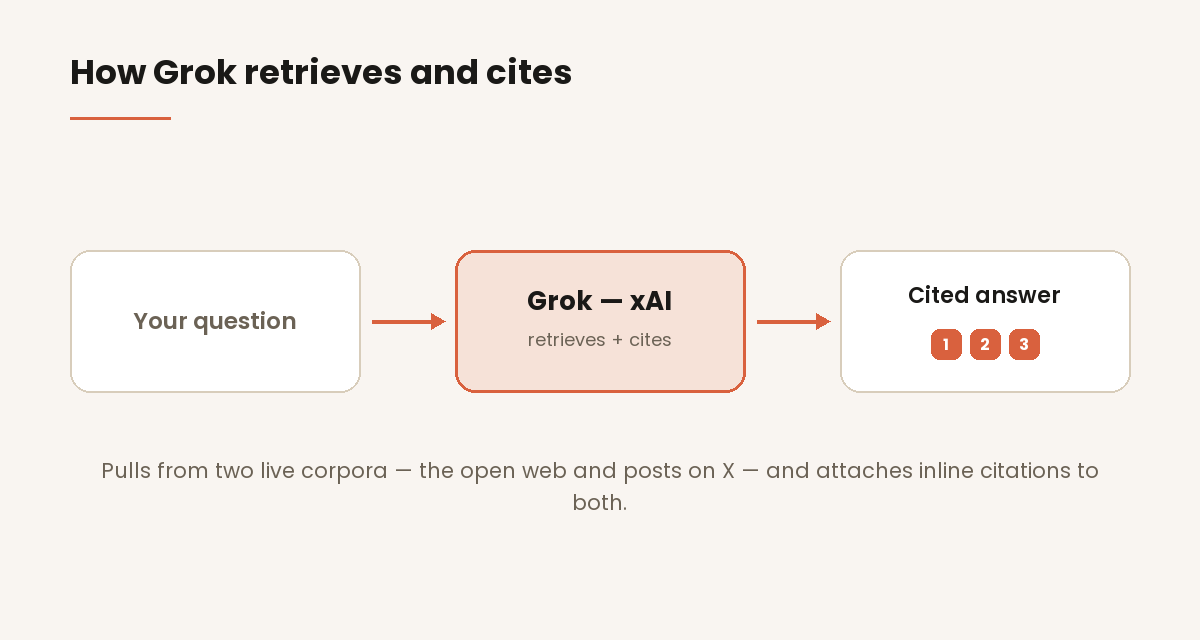
Every AI-citation guide starts by asking whether the engine searches the live web. For Grok, that is the wrong first question — because the answer is bigger. Grok’s Live Search reads the open web and the live X post graph in parallel, then synthesises both into one answer with citations to each (xAI Live Search documentation). xAI’s own launch note put it plainly: with Live Search, “Grok can now search through realtime data from 𝕏, the internet, trending news, and more” (xAI, May 2025).
That is a genuinely different retrieval model. ChatGPT Search and Perplexity retrieve live web pages; Grok retrieves live web pages and the social layer sitting on top of them — the posts, replies, and threads where a topic is actually being discussed right now. For any query with a time dimension — breaking news, product launches, “what are people saying about X”, live events — Grok can pull the primary chatter directly, not a web article summarising it after the fact.
The X integration is not a bolt-on. Grok powers the search experience inside X itself, and is available as a standalone assistant at grok.com and through the Grok mobile apps. So a citation in Grok can surface in three places at once: the standalone chatbot, the apps, and the X interface where hundreds of millions of people already are.
The scale is climbing fast, which is what turns a structural difference into a commercial one:
The strategic consequence: optimising for Grok is not just a subset of your existing GEO work. The web-layer tactics carry over, but there is a second, largely uncontested surface — real-time X presence — where most competitors are doing nothing at all.
How Grok retrieves and cites sources
Grok’s retrieval runs through xAI’s Live Search layer, which the model invokes autonomously — it decides whether to search, when, and which pools to draw from, without the user asking. Understanding the two pools it draws from tells you exactly what to optimise.
The web pool
For web retrieval, Live Search behaves like the other retrieval engines: it searches the internet, accesses pages, and extracts relevant passages to answer with up-to-date content (xAI Web Search docs). Everything that makes a page extractable for ChatGPT and Perplexity makes it extractable for Grok’s web pool — clean server-rendered HTML, a direct answer in the opening sentence of each section, and specific, attributable claims.
The X pool
This is the pool that has no equivalent anywhere else. Grok’s X search supports keyword search, semantic search, user search, and thread fetch across live public posts (xAI X Search docs). At the API layer it exposes controls that reveal how the retrieval thinks: you can target or exclude specific handles (allowed_x_handles / excluded_x_handles, up to 20 each), constrain a search to a date window (from_date / to_date), and let Grok interpret images and video inside posts. The practical takeaway: Grok can and does treat individual X accounts as retrievable, filterable sources — which means your own X presence is a citable corpus, not just a distribution channel.
The citation layer
Grok returns inline citations to the specific pages and posts an answer was built from, and its search results carry citation fragments, URLs, and metadata (xAI Live Search docs). A source has to clear three bars to be cited: it must be discoverable in one of the two pools, fresh enough to satisfy Grok’s recency weighting (which leans hard on live signals), and structured into a passage clean enough to extract. Miss any one of the three and you are invisible to the answer, however good the underlying content is.
Step 1 — The crawler problem: why robots.txt alone won’t get you into Grok
Here is where Grok breaks the pattern the other engines set. For Perplexity you confirm PerplexityBot in robots.txt; for ChatGPT you allow OAI-SearchBot and GPTBot. Both vendors publish crawler documentation with user-agent strings and verifiable IP ranges — Perplexity in its official bot docs, OpenAI likewise. xAI does not.
xAI documents a GrokBot user agent, but it publishes no dedicated crawler page with IP ranges comparable to Perplexity’s or OpenAI’s, and independent crawler-monitoring services report that Grok’s live retrieval traffic frequently arrives under rotating residential IPs and standard browser user agents rather than a declared GrokBot string (AI User-Agent Landscape 2026, No Hacks). The consequence is uncomfortable but important to state plainly: you cannot reliably allow — or block — Grok’s real-time retrieval with a single robots.txt user-agent rule the way you can for PerplexityBot or GPTBot.
What this means in practice:
Do not rely on a Grok-specific allow rule. Instead, make sure your site is broadly accessible to well-behaved crawlers and does not gate main content behind JavaScript rendering, login walls, or aggressive bot filtering. If a WAF or security plugin blocks unfamiliar or datacenter traffic by default — Cloudflare’s AI-bot rules are a common culprit — Grok’s retrieval can be caught in the same net as everything else. Review those rules on the assumption that Grok will not announce itself.
Add a GrokBot allow directive anyway, as a low-cost hedge for any retrieval that does respect the documented user agent:
User-agent: GrokBot
Allow: /
Lean on the X pool to reduce crawler dependence. Because Grok also retrieves from X, a strong, recent X footprint gives Grok a route to cite you that does not depend on its web crawler reaching your pages at all. This is the practical reason the X layer matters so much for Grok specifically — it is partly a hedge against an opaque crawler.
Step 2 — Structure your web content for sentence-level extraction
Grok’s web pool rewards exactly the extractable structure ChatGPT and Perplexity do, so the web-layer work here is not wasted effort — it compounds across all three engines at once.
Lead each section with a flat, declarative answer to the question its heading implies, add the evidence, and finish on a concrete implication. The opening line has to hold up on its own as an attributable claim, because that is where Grok’s web pool is most likely to extract. For the underlying framework, see What Is Generative Engine Optimization (GEO).
Build quotable standalone statements
Grok’s web extraction unit — like ChatGPT’s and Perplexity’s — is the standalone sentence of roughly 15 to 25 words that answers in full. Draft them on purpose. For example:
- “Grok reads the live X post graph and the open web in parallel, making it the only major assistant that cites real-time social posts as first-class sources.”
- “Because xAI publishes no verifiable crawler IP ranges, a strong real-time X presence is the most reliable route into a Grok citation.”
Lines like these are engineered pull-quotes, not warm-up sentences.
Include verifiable statistics with primary sources
Grok’s retrieval weights specific, attributable data. Every statistic should link directly to its primary source — the original study or documentation page, not a roundup that references it. If you cannot link a figure to a primary source, state it as direct analysis instead. A claim carried as your own analysis is more citable than an unsourced percentage — and, as the next section covers, it also insulates you from Grok’s tendency to surface fast-moving claims before they are confirmed.
Step 3 — Win the X layer: build a real-time footprint Grok can cite
This is the step with no equivalent in any other engine’s playbook, and the one where you can earn Grok citations your competitors structurally cannot. Because Grok treats X posts as a retrievable, filterable corpus, your X account is a source Grok can pull from directly.
Post your primary claims and data on X, in your own words. When you publish research, a framework, or a distinctive point of view, restate the core claim as a standalone X post — a self-contained, quotable statement, exactly as you would engineer an extraction point on-page. That post becomes independently retrievable in Grok’s X pool, tied to your handle.
Build handle-level authority on your topic. Grok’s X search can focus on specific handles, and its retrieval favours recency and relevance. An account that posts consistently and specifically about one domain reads as a stronger topical source than an account that posts about everything occasionally — the same topical-consistency logic that governs domain-level web citation, applied to your handle.
Earn engagement on substantive posts. Semantic relevance and freshness drive what Grok surfaces from X, so posts that spark genuine discussion and replies on your topic are more likely to be pulled into an answer than posts that sink without a trace.
Keep your web and X entities consistent. The name, expertise, and links on your X profile should match your site byline and Person schema. Grok is cross-referencing the same entity across both pools; consistency raises the confidence with which it can attribute a claim to you.
Step 4 — Schema and entity signals for the web pool
Schema only governs Grok’s web pool, but there it does real work. Two signals matter most for an engine this recency-biased: an accurate dateModified on your Article markup, so currency-sensitive queries don’t quietly demote you, and — uniquely for Grok — a Person block whose sameAs links include your X profile, tying the web entity Grok reads on-page to the exact handle it reads in the X pool. FAQPage markup keeps its extraction value even after Google deprecated the FAQ rich result. For the field-by-field build, see Structured Data for AI Search.
That cross-pool consistency is the whole entity game for Grok: a named author whose credentials line up across site, X, and LinkedIn is attributed far more confidently than an anonymous byline. For why entities beat keywords across AI search, see Why Entities Matter More Than Keywords for AI Search.
Cross-check Grok’s real-time answers against a citation-first engine
The same trait that makes Grok valuable — reading the live X firehose — is also its biggest reliability caveat, and it is worth building into your process rather than ignoring. Because Grok weights recent social signal heavily, it can surface claims that are fast-moving and not yet verified: a viral post, an unconfirmed report, a number that is circulating before anyone has sourced it. Real-time social access buys you speed at the cost of some certainty.
The practical discipline is simple. Treat Grok as a recency-and-discovery engine — excellent for “what is being said right now” — and cross-check anything load-bearing against a citation-first engine before you act on it. Perplexity is the natural counterweight: it is the most Google-aligned AI assistant, it displays its web sources prominently inline, and it does not lean on a social firehose. If Grok surfaces a claim and Perplexity corroborates it from named web sources, you can rely on it; if only Grok has it, treat it as a lead, not a fact.
This matters for your own content too. The most Grok-citable version of your material is the version that would also survive a citation-first engine’s scrutiny — specific, primary-sourced, and attributable. Writing for verifiability is what lets you benefit from Grok’s speed without inheriting its noise.
How to track when Grok cites you
There is no native Grok dashboard, so tracking is manual plus analytics — and it has to span both surfaces, the web click and the X citation. Run your priority prompts in Grok monthly, at grok.com and inside X, since the two can return different sources; note whether your domain or handle is cited and which competitors show up instead. This is the only way to catch citation presence when no click follows — and because Grok can weight X and web differently, varying the phrasing tells you which surface each piece is winning on.
For clicks, fold grok.com into a custom GA4 AI channel group. The Grok-specific catch: citations surfaced inside the X app rarely pass clean referrer data, and the standalone apps can drop attribution entirely — so, as with ChatGPT’s mobile app, GA4 will undercount your real Grok-influenced traffic. The full channel-group setup is in How to Track AI Referral Traffic in GA4.
FAQ
Does Grok search the web, or just X?
Both, simultaneously. Grok’s Live Search retrieval layer can draw from four live pools — the open web, X (formerly Twitter) posts, news, and RSS feeds — and Grok decides autonomously whether and where to search for a given query (xAI Live Search documentation). Its defining trait is native, real-time access to the live X post graph, which no other major assistant reads as a first-class citation source. For queries with a time dimension, Grok can pull the primary social chatter directly rather than a web article summarising it later.
How do I let GrokBot crawl my site?
Unlike Perplexity and OpenAI, xAI publishes no dedicated crawler documentation page with verifiable IP ranges, and independent monitoring reports Grok’s live retrieval often arriving under rotating residential IPs and browser user agents rather than a declared GrokBot string. You cannot reliably allow or block it with one robots.txt rule. The practical approach: keep your site broadly accessible to well-behaved crawlers (no JS-gated main content, no over-aggressive WAF or Cloudflare AI-bot blocking), add a User-agent: GrokBot / Allow: / directive as a low-cost hedge, and build a real-time X presence so Grok has a route to cite you that does not depend on its web crawler reaching your pages.
What makes getting cited by Grok different from ChatGPT or Perplexity?
The web-layer work is nearly identical — definition-first structure, quotable standalone sentences, FAQ schema, and named-author entity signals win citations across all three. The difference is Grok’s second pool: it reads live public X posts as retrievable, citable sources. That creates a largely uncontested surface where your own X presence — consistent handle, topical posting, primary claims restated as standalone posts — can earn Grok citations that competitors optimising only for the web will never see. See How to Get Cited by ChatGPT and How to Get Cited by Perplexity for the engine-specific web playbooks.
Does Grok show its sources?
Yes. Grok returns inline citations to the specific web pages and X posts an answer was built from, and its search results include citation fragments, URLs, and metadata (xAI Live Search docs). Like a Perplexity citation, a Grok citation is visible attribution rather than invisible influence — which is what makes it both a measurable traffic source and a trackable visibility signal.
Can I trust the answers Grok gives from X?
Treat them with appropriate caution. Because Grok weights recent social signal heavily, it can surface fast-moving claims from X before they are independently verified — a viral post or an unconfirmed number circulating in real time. Use Grok as a recency-and-discovery engine, then cross-check anything load-bearing against a citation-first engine such as Perplexity, which displays named web sources inline and does not depend on a social firehose. If only Grok has a claim, treat it as a lead rather than a fact.
How do I get my X posts cited by Grok?
Post your primary claims and data as standalone, self-contained X posts in your own words — the same “engineered extraction point” discipline you apply on-page. Post consistently and specifically about one topic so your handle reads as a topical authority, since Grok’s X search can focus on individual handles and weights recency and relevance. Earn genuine engagement on substantive posts, and keep your X profile’s name, expertise, and links consistent with your site byline and Person schema so Grok can confidently attribute the claim to the same entity across both pools.
How can I tell if Grok is citing me?
Two methods, both needed because Grok spans two surfaces. First, run your 10–15 priority prompts directly in Grok each month — at grok.com and inside X, since they can return different sources — and record whether your domain or handle appears, which URL or post was cited, and which competitors showed up instead; this captures presence even when nobody clicks. Second, add grok.com to a custom GA4 AI channel group to capture web click-throughs, keeping in mind that citations surfaced inside the X interface and the standalone apps can drop referrer data, so analytics will undercount. See How to Track AI Referral Traffic in GA4 for the setup.
Where is Grok available?
Grok is available as a standalone assistant at grok.com, through the Grok mobile apps on iOS and Android, and directly inside X, where it powers search and assistant features. A single Grok citation can therefore surface across all three surfaces at once — including the X interface, where hundreds of millions of users already are — which is part of why the X layer is so central to a Grok-specific strategy.