 Nadia Mohamed
AI-SEO & GEO
Edtech Marketing Strategy in 2026: Where Course Buyers Actually Search Now
An edtech marketing strategy in 2026 is the plan that gets your course named when a prospective learner asks Google, ChatGPT or Perplexity which course to take, and then makes the course page good enough to close the decision. The channels have not changed much. What has changed is where the shortlist is made: increasingly inside an AI-written answer, before anyone clicks a result.
This article covers where course buyers search now and what the evidence actually says, why the usual edtech marketing checklist misses that shift, and what two edtech engagements on this site show about the technical layer underneath. It ends with a six-part strategy and what an AI implementation engagement for an edtech team looks like in practice.
Key takeaways
- Course buyers still start on Google, but many read the AI answer first. In one 2025 survey of prospective higher-education students, half used AI tools weekly and most read AI Overviews before clicking a result.
- “Best course for X” queries are long, comparative questions, which is exactly the query shape that triggers AI answers and gets fanned out into sub-searches.
- There is no special AI markup. Google says a page must be indexed and eligible for a snippet to be cited in AI Overviews or AI Mode, so the technical foundation is the entry ticket.
- Course pages are the unit that gets cited. Outcomes, duration, price, format and prerequisites belong in visible text, consistent everywhere the course is listed.
- Measure the shift directly: AI referrals as their own channel in analytics, plus a monthly prompt check of which providers each assistant names for your category.
Where course buyers actually search now
The honest answer is “in more places than before, and Google is still one of them”. The change is less a move away from Google than a move of the decision point from the list of blue links to the answer above them.
Google is still the front door, but the answer sits above the links
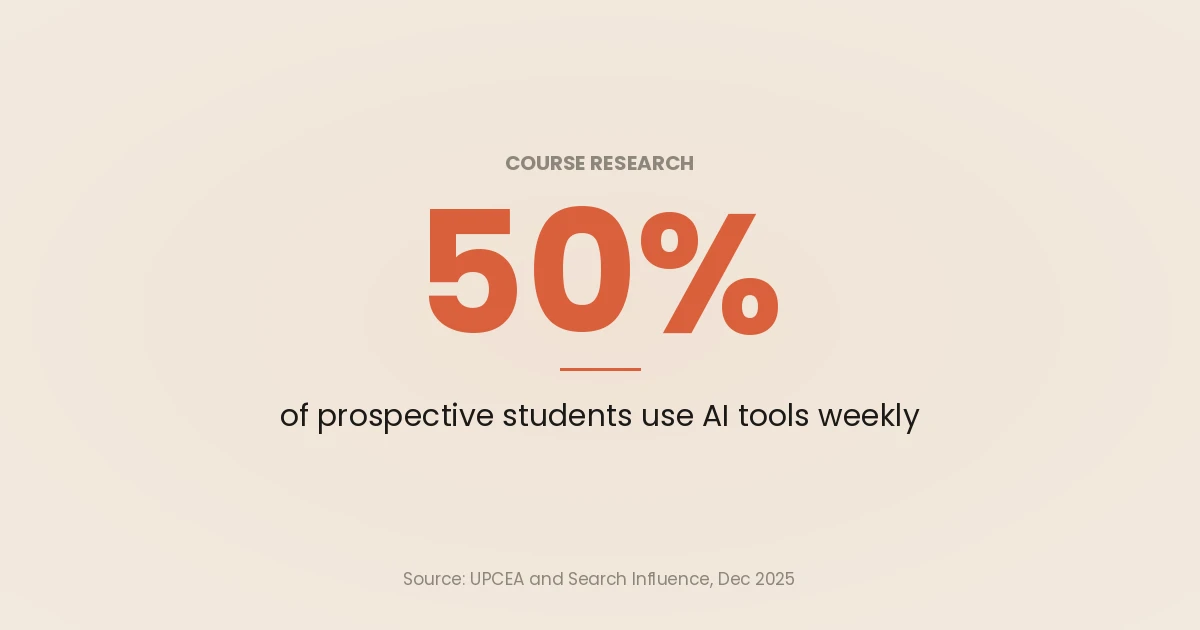
The most specific data on course buyers comes from higher education. In research from UPCEA and Search Influence, 50% of prospective students said they use AI tools weekly and 79% said they read Google’s AI Overviews before clicking any result. The same study found 84% still use search engines to research programmes, 61% use YouTube and 50% use AI tools. It is a survey of prospects for US higher education, published with an AI SEO agency that sells this work, so treat the percentages as directional for other edtech segments rather than as a benchmark.
The scale on Google’s side is not in doubt. At Google I/O 2026 (19 May 2026) Sundar Pichai said AI Overviews “now has over 2.5 billion monthly active users” and, of AI Mode, that “in just a year, it’s already surpassed 1 billion monthly active users” (Google’s keynote transcript).
What that does to clicks is where the evidence gets thinner. Pew Research found users clicked a traditional search result on 8% of visits where an AI summary appeared, against 15% where one did not (Pew Research Center, July 2025). That is panel browsing data from US adults collected in March 2025, and it compares searches that had an AI summary against searches that did not, which are different query populations rather than the same queries measured before and after. The same Pew analysis found AI summaries appeared on 53% of searches of 10 words or more and on 60% of searches that began with a question word, against 8% of one- or two-word searches.
”Best course for X” is the query shape AI answers were built for
That last finding matters most for edtech. Nobody searching for a course types two words. They type “best online UX design course for career changers with a full-time job” or “is a data analytics bootcamp worth it in 2026”. Those are long, comparative, question-shaped queries, the kind that most often produce an AI answer.
Google says AI Mode is particularly helpful for “queries where further exploration, reasoning, or complex comparisons are needed”, and says both AI Overviews and AI Mode may use a “query fan-out” technique that issues multiple related searches across subtopics (Google Search Central, AI features and your website). A course comparison is fanned out into sub-questions about price, duration, job outcomes, accreditation and reviews. Each sub-question is a chance for a different page to be cited, and a course page that answers none of them clearly is not in the running. The explainer on what AI Overviews are covers the mechanics in more depth.
Verification still happens on your site
The same UPCEA research found 56% of prospects were more likely to trust brands cited by AI, and 77% trusted university websites most when confirming information. The pattern is a loop: the AI answer builds the shortlist, and the provider’s own page confirms or loses the decision. Both halves are marketing problems, and both are technical problems.
Why the standard edtech marketing strategy misses the shift
Read the pages that currently rank for “edtech marketing strategy” and you get the same list: content marketing, SEO, email nurture, paid search, social, webinars, free trials, case studies. None of that is wrong. Most of it is written for selling to schools and districts, and none of it explains how a course gets named in an answer that the buyer reads before visiting anyone.
The gap is not a missing channel. It is that every channel now feeds, or fails to feed, the same answer engines. Here is how the familiar channels change when the shortlist is made inside an AI answer.
| Channel | What the old playbook measures | What changes when the shortlist is an AI answer |
|---|---|---|
| SEO | Rankings and clicks for head terms | Whether course pages are indexed, rendered and answer the fan-out sub-questions in plain text |
| Content marketing | Traffic to blog posts | Whether comparison and outcome content is specific enough to be quoted, with named authors and dates |
| Reviews and communities | Star ratings on the provider’s own site | Third-party reviews, forum threads and videos that assistants read when asked “is it worth it” |
| YouTube | Views and subscribers | Course walkthroughs and graduate stories as citable sources, since prospects use YouTube to research |
| Paid search | Cost per lead | Unchanged mechanics, but brand search volume becomes a signal of AI-driven demand |
| Analytics | Organic sessions and conversions | AI referrals as a separate channel, plus prompt-level visibility that analytics cannot see |
The B2B version of this shift is covered in how AI search reshapes the B2B buying journey. Edtech has the same structure with a different buyer: an individual weighing a large personal spend, which is exactly the decision people now talk through with an assistant.
What CareerFoundry shows about the foundation
The strongest argument for putting the technical layer first comes from the CareerFoundry engagement: a multi-year role as the engineering counterpart to an edtech marketing team. The work covered CMS migrations, a structured data rollout across course, article, organisation and breadcrumb templates, Core Web Vitals, and international SEO architecture across regions.
The documented outcome is 340% growth in organic traffic over multiple years, with no traffic lost through migrations. The split of responsibilities is the point. The marketing team owned content strategy, editorial and on-page SEO. The engineering side made sure the infrastructure underneath never became the bottleneck.
To be precise about what that proves: the 340% was measured as organic search traffic, not as AI citations. What it demonstrates is that editorial output compounds only when the foundation holds, through migrations, new markets and template changes. That foundation is exactly what AI features now draw on. Google’s own documentation says there are “no additional technical requirements” for appearing in AI Overviews or AI Mode beyond being indexed and eligible to be shown with a snippet (Google Search Central). The team that already has clean rendering, stable URLs and structured data is the team that is eligible.
The technical layer: what the learning-platform audit found
The second engagement is the opposite shape. The multilingual learning platform audit was a fixed three-week structural review of a headless platform serving learners across eleven locales.
The foundation was sound. Server-side rendering was clean across every template, hreflang reciprocity was perfect within declared pairs, and the canonical layer was unusually clean. The headline finding was that the site emitted no structured data anywhere, on any template, in any locale. The structured data rollout became the spine of the action plan, sequenced as a sitewide foundation first, then high-traffic templates, then specialised layers.
That combination is common in edtech: a well-engineered product with a marketing surface nobody has specified. Three parts of the technical layer decide whether course pages can compete in AI answers.
Course pages must render as text
If the course outcomes, syllabus and price live in a JavaScript widget or a PDF, the crawler that feeds the answer may never see them. Google’s AI features guidance lists “making sure that important content is available in textual form” among the fundamentals (Google Search Central). The JavaScript SEO guide covers how to check what a crawler actually receives.
AI search crawlers must be allowed in
Blocking AI training crawlers is a reasonable choice. Blocking AI search crawlers by accident is not, and it happens when a blanket rule or a CDN bot setting catches everything. OpenAI says sites opted out of OAI-SearchBot “will not be shown in ChatGPT search answers”, and that each of its bot settings is independent, so a site can allow OAI-SearchBot while disallowing GPTBot (OpenAI crawler documentation). Perplexity recommends allowing PerplexityBot to appear in its search results and notes that it may take up to 24 hours for robots.txt changes to be reflected (Perplexity crawler documentation). For Google, robots.txt directives for Googlebot are the control for AI features in Search, and Google-Extended covers some of Google’s other AI systems (Google Search Central).
A robots.txt that keeps course pages visible to AI search while opting out of training looks like this:
# Search and answer engines: allowed
User-agent: Googlebot
Allow: /

User-agent: OAI-SearchBot
Allow: /

User-agent: PerplexityBot
Allow: /

# Model training: opted out
User-agent: GPTBot
Disallow: /

User-agent: Google-Extended
Disallow: /

User-agent: *
Allow: /
Disallow: /account/
Disallow: /checkout/
Then check the firewall. Perplexity’s documentation includes WAF rules for Cloudflare and AWS precisely because bot protection often blocks what robots.txt allows. The robots.txt guide for developers covers precedence rules and the other AI user agents.
Structured data: know which rich results still exist
Course markup has changed under edtech teams’ feet. Google’s documentation log records that on 9 September 2025 it removed the documentation for course info structured data, along with estimated salary, learning video, special announcement and vehicle listing, because “these structured data types are no longer shown in Google Search results” (Google Search Central documentation updates).
The course list rich result is still documented. As of September 2026 it is available in English, requires at least three courses marked up, needs name and description on each Course (with provider recommended), and needs ItemList markup on a summary or all-in-one page (Google’s Course list documentation). A course detail page carries markup like this, with the summary page listing it in an ItemList:
{
  "@context": "https://schema.org",
  "@type": "Course",
  "name": "UX Design Foundations",
  "description": "A 12-week part-time course in user research, wireframing and usability testing.",
  "url": "https://www.example.com/courses/ux-design-foundations/",
  "provider": {
    "@type": "Organization",
    "name": "Example Academy",
    "sameAs": "https://www.example.com/"
  }
}
Rich results aside, markup is how you state the course’s facts in a form a machine cannot misread, and Google asks that structured data match the visible text on the page. The Course schema guide has full examples, including the list page and the properties worth adding beyond Google’s minimum.
Multilingual platforms multiply every gap
A platform in eleven languages has eleven versions of every missing fact. Hreflang tells search engines which locale to show; it does not fix a course page that answers the price question in English and not in German. The hreflang implementation guide covers the architecture side, and the custom edtech software specification covers what to put in the brief before a platform is built.
An edtech marketing strategy for 2026 in six workstreams
This is the order I would run it in for a course provider or a learning platform that sells to individuals. Schools-and-districts sales motions need the same technical layer but a different prompt set.
1. Map the prompts your buyers actually ask
Write down 30 to 50 questions a prospective learner in your category would ask an assistant: “best”, “vs”, “is it worth it”, “how long does it take”, “can I do it alongside a job”, “which course for a career change into X”. Run them monthly in ChatGPT, Perplexity, Gemini and Google AI Mode, and record which providers are named and which pages are cited. The method is set out in checking whether your business appears in ChatGPT and Perplexity.
2. Make every course page answer the fan-out questions
Each course page should state, in visible text: who it is for, the outcome, duration and weekly hours, format, start dates, total price and payment options, prerequisites, and what happens after completion. The UPCEA research makes the same point about consistency: details that differ between the catalogue, the landing page and external listings give an assistant a reason to skip or misstate the course. One source of truth for course facts, published everywhere from the same data, is the fix.
3. Fix eligibility before content
Crawlable, rendered, indexed, fast, with structured data that matches the page. This is the layer from the two case studies, and it is the one most marketing plans assume is already done. Phase 2 (technical and crawl health) and Phase 8 (GEO and AI search) of the 12-phase SEO and GEO audit cover it in detail.
4. Build the evidence assistants look for elsewhere
“Is it worth it” answers are assembled from reviews, forum threads, graduate stories and videos, not from your landing page. Encourage reviews on the platforms your category uses, publish graduate outcomes with enough detail to be quoted, and treat YouTube walkthroughs as research material rather than brand content. The patterns are covered in how Reddit threads earn AI citations and YouTube and AI citations.
5. Measure AI as its own channel
Google counts traffic from AI Overviews and AI Mode inside the overall “Web” search type in the Search Console Performance report (Google Search Central). Referrals from ChatGPT, Perplexity and other assistants can be split out in GA4 with a custom channel group, set up as described in the AI referral traffic tracking guide. Pair that with the monthly prompt check, and watch branded search impressions as a rough proxy for demand that started in an assistant.
6. Keep the classic channels, pointed at the new shortlist
Email nurture, paid search, webinars and partnerships still convert. What changes is the brief: nurture content should answer the same comparison questions the assistants are asked, and paid search budgets should protect the branded terms that people search after an assistant has named the course.
What an AI implementation engagement for an edtech team looks like
Most edtech teams do not lack ideas for AI search. The UPCEA snap poll of 30 member institutions found 30% had a formal AI search strategy and 70% cited competing priorities or limited bandwidth as a barrier (UPCEA). The gap is implementation capacity, which is why this work is best scoped as an engagement with an end date rather than an open-ended retainer.
A typical shape, based on how the engagements above were run:
- Baseline, week one. The prompt matrix run across four assistants, a crawl and render check of the course templates, a robots.txt and firewall review for AI crawlers, and the analytics channel set-up so there is a before number.
- Course page template, weeks two to three. One template fixed properly, with visible course facts, structured data that matches them, and a single course-data source the template reads from, so the same facts reach the page, the listings and the markup.
- Tooling. Small internal tools that keep the work going after handover, for example an automated monthly prompt run that logs which providers each assistant names, or a check that flags when a course page’s price or dates drift from the source of truth. The free AI tools on this site show the scale of tool this means.
- Handover. Documentation, a working session with the marketing and engineering owners, and a clear split of who maintains what, the same marketing-and-engineering split that made the CareerFoundry work compound.
If your team has the strategy but not the engineering time to ship it, the AI tools and software service is where the build side of that engagement lives.
Frequently asked questions
What is an edtech marketing strategy?
An edtech marketing strategy is the plan for how a learning product gets found, shortlisted and chosen by learners, schools or employers. In 2026 it has to cover AI-written answers as well as classic search results, because many prospects read an AI Overview or ask an assistant before visiting any provider’s site. The channels are familiar; the difference is that course pages must be eligible and specific enough to be cited.
Do students really use ChatGPT to choose courses?
The best course-specific data comes from higher education. UPCEA and Search Influence reported that half of prospective students use AI tools weekly and most read Google’s AI Overviews before clicking a result. It is a single survey with a commercial partner, so treat it as directional, but it matches what a monthly prompt check will show you for your own category.
Is Course schema still worth adding?
Yes, with the right expectations. Google retired the course info rich result in September 2025, but the course list rich result is still documented for English results. More importantly, structured data states a course’s name, provider and description in a form machines cannot misread, as long as it matches the visible page.
How do I know whether AI assistants recommend my courses?
Run a fixed set of 30 to 50 buyer questions in ChatGPT, Perplexity, Gemini and Google AI Mode every month and record which providers are named and which pages are cited. Track the share of answers that name you against your three closest competitors. Analytics alone cannot show this, because a buyer who reads an answer that names a competitor never visits your site.
Does AI search replace SEO for edtech companies?
No. Google says a page only needs to be indexed and eligible for a snippet to appear in AI Overviews and AI Mode, and there are no additional technical requirements. The SEO foundation is the entry ticket; what changes is that specific, consistent course facts and third-party evidence decide which eligible provider is named.