 Nadia Mohamed
AI-SEO & GEO
Does Your Business Appear in ChatGPT and Perplexity?
How do you check if your business appears in ChatGPT and Perplexity?
Checking whether ChatGPT, Perplexity, Claude, and Google AI Overviews cite a business requires three layers of measurement run together: a manual prompt matrix run monthly across all four engines to record citations directly, an AI source channel group in GA4 to measure the downstream traffic those citations produce, and an LLM-readiness content score on the priority pages that surface the structural gaps causing missing citations. None of the three is sufficient on its own — citation visibility, traffic attribution, and content scoring measure different parts of the same pipeline.
TL;DR — Key takeaways
- All four major LLMs now do live retrieval, not static training-data lookup. ChatGPT Search launched 31 October 2024 via Bing, Perplexity and Claude have always done live retrieval, and Google AI Overviews uses Google’s own index. Checking AI visibility is checking what the live retrieval pipelines surface right now, not what the training corpora memorised.
- The manual prompt matrix is the most direct measurement available and works with a spreadsheet alone: 20+ priority prompts, run monthly across ChatGPT, Perplexity, Claude, and Google AI Overviews, with citation frequency and competing-source list recorded each cycle.
- Standard GA4 does not separate ChatGPT, Perplexity, Claude, and Gemini referrals from broader organic / referral channels — a custom AI source channel group is required to attribute the downstream traffic that citation visibility produces.
- AI-referred traffic converts above organic on both published measurements, neither of which generalises — the benchmarks and their limits. Previsible measured ChatGPT at 92.4% of standalone LLM referral share across 6.77M sessions — excluding Google AI Overviews and AI Mode. The traffic that AI citation produces converts at materially higher rates than equivalent organic search traffic.
- The AEO Analyzer at aeo-analyzer.nadiamohamed.me scores individual pages for the structural properties LLMs cite — schema validity, entity signals, FAQ extractability, original data presence. It is a pre-publication and gap-analysis tool that complements the prompt-matrix measurement (sign-up required, three free analyses per month).
How each engine actually retrieves content in 2026
The widespread assumption that ChatGPT works from a static training-data snapshot is no longer correct. ChatGPT Search launched 31 October 2024 and now performs live web retrieval via Bing’s search infrastructure for any query the model judges to require current information. Perplexity has always done live retrieval through its own crawler. Claude added web search in March 2025 through Anthropic’s retrieval infrastructure. Google AI Overviews runs entirely on Google’s own index.
The practical implication for checking AI visibility: all four engines respond to the current state of the public web within the propagation window of their retrieval crawlers (typically 4–12 weeks for new content to appear consistently in citations, faster for sites with established entity signals). The “pre-2023 web presence” framing that dominated early generative engine optimization advice is outdated for 2026 — what matters now is the live retrieval pipeline, not the training corpus.
The four engines still differ in their retrieval and citation behaviour:
- ChatGPT (Search mode) retrieves via Bing and cites sources inline. ChatGPT’s citation pattern weights brand mentions, schema-validated content, and topical authority signals — all of which can be improved through deliberate optimisation.
- Perplexity retrieves via its own crawler and is the most aggressive citer of the four, attaching numbered citations to nearly every claim. Ahrefs’ 15,000-prompt study measured 28.6% overlap between Perplexity citations and Google’s top 10 — the highest of any LLM tested. Perplexity rewards content that ranks in traditional search but also draws from a broader pool of sources than Google does.
- Claude (web search) retrieves through Anthropic’s infrastructure and cites less aggressively than Perplexity but more transparently than ChatGPT in conversational mode.
- Google AI Overviews draws citations almost entirely from Google’s own index. In a March 2026 Ahrefs update, 38% of AI Overview citations came from pages already ranking in Google’s top 10, where “top 10” means the first 10 SERP blocks rather than organic positions 1-10 — down sharply from the 76% Ahrefs measured in mid-2025, after Google made Gemini 3 the AI Overviews default. Strong technical SEO still improves AI Overview citation eligibility, but the top-10 overlap is looser than it was a year ago.
The cross-engine baseline measured in the Ahrefs study: an average of 12% AI–Google overlap across all four engines, with ChatGPT lowest at 8% and Perplexity highest at 28.6%, measured on long-tail prompts and on standalone assistants rather than AI Overviews, where the same dataset put overlap at 76%. AI citation is partly a Google ranking proxy and partly a separate discipline, and the proportion depends on which engine is being optimised for.
The manual prompt matrix — baseline measurement
The most direct measurement available for AI visibility is the manual prompt matrix: a documented set of priority prompts run monthly across the four engines, with citation results recorded in a spreadsheet. The methodology requires no tooling beyond browser access to the four engines and 60–90 minutes per monthly cycle.
The structure of the prompt matrix:
- Identity prompts — exact business name, business name plus location, business name plus primary service. Test whether the engines correctly identify the business and what credentials and services they report.
- Service / category prompts — “Best [service] in [city]”, “Top [service category]”, “Who provides [service]”. Test whether the engines surface the business in category-level recommendations without the brand being named in the prompt.
- Problem prompts — “How to [solve problem the service addresses]”, “Best way to [achieve outcome]”, “Who can help with [specific challenge]”. Test whether the engines route problem-stage prompts to the business.
- Comparison prompts — “[Business] vs [competitor]”, “Alternatives to [major competitor]”, “Best [category] companies compared”. Test whether the engines include the business in side-by-side comparisons.
- Expertise prompts — “[Industry] expert advice”, “How to choose [service type]”, “[Industry] best practices”. Test whether the engines treat the business as an authoritative voice on the topic.
For each prompt, record four data points: (1) was the business cited at all, (2) what position in the cited source list, (3) which competing sources were cited alongside, (4) what specific information the engine attributed to the business. Run the same prompt set every month and track the trajectory. Improvement is measured as gap closure — the share of priority prompts where the business is cited divided by the total priority prompt set.
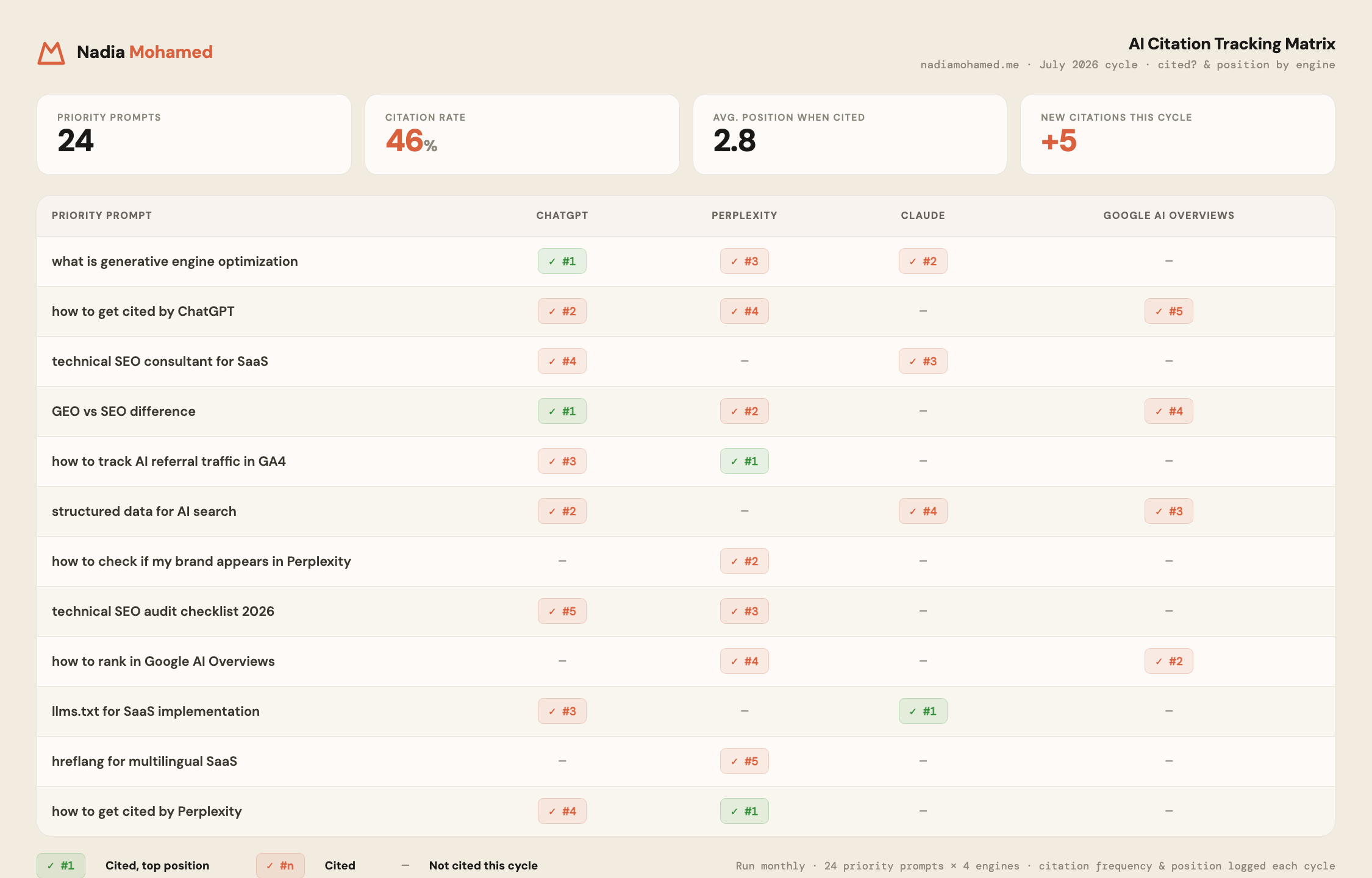
/assets/screenshots/prompt-tracking-matrix.png The Prompt → Content Gap Matrix that Phase 8 of the 12-phase audit framework formalises is this same methodology applied at engagement scale, with prompt sets calibrated to the business’s ideal customer profile and tested across 4 platforms × 20+ prompts.
AEO Analyzer — page-level content scoring
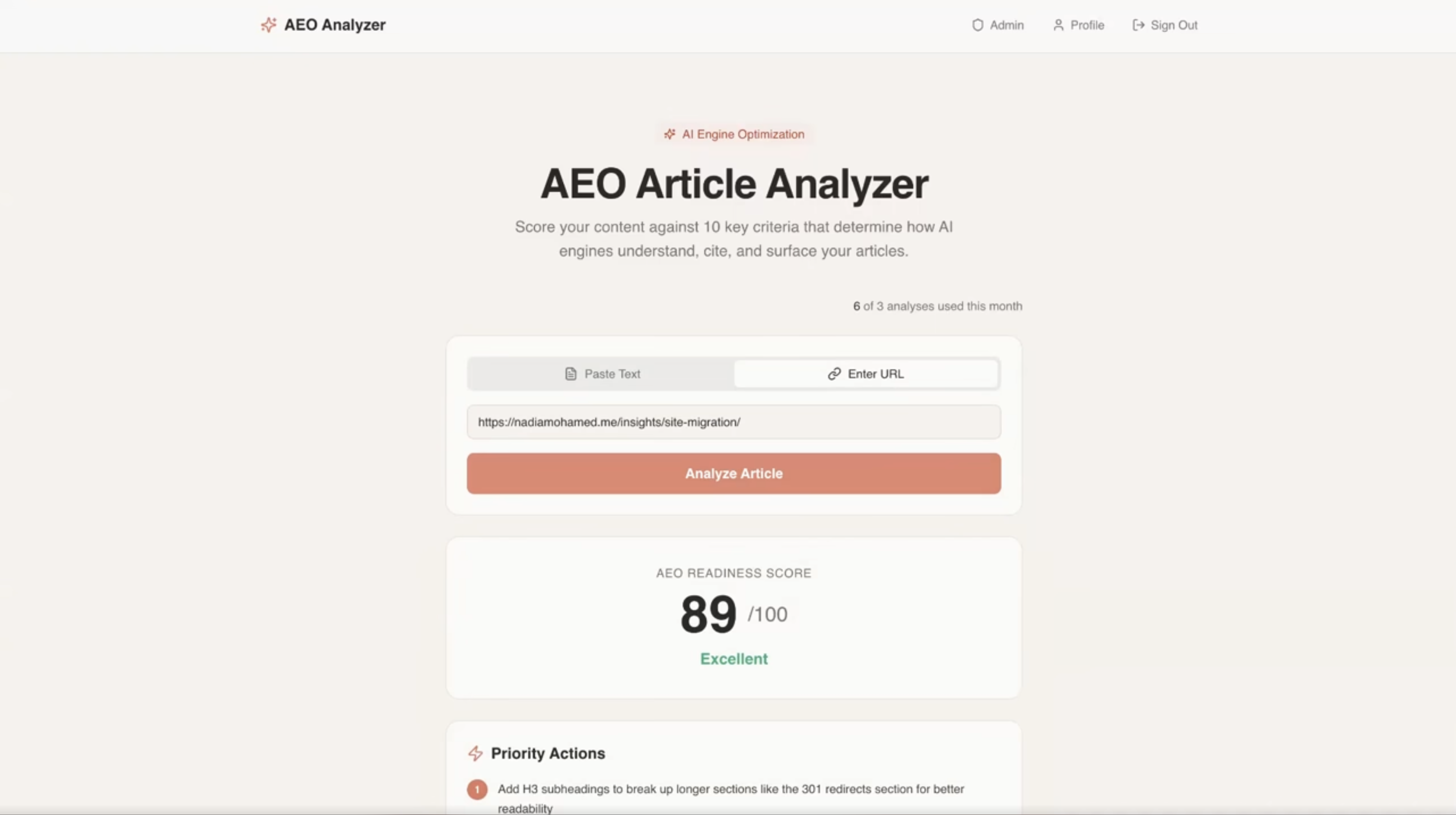
The manual prompt matrix measures whether citation is happening. It does not directly identify which structural properties of the source pages are limiting citation. For that gap analysis the AEO Analyzer scores individual URLs against the patterns most consistently associated with AI citation: valid schema markup, FAQ extractability, Person entity signals, original data anchors, freshness, and question-led structure.
These properties are the ones that most consistently recur across cited content: comprehensive structured data helps AI systems parse and attribute content, removing ambiguity that can otherwise prevent citation; cited content frequently quotes recognised, credentialed experts; pages with original data are cited substantially more often than pages without; and recently updated content earns more citations. Each is one of the structural properties the AEO Analyzer scores against.
The tool produces a per-URL score, identifies the specific structural gaps relative to that pattern, and lists the deployable fixes in priority order. Sign-up required (three free analyses per month). The AEO Analyzer complements the prompt matrix: the matrix measures the outcome (citation), the analyzer measures the inputs (the structural properties that determine citation).
/assets/screenshots/aeo-analyzer-result.png GA4 AI source channel group — downstream traffic attribution
The third measurement layer is downstream traffic attribution. Standard GA4 does not separate ChatGPT, Perplexity, Claude, and Gemini referrals from the broader organic and referral channels by default, which means the traffic AI citation produces is invisible in default reporting. The fix is a custom AI source channel group that isolates the LLM referrer hosts into a single attribution bucket.
The custom channel group uses a regex match against the source/medium dimension to catch all four major engines plus the emerging ones: chatgpt.com, chat.openai.com, perplexity.ai, claude.ai, gemini.google.com, bing.com with AI source parameters, and the oai-searchbot user agent. The full regex pattern and the GA4 setup steps are documented in the GA4 AI tracking piece.
Once the channel group is live, AI-referred traffic appears as its own row in GA4’s acquisition reports and can be attributed against the same conversion goals as the broader organic channel. The Microsoft Clarity data published via Digiday across 1,200 sites measured LLM referral traffic converting to sign-ups at 1.66% versus 0.15% for search referrals — the cluster benchmark to evaluate AI-referred conversion against.
Why a business does not appear in ChatGPT and Perplexity
The recurring root causes, in order of frequency:
- Missing or invalid schema. Pages without Article, FAQPage, Person, or Organization schema produce no machine-readable signal for the AI engine to extract. Valid schema gives AI systems a cleaner signal to parse and attribute, resolving the ambiguity that would otherwise keep the page out of the cited set. The schema layer is documented in the schema markup foundation piece.
- Entity resolution failure. AI engines try to resolve the byline to a known entity in their knowledge graph. Anonymous “Admin” bylines, inconsistent name representation across platforms, or missing Person schema with a populated
sameAsarray all break the entity resolution and degrade citation confidence. The mechanics are in the E-E-A-T for AI search piece. - NAP inconsistency for local businesses. Different addresses on Google Business Profile versus the website, varying service descriptions across directories, conflicting contact information. AI engines doing local query retrieval use NAP consistency as a verification signal.
- Content depth insufficient for citation candidacy. Thin service pages with no FAQ, no original data, no schema, and no author attribution provide insufficient context for the AI engine to evaluate the source against competing candidates.
- Missing question-led structure. Articles structured as topic-led blog posts (“Our approach to marketing”) rather than question-led answers (“What does a marketing audit cover?”) fail to map to the prompts users bring to AI engines.
None of these are insurmountable. Each maps to a deployable fix at the schema, entity, content, or NAP layer — the substance of a GEO and technical SEO engagement. The step-by-step GEO audit checklist walks the layers in implementation order, and the 12-phase audit framework places the work inside a sequenced engagement that also covers technical SEO, content architecture, and tracking.
What specific prompts to test against
The prompt set that produces actionable signal is calibrated to the actual prompts a target customer would bring to an AI engine, not to keyword research from traditional SEO tools. The structural rule: write prompts the way a real user would write them, not optimised for search volume.
For service businesses
- Problem prompts: “How to [solve problem the service addresses]”, “Best way to [achieve outcome the service provides]”, “Who can help with [specific challenge]”.
- Comparison prompts: “[Service] vs [alternative approach]”, “Alternatives to [major competitor]”, “Best [industry] companies compared”.
- Location prompts: “[Service] near me”, “Best [industry] in [city]”, “Top [service] [region]”.
- Expertise prompts: “[Industry] expert advice”, “How to choose [service type]”, “[Industry] best practices”.
For product businesses
- Category prompts: “Best [product category] 2026”, “[Product category] reviews and recommendations”, “Top [product type] for [specific use case]”.
- Feature prompts: “[Product category] with [specific feature]”, “[Product type] for [target audience]”, “Most reliable [product category]”.
For each prompt run in both ChatGPT and Perplexity, document which businesses appear and the reasoning the engine provides for its recommendations. The reasoning is itself valuable signal — it reveals the criteria the engine surfaces, which can be reinforced or contradicted by the source content.
How often to monitor AI visibility
The cadence that captures meaningful signal without producing noise:
- Monthly — full prompt matrix across the four engines for the 20+ priority prompts. Track citation count, citation position, and competing-source list each cycle.
- Quarterly — expanded prompt set including emerging query patterns, plus a full AEO Analyzer scoring pass on the priority pages.
- After major changes — website redesigns, content overhauls, new service launches, press coverage, location changes — run an immediate matrix to baseline against the pre-change cycle and catch regressions early.
Weekly monitoring produces noise rather than signal for most businesses because the AI engines’ retrieval pipelines do not propagate changes that fast — schema and content updates take 4–12 weeks to fully reflect in citation behaviour, and the AI Overview side has additional volatility (Conductor measured AI Overview presence shifting from 23% in September 2025 to 47% in January 2026 to 34% in February 2026 across tracked queries). Monthly cycles capture the propagation; weekly cycles catch the noise.
How to track (monitor) your brand’s mentions and citations in Perplexity and ChatGPT
Checking whether you appear in AI answers once is a snapshot. Tracking — monitoring continuously — is the discipline that catches when a citation appears, disappears, or shifts to a competitor. A one-time check tells you where you stand today; ongoing tracking tells you whether the structural work is moving the needle and alerts you when Perplexity or ChatGPT swaps your source URL out for someone else’s. There are three ways to do it, in ascending order of cost and automation. For the statistics behind the matrix, how many prompts and repeats you need before a change in citation share means anything, see the AI share of voice methodology.
1. Manual prompt-set monitoring (free). Run the same 20+ priority prompts across ChatGPT, Perplexity, Claude, and Google AI Overviews every month and log the results in a spreadsheet — the manual prompt matrix described above. For each prompt, record whether you were cited, at what position, and which competing sources appeared. Perplexity makes this easiest because it attaches numbered, clickable citations to nearly every claim, so you can see the exact source URL it pulled from. This is the only method that costs nothing and it remains the ground truth the paid tools are approximating.
2. Tracking which source URLs Perplexity cites. The question most people actually want answered — “how can I see which source URLs Perplexity cites?” — is answered directly inside Perplexity’s own interface: every answer lists its numbered sources with the exact page URLs it retrieved. Log those URLs against each prompt in your matrix so you can see whether Perplexity is citing your homepage, a specific blog post, or a third-party directory that mentions you. On the traffic side, pair this with a GA4 AI source channel group so you can measure the referral clicks those citations actually drive, not just the citation itself.
3. Dedicated AI-visibility tracking tools. When manual monitoring stops scaling — more prompts, more engines, daily cadence, competitor benchmarking — a purpose-built tracker automates the prompt runs and stores the history. The credible options as of July 2026, with verified pricing:
- Ahrefs Brand Radar — tracks brand mentions (named in the answer) and citations (linked as a source) daily across ChatGPT, Gemini, Perplexity, Copilot, Google AI Overviews, and AI Mode, benchmarks share of voice against competitors, and surfaces top cited pages and domains. It is an add-on to an Ahrefs subscription at $398/month for the Select-platforms tier or $699/month for all platforms, each including 2,500 custom-prompt checks. Ahrefs also runs a free AI Visibility Checker for a one-off spot check with no signup.
- Otterly.ai — you build a prompt library, and it runs those prompts across six engines (Google AI Overviews, ChatGPT, Perplexity, Google AI Mode, Gemini, Copilot), reporting a brand-visibility index, link citations, and competitor comparison. Lite is $29/month for 15 prompts, Standard $189/month for 100 prompts, Premium $489/month for 400 prompts.
- Peec AI — prompt-based tracking across ChatGPT, Perplexity, and Google AI Overviews with daily updates, competitor benchmarking, and unlimited seats. Starter is roughly $89–95/month for the entry prompt allowance, scaling to a Pro tier around $199/month.
- Profound — an enterprise answer-engine-optimization platform (used by larger brands for high-volume monitoring). Pricing is sales-led; public references cite a $99 Starter and $399 Growth tier, with enterprise deployments typically $2,000+/month.
The rule of thumb: if you track fewer than ~20 prompts on one or two engines, manual monitoring in a spreadsheet is genuinely sufficient and free. Reach for a paid tool when you need daily cadence, more than a handful of engines, or competitor share-of-voice comparison — the automation is what you are paying for, not a fundamentally different measurement. Tracking is only half the job, though: once monitoring shows a gap, the fix is structural, and the step-by-step guide to getting cited by Perplexity walks the specific changes that move a source into the citation set.
What to do when the business is not cited
The fix sequence that produces the largest citation lift per unit of work:
- Deploy schema baseline. Article, FAQPage, BreadcrumbList, Person, and Organization schema at template level. Validate via Google’s Rich Results Test — and check FAQPage markup in the Schema.org validator, which covers it now that Google removed FAQ from the Rich Results Test in June 2026. Machine-readable markup makes a page easier for AI engines to attribute confidently.
- Reinforce the entity layer. Person schema on the About page with at least three independent
sameAsURLs (LinkedIn, Wikipedia, GitHub, ORCID, major media bylines). Consistent name representation across all external profiles. Article author references to the Person entity by@id, not duplicated inline. - Add FAQ blocks to priority pages. 4–10 question-answer pairs per priority page, formatted with rendered FAQPage schema, each answer self-contained between 40–150 words.
- Restructure topic-led pages to question-led. Each H2 is a question or noun phrase that maps cleanly to one. Open with the direct answer in a definition block, then elaborate.
- Publish original data. First-party data is cited far more than secondary summaries. Original analysis from direct work, methodology papers, comparative measurements — data that competitors cannot replicate by summarising secondary research.
- Tighten NAP consistency for local queries. Match Name / Address / Phone exactly across Google Business Profile, on-page LocalBusiness schema, directory listings, and the social profile bios in the
sameAsarray. - Set up the GA4 AI source channel group so the downstream traffic from the citations becomes measurable.
Re-run the prompt matrix monthly. The first measurable improvements typically appear at 4–8 weeks; meaningful citation pattern shifts usually appear by 8–16 weeks as the AI engines re-crawl and re-resolve the entity signals.
For the platform-specific playbooks behind this fix sequence — the deeper, engine-by-engine optimisation work — see how to get cited by Perplexity and how to get cited by ChatGPT.
Frequently asked questions
How accurate is the business information that appears in ChatGPT and Perplexity?
Accuracy varies by engine and by the consistency of the business’s own web presence. ChatGPT Search (since 31 October 2024) and Perplexity both do live retrieval, so they tend to return current information when the source pages are themselves current. Inaccuracies typically trace back to inconsistent NAP data across the open web, missing schema that would clarify the business entity, or outdated content on the business’s own site that the engines are dutifully extracting. The fix is to update the upstream sources — the website, Google Business Profile, directories, and social profiles — rather than to try to correct the engines directly.
Can I request removal of incorrect business information from AI search results?
None of the major LLMs offers a direct removal process equivalent to Google’s content removal tools. The most effective approach is the upstream fix: update the incorrect information at every source where it currently appears (the business’s own website, Google Business Profile, directory listings, press releases that may be cached), then re-test the engines monthly to verify the corrected information propagates. Live retrieval-based engines (ChatGPT Search, Perplexity, Claude, Google AI Overviews) typically reflect upstream corrections within 4–12 weeks of the source content being updated.
Do paid advertising campaigns improve AI search visibility?
No, not directly. None of the major LLMs currently includes paid ad inventory in their citation pipelines, and paid Google ads do not influence Google AI Overview citation selection. The indirect path is that paid campaigns that drive sustained traffic to specific pages can accelerate the schema and entity signal accumulation that does influence citation, but this is a long-form pattern rather than a direct mechanism. The higher-leverage spend for AI visibility is deploying the schema baseline, reinforcing the entity layer, and producing original data — none of which require ad budget.
How long does it take for business information updates to appear in AI search results?
For the live retrieval engines (ChatGPT Search, Perplexity, Claude, Google AI Overviews) the typical propagation window is 4–12 weeks for content and schema changes to fully reflect in citation behaviour. Simple factual updates — a changed address, an updated price — can appear within days as the engines re-retrieve the source pages. More complex changes — new schema, new Person entity, new FAQ blocks, restructured H2s — take the full 4–12 weeks because the engines need to re-crawl, re-resolve entities, and accumulate enough citation candidates to update their retrieval ranking.
Should I optimise differently for ChatGPT versus Perplexity?
The underlying optimisation patterns are the same: schema baseline, entity layer, FAQ blocks, original data, freshness discipline. The relative weighting differs slightly. Perplexity weights traditional Google ranking more heavily than ChatGPT does — Ahrefs measured 28.6% Perplexity overlap with Google’s top 10 versus 8% for ChatGPT, on long-tail prompts, and for standalone assistants rather than AI Overviews — so strong technical SEO produces visible Perplexity citation lift faster than it produces ChatGPT lift. ChatGPT weights brand mention density and broad topical authority more heavily, which means external mentions and citation patterns across the open web carry more weight for ChatGPT visibility. The practical sequence is identical in both cases: schema first, then entity, then content structure, then external mentions.
Which tools should I use to monitor AI visibility?
The three measurement layers each call for a different tool. The prompt matrix runs in a spreadsheet against direct browser access to ChatGPT, Perplexity, Claude, and Google AI Overviews — no specialised tool required. The content scoring runs through the AEO Analyzer at aeo-analyzer.nadiamohamed.me, which scores individual pages against the structural patterns most associated with citation (sign-up required, three free analyses per month). The traffic attribution runs through a custom GA4 AI source channel group that isolates ChatGPT, Perplexity, Claude, and Gemini referrals into a single bucket. The three together produce a full picture; any one of them produces a partial picture.
How many businesses do AI engines typically cite per query?
The number varies by engine and by query type. Perplexity is the most aggressive citer of the four, often attaching 3–8 numbered citations to a single generated answer. ChatGPT Search typically cites 1–4 sources inline. Claude with web search cites 2–5 sources transparently. Google AI Overviews typically surfaces 2–6 cited sources in the expandable citation panel. The practical implication: citation slots are scarce relative to ranked organic positions (where 10 results appear per page), which makes each citation higher-leverage but also harder to win. This is why the structural patterns that improve citation eligibility matter more than the volume of optimisation attempts.
Is monitoring AI visibility worth the time for a small business?
The conversion economics make it worth the time even at small scale. AI-referred traffic converts above organic on both published measurements (the benchmarks and their limits), and Microsoft Clarity measured LLM referral sign-up conversion at 1.66% versus 0.15% for search referrals, an 11× differential. A small business that captures even modest AI-referred traffic captures it at materially higher conversion rates than equivalent Google organic traffic. The monthly prompt matrix takes 60–90 minutes and surfaces the gap directly, which makes it the highest-leverage hour-for-hour measurement available for small business marketing in the AI era.
How do I track my brand’s mentions in Perplexity?
Run the same set of priority prompts in Perplexity every month and log the results in a spreadsheet: whether your brand was named, at what position, and which competing sources appeared. Perplexity makes manual tracking straightforward because it attaches numbered, clickable citations to nearly every claim, so the exact source URLs it retrieved are visible in each answer. This is free and remains the ground truth. To automate it — daily cadence, more prompts, competitor benchmarking — use a dedicated tracker such as Ahrefs Brand Radar (from $398/month), Otterly.ai (from $29/month), or Peec AI (from €70/month, priced in euro, billed annually, and capped at three models per tier below Enterprise). Pair either approach with a GA4 AI source channel group to measure the referral traffic the mentions produce.
How can I see which source URLs Perplexity cites?
Perplexity shows its source URLs directly in every answer: each numbered citation links to the exact page it retrieved, listed beneath or alongside the response. Click through to see whether it pulled from your homepage, a specific blog post, or a third-party site that mentions you. To track this over time, log each cited URL against its prompt in your monitoring spreadsheet so you can see when Perplexity swaps one source for another. For programmatic or high-volume tracking, tools like Ahrefs Brand Radar surface the top cited pages and domains per prompt automatically, and a GA4 AI source channel group confirms which of those citations actually send referral clicks.
How do I monitor Perplexity citations continuously?
Continuous monitoring means running the same prompt set on a fixed cadence and comparing each cycle against the last, rather than checking once. For manual monitoring, a monthly prompt-matrix run across ChatGPT, Perplexity, Claude, and Google AI Overviews captures meaningful change without the noise a weekly cycle produces — AI retrieval pipelines take 4–12 weeks to propagate content and schema updates, so monthly is the natural resolution. For always-on tracking, a dedicated tool such as Ahrefs Brand Radar, Otterly.ai, Peec AI, or Profound runs the prompts daily and stores the citation history, alerting you when a citation appears, disappears, or shifts to a competitor.
Next step
The fastest baseline measurement is the manual prompt matrix run once this week — 20 priority prompts across ChatGPT, Perplexity, Claude, and Google AI Overviews, citation results documented in a spreadsheet. The first cycle takes about 90 minutes and establishes the baseline that future monthly cycles measure improvement against. From there, the AEO Analyzer scoring on the priority pages surfaces which structural gaps to close first, and the GA4 AI source channel group makes the downstream traffic from the eventual citation lift measurable. The step-by-step GEO audit checklist walks the structural fixes in implementation order.