 Nadia Mohamed
AI-SEO & GEO
Generative Engine Optimization Statistics 2026: 51 Verified Numbers on AI Search, Citations and Traffic
Generative engine optimization statistics measure three things: how many people now get answers from AI systems instead of blue links, what that does to clicks and conversions, and which pages those systems choose to cite. This page collects the GEO statistics I actually use when I scope AI search work for SaaS teams, and every figure below was checked against the page that originally published it, with the year and the methodology named. If you want the definitional groundwork first, start with what generative engine optimization is and come back for the numbers.
Key takeaways
- AI search is huge at platform level and still small as a share of searches: ChatGPT has 900 million weekly users, yet only 0.34% of Google searches reach AI Mode.
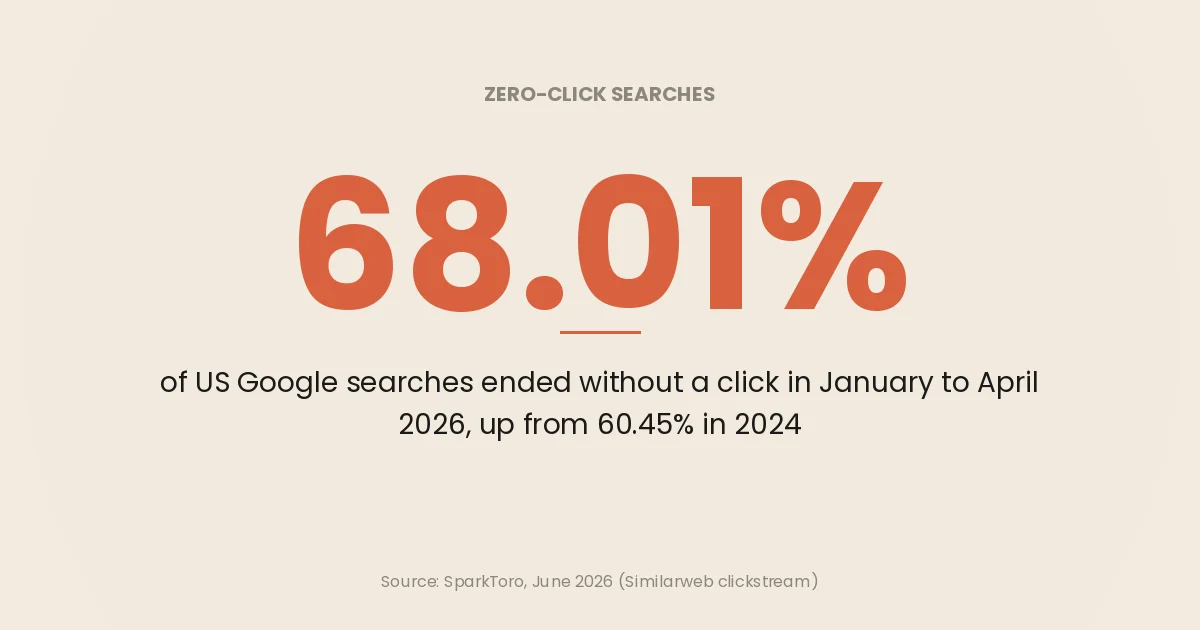
- 68.01% of US Google searches ended without a click in early 2026, up from 60.45% in 2024, per SparkToro (June 2026).
- AI-referred visitors convert above organic search in every published dataset, from a base below 1% of sessions.
- Earned media takes 84% of AI citations, and the off-site signal Ahrefs found correlating most strongly with AI Overview visibility is mentions on YouTube, ahead of branded web mentions and well ahead of backlinks.
- Only 40.6% of marketers are updating their SEO strategy for AI search, and just 23% are measuring it.
Generative Engine Optimization Statistics: The Numbers That Matter in 2026
The headline generative engine optimization statistics beyond the takeaways above, each traced to its source:
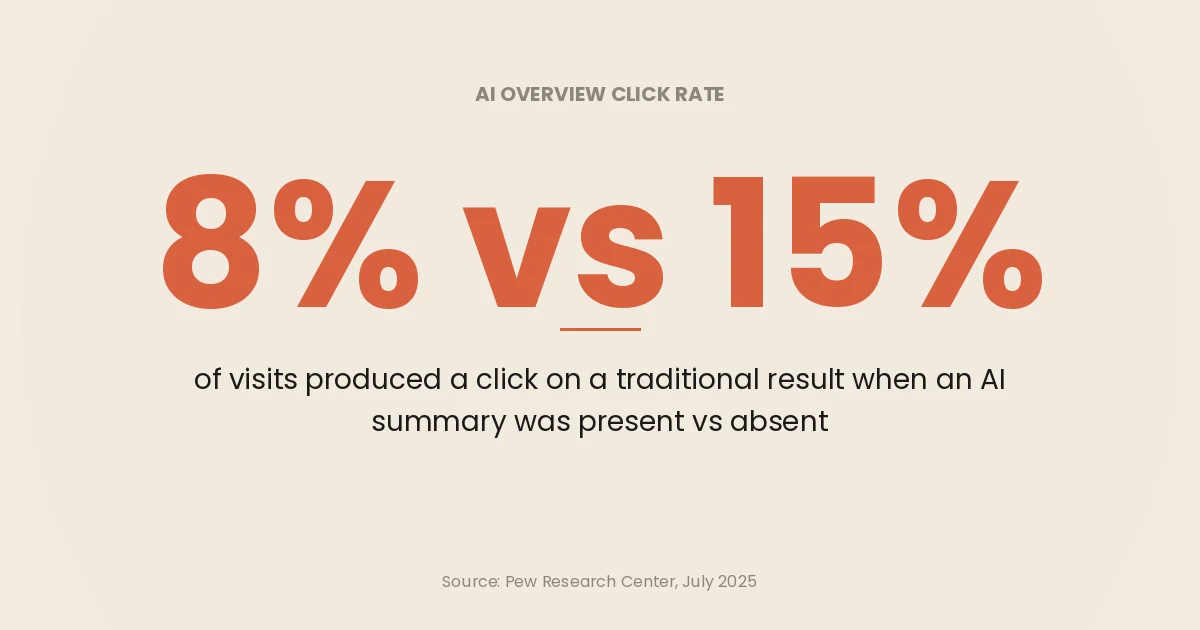
- When an AI summary appears on a Google results page, users click a traditional result on 8% of visits, against 15% when there is no summary, in browsing data from 900 US adults analysed by Pew Research Center (July 2025).
- Across 75,000 brands, Ahrefs measured branded web mentions at 0.664, Domain Rating at 0.326 and backlinks at 0.218 against AI Overview visibility, in Ahrefs’ brand-correlation study. These are Spearman coefficients that Ahrefs themselves call moderate to very weak, and they warn against reading them causally, so treat mentions as the strongest of a weak set rather than dividing one coefficient by another.
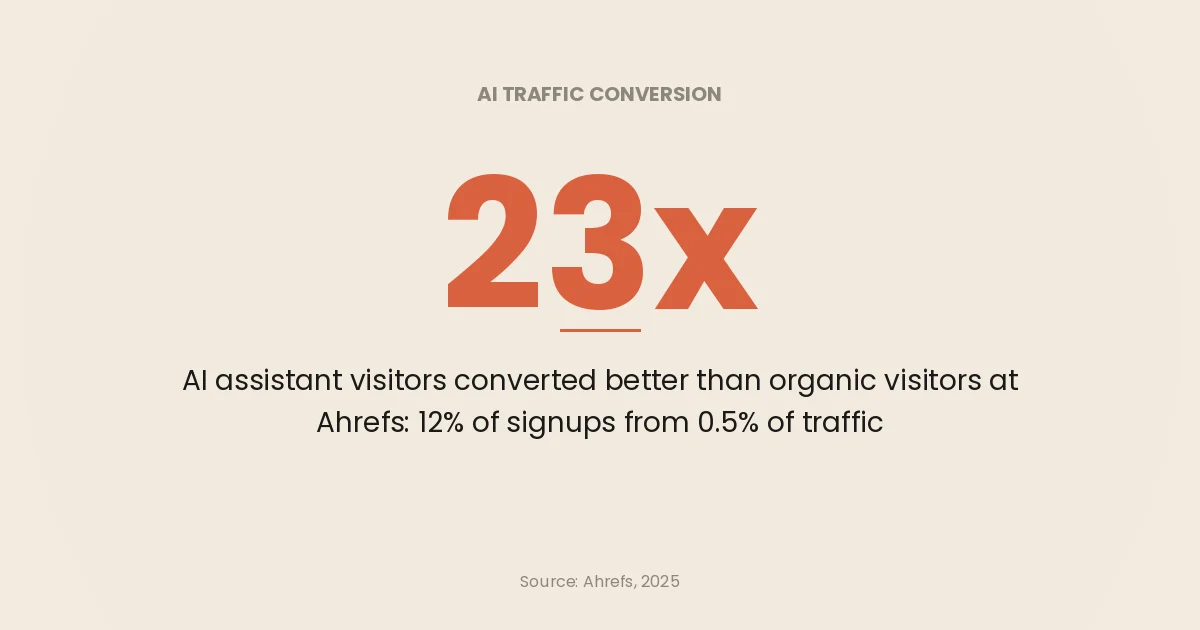
- Traffic from AI assistants generated 12% of Ahrefs’ signups while accounting for 0.5% of its traffic, a 23x conversion advantage over organic visitors, per Ahrefs’ own signup data (2025).
- 92% of marketers plan to optimise or already optimise for both traditional and AI search, yet only 40.6% are currently updating their SEO strategy for AI engines, according to ConvertMate (2026).
Two caveats apply to every number on this page. First, the measurement methods differ: clickstream panels, browser panels, GA4 exports and self-reported surveys produce different figures for what sounds like the same question, so I keep them side by side rather than averaging them. Second, several widely repeated GEO statistics could not be traced to a primary study at all, and they are not here.
The sections below go through adoption, clicks, conversion, citation behaviour, content tactics, budgets and measurement in turn.
How Many People Actually Use AI Search?
AI search adoption is large at the platform level and still small as a share of total search sessions, and both statements are true at the same time. The platform figures come from company announcements and earnings calls. The share-of-search figures come from clickstream panels that watch what a sample of users does across the day. They answer different questions, which is why the AI search statistics in this section are grouped by what was measured. It is the first place the generative engine optimization statistics split by method.
Platform Scale: ChatGPT, Gemini and AI Mode
ChatGPT weekly active users passed 900 million in February 2026, the figure OpenAI announced and TechCrunch (February 2026) reported, putting the assistant within reach of a billion.
Google’s own products are at a comparable scale. According to Wellows’ summary of Alphabet’s Q2 2026 earnings, Google AI Mode has passed 1 billion monthly active users, and the same earnings summary puts the Gemini app at 950 million monthly active users with daily active users tripling year over year, per Alphabet’s Q2 2026 earnings (via Wellows). I cite these through a secondary source because Alphabet publishes the figures in earnings transcripts rather than on a stable page; treat them as company-reported, not independently measured.
Usage intent matters as much as scale. According to an Adobe survey (July 2025, via Wellows), 77% of US ChatGPT users treat it as a search engine. That survey is now more than a year old, so I use it as a directional signal rather than a current benchmark.
Share of Search That Has Moved to AI
Here the numbers shrink, and the definitions decide the result. An estimated 5.6% of US desktop-browser search traffic went to an AI-powered LLM such as ChatGPT or Perplexity by mid-2025, in Datos data reported by the Wall Street Journal (2025). Note the qualifier: desktop browsers only, so mobile app usage is excluded.
Inside Google itself, only 0.34% of searches transitioned into AI Mode during the January to April 2026 window measured by SparkToro’s 2026 clickstream analysis, which suggests the billion-user AI Mode figure is driven by the feature being surfaced inside Google, not by people choosing it as a destination.
Consumer surveys point the other way, and the gap tells you how much self-reporting inflates behaviour. 58% of consumers say they have replaced traditional search engines with generative AI tools for product and service recommendations, up from 25% in 2023, in a 12-country survey of 12,000 consumers by Capgemini Research Institute (January 2025). Panel data from Similarweb (January 2026) puts it more narrowly: 35% of US consumers start product discovery with an AI tool, against 13.6% who start with a search engine. For a SaaS marketing team, the practical reading is that discovery-stage behaviour has already shifted more than total search volume has, which is exactly where GEO pays off first.
What AI Overviews and AI Answers Do to Clicks
AI Overviews reduce clicks to websites, and the size of the reduction depends on how you measure it. The three most cited datasets on zero-click searches and AI Overviews CTR use three different methods, and none of them is wrong; they are counting different things. I keep the full analysis in my zero-click searches deep dive and the CTR mechanics in AI Overview CTR impact, so this section sticks to the AI Overview statistics themselves, the part of the generative engine optimization statistics that most often gets misquoted.
Zero-Click Share by Measurement Method
The clickstream view is the most quoted, and it is the SparkToro figure in the takeaways above: just over two thirds of US Google searches ended without a click in the first four months of 2026, measured on a Similarweb panel.
The browser-panel view from Pew is narrower and more behavioural. In the same Pew study that produced the click-rate gap quoted above, users ended their browsing session entirely after 26% of search pages that showed an AI summary, compared with 16% of pages that showed only traditional results. The two numbers are not comparable: one counts searches without any click, the other counts sessions that stopped. Quote them with their definitions or not at all.
Sources cited inside the summary do not recover the lost clicks. Only 1% of visits to a Google page with an AI summary produced a click on a link inside that summary, in Pew’s July 2025 study. Being cited is a visibility outcome, not a traffic outcome, and the two need separate KPIs.
CTR When an AI Overview Is Present
The SERP-data view comes from rank trackers. Google AI Overviews reduce clicks to websites by 34.5%, per Ahrefs (2025), a correlational year-over-year comparison across a keyword panel rather than a measured loss on any one site. A later reading is steeper: AI Overviews now appear on more than 20% of Google searches and, when present, cut click-through rates by nearly 60%, according to Ahrefs data cited by SparkToro (2026). The two Ahrefs figures were published a year apart. Read them as a trend line, not a contradiction.
Impressions moved in the opposite direction. Search impressions rose by over 49% in the year after AI Overviews launched while click-throughs fell nearly 30%, in BrightEdge (May 2025) data, which is why a Search Console dashboard can look healthier while traffic falls.
Publishers felt the aggregate effect first: organic search traffic to news sites fell from a peak of over 2.3 billion monthly visits in mid-2024 to under 1.7 billion by mid-2025, in Similarweb data reported by TechCrunch (July 2025). For a SaaS site with a smaller informational footprint, the damage concentrates on top-of-funnel explainer content, which is the content most worth restructuring for citation rather than clicks.
Does AI-Referred Traffic Convert?
AI referral traffic is small, growing fast, and converts above organic search in every published dataset I could verify. That is the whole finding among the generative engine optimization statistics on traffic, and the important word is “published”: the conversion benchmarks come from a handful of companies’ own analytics, so none of them generalises to your ICP. Measure your own before you budget on someone else’s number; the setup is in my guide to track AI referral traffic in GA4.
The growth rates first. Monthly AI-referred traffic rates increased 600% between January and October 2025 while AI still accounted for under 1% of overall traffic, in the Quantum Metric (2025) peak-season benchmark. AI-referred sessions grew 527% year over year in the first five months of 2025, according to Previsible’s 2025 AI Traffic Report as summarised by Digital Agency Network, since the original report has since been replaced on Previsible’s site. In retail, AI-driven traffic to US retail websites grew 693% year over year during the 2025 holiday season, in Adobe Analytics (2025 holiday season) data covering more than a trillion visits.
Three datasets, three growth rates in the same order of magnitude, all from a base below 1% of sessions.
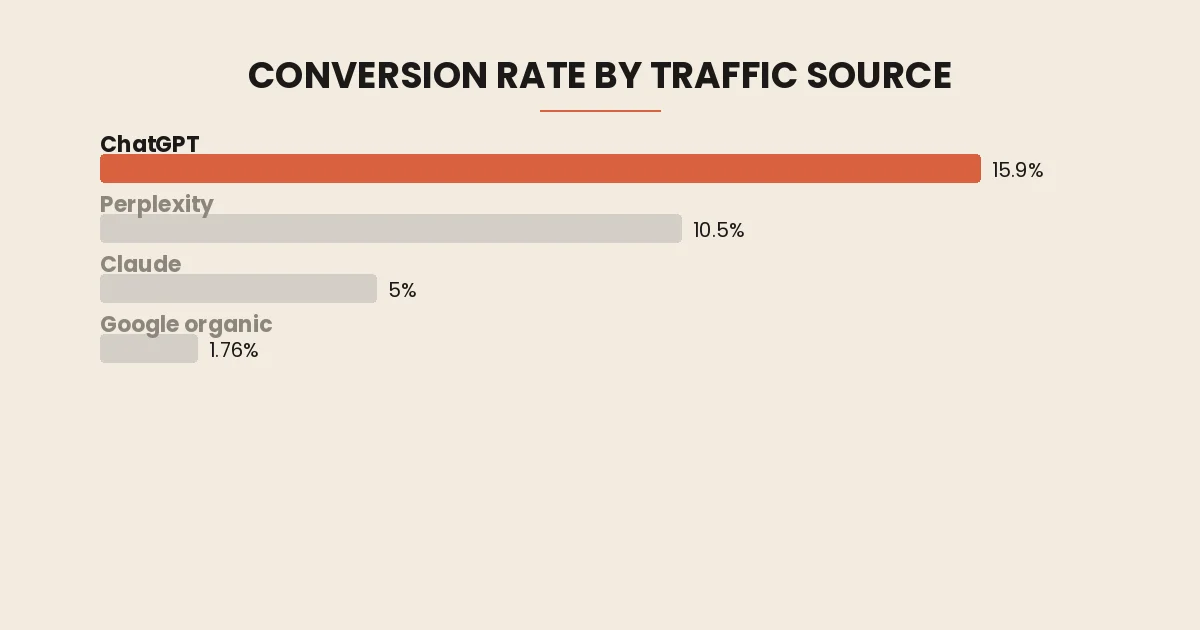
Now the AI traffic conversion rate figures, with their scope stated. In a single-client case study using GA4 data from October 2024 to April 2025, visitors converted at 15.9% from ChatGPT, 10.5% from Perplexity and 5% from Claude, against 1.76% from Google organic, per Seer Interactive (June 2025). On the retail side, AI referrals to US retail sites converted 31% more than other traffic sources during the 2025 holiday season and AI-referred shoppers were 33% less likely to bounce, according to Adobe Digital Insights (2025), and AI-driven revenue per visit was up 254% year over year in the same period, per Adobe Digital Insights (January 2026). Add the Ahrefs signup figure from the summary above and the pattern holds across a B2B agency client, a SaaS vendor and US retail.
The mechanism is intent compression rather than magic. Someone arriving from a ChatGPT answer has already had the explainer conversation; the click is an evaluation click, so it behaves like bottom-of-funnel traffic even when the original prompt was informational. That is also why the conversion multiple will shrink as AI referral volume grows and starts to include earlier-stage visitors. Track the ratio over time, not the snapshot.
Which Sources Do AI Engines Cite?
AI citations follow different rules from Google rankings, and the AI citation statistics below, the least intuitive of the generative engine optimization statistics, show how different. Which sources AI cites depends on the engine: Google AI Overviews lean heavily on pages that already rank, while standalone assistants draw on a much wider and more volatile pool. The engineering implication is that ranking work and citation work overlap on the foundations but diverge on the page.
How Much AI Citation Overlaps With Google Rankings
For Google’s own AI surface the overlap was high in 2025 and has fallen sharply since. 76.1% of URLs cited in Google AI Overviews also ranked in Google’s top 10, in a study of 1.9 million citations across 1 million AI Overviews by Ahrefs (July 2025). Ahrefs’ own re-run found 37.9% eight months later, across 4 million citations on 863,000 SERPs in March 2026, where “top 10” counts the first 10 SERP blocks rather than organic positions 1 to 10; their blue-links-only test gave 37.10%, so the distinction barely moves it. A third 2026 dataset lands near the same place from the other direction: 83% of AI Overview citations come from pages outside the organic top 10, across 12,500 queries and 8,000 domains in ConvertMate’s 2026 benchmark. Part of the gap is timing, since Overviews cited far more non-ranking pages by 2026 than in mid-2025. Part is method, since Ahrefs analysed only the three most visible citations per answer and the two studies used different query sets.
I quote both, dated, and I do not average them.
Across standalone assistants the pools barely touch. Only 11% of cited domains overlap between ChatGPT and Perplexity, in Joshua Blyskal’s 100,000-prompt analysis. Winning a citation in one engine tells you little about the next, and it is why my platform-specific notes on how to get cited by ChatGPT read differently from the AI Overviews playbook.
Earned Media, Brand Mentions and the Wikipedia Effect
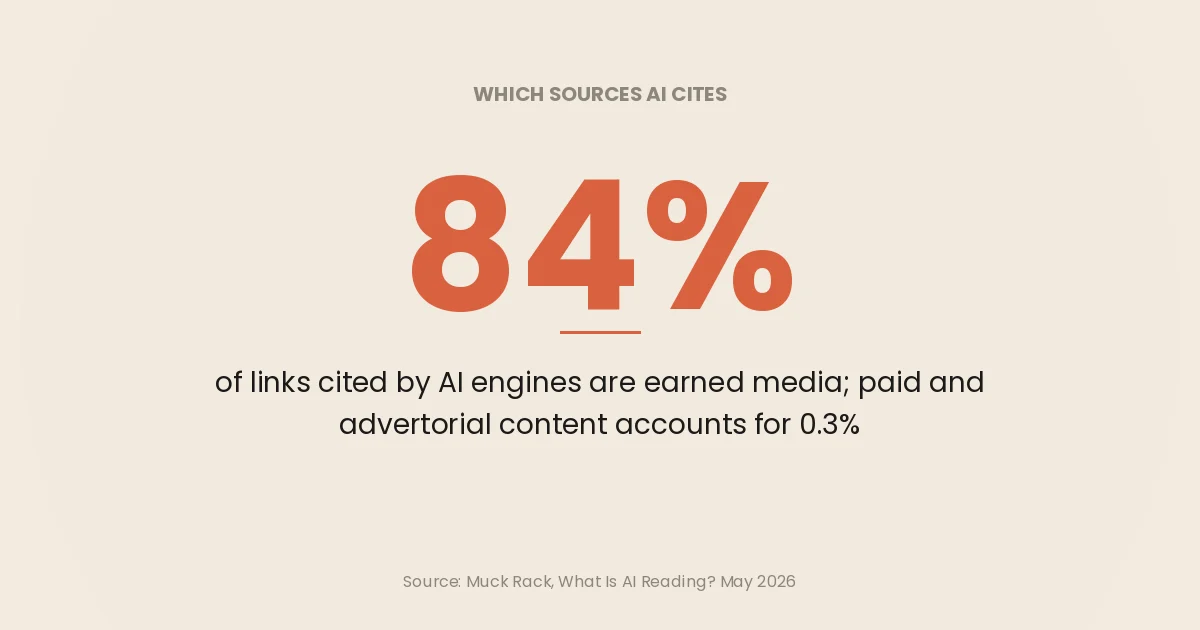
The source mix is dominated by third parties, not by brands’ own pages. Earned media accounts for 84% of all links cited by AI engines, while paid and advertorial content accounts for 0.3%, across more than 25 million links analysed by Muck Rack (May 2026). Professional journalism alone makes up 27% of citations, and that share has stayed between 25% and 27% across all three editions of Muck Rack’s What Is AI Reading? (May 2026) since July 2025. Being written about beats writing about yourself.
The correlation data says the same thing from the other side. Branded web mentions score 0.664 against AI Overview visibility where backlinks score 0.218 and Domain Rating 0.326, across 75,000 brands in Ahrefs’ brand-correlation study, reported as Spearman correlations that Ahrefs describe as moderate to very weak and warn against reading causally, and YouTube mentions show the strongest off-site correlation with AI visibility at roughly 0.737 across ChatGPT, AI Mode and AI Overviews, per an Ahrefs December 2025 study (via Omnibound), which I could only confirm on the roundup rather than the original page.
Concentration is severe: the top 5 domains capture 38% of Google AI Overview citations, the top 10 take 54% and the top 20 take 66%, across 36 million Overviews in The Digital Bloom’s AI Overview study. Reddit is the fastest riser in that set: its AI citation rate rose 450% between March and June 2025 and it now accounts for 21% of AI Overview citations, according to The Digital Bloom (2025). For a brand, the levers are entity clarity and third-party coverage, which is the territory covered in E-E-A-T and entity signals for AI citations.
Which Content Tactics Move Citation Rates?
The evidence for specific GEO tactics is the thinnest part of the generative engine optimization statistics, thinner than the marketing around it, and the strongest results come with conditions attached. Below are the figures I trust, starting with the GEO research paper that gave the field its name, then the freshness and structure data, then the llms.txt numbers, because that is the tactic clients ask about most and the one with the least support.
What the Founding GEO Paper Found, and Its Limits
The original study rewrote source pages nine ways and measured how much of a generative answer each version earned. Quotation Addition was the top-scoring method with a Position-Adjusted Word Count score of 27.2 against 19.3 for unoptimised content, a 41% improvement, in the KDD 2024 GEO paper (Aggarwal et al.). Statistics Addition scored 25.2 on the same metric, roughly 31% above baseline, in the same KDD 2024 paper. The widely repeated claim that “adding statistics lifts visibility 41%” conflates the two rows; the 41% belongs to quotations.
At the bottom of the table, keyword stuffing scored 17.7, below the 19.3 baseline and the only tested method that underperformed doing nothing, per the GEO paper’s results table.
The caveat is structural. The gains hold only for sources already present in the retrieved context, and no reviewed technique showed a stable, longitudinal, cross-platform effect on organic discoverability, according to a July 2026 critical survey of 45 GEO studies, an unreviewed preprint whose conclusions cut against most GEO vendor claims and which reports that GEO rewrites can reduce AI retrieval by 16%. In plain terms: rewriting a page helps it win the citation once the engine has already retrieved it, and retrieval still depends on the unglamorous work of being crawlable, indexed and known.
Freshness, Structure and Length
Freshness is the best-supported on-page signal. Content updated within 30 days receives 3.2x more AI citations, per ConvertMate (2026). The nuance is that updating beats publishing: across 4,124 pages cited in LLM answers, 72% had been updated in the past year but only 42% were published in the past year, in Seer Interactive’s 2026 recency study. Content freshness AI citations depend on an honest dateModified, which is why my AI citation decay analysis treats the refresh cadence as an infrastructure decision.
Structure and length show up too. 68.7% of pages cited by ChatGPT follow a logical, sequential heading hierarchy and 87% use a single H1, in the 2026 State of AI Search report. Pages above 20,000 characters average 10.18 AI citations each versus 2.39 for pages under 500 characters, roughly 4.3x, in ConvertMate’s GEO Benchmark 2026. Position within the page matters as well: 44.2% of all LLM citations come from the first 30% of the content, per SparkToro (January 2026, via Omnibound).
These are correlations from observational datasets. Treat them as priors for what to test, not proof of cause.
llms.txt Adoption vs Effect
Adoption is low and the effect is absent. Only 10.13% of nearly 300,000 domains had an llms.txt file in November 2025, with no correlation between having the file and how often a domain was cited by LLMs, and removing it from the prediction model improved accuracy, per SE Ranking (November 2025). Google is explicit: its AI features guidance tells site owners they can ignore “AEO/GEO hacks” such as creating unnecessary AI text files like llms.txt for Google Search, in Google’s AI features guidance last updated 10 July 2026.
I still ship the file for SaaS clients when it costs nothing, for the reasons in my llms.txt for SaaS note, but it never appears in a forecast.
How Marketers Are Responding: Budgets, Adoption and Market Size
GEO adoption is mostly intent so far, and the gap between planning and doing is the clearest of the generative engine optimization trends in this dataset. Only four in ten marketers are currently updating their SEO strategy for AI engines even though nine in ten plan to, the ConvertMate figure quoted in the summary above.
54% of US marketers say they plan to implement GEO within three to six months, per eMarketer (January 2026, via Omnibound), a figure I could only confirm on the roundup because the eMarketer survey sits behind a subscription. Measurement lags even further: only 23% of marketers are currently investing in prompt tracking and GEO measurement, according to Incremys (2026). Most teams are optimising for a channel they cannot yet see.
The supply side is packaging GEO as an add-on rather than a discipline. 54.8% of agencies integrate GEO into their SEO services while only 27.1% offer it as a standalone paid service, as reported by Digital Agency Network’s agency survey (2026) on DAN’s own statistics page, which does not publish the sample size, so treat it as indicative rather than representative. Broader AI adoption in marketing teams gives the context: 51% of marketing teams were piloting or scaling AI in 2024, up from 42% the year before, in the roughly 1,800-respondent Marketing AI Institute (2024) State of Marketing AI report.
On GEO market size, one number deserves a health warning. Dimension Market Research (February 2026) values the global GEO market at USD 1.09 billion in 2026 and projects USD 17.1 billion by 2034, a 40.6% compound annual growth rate. An earlier edition of the same report, still widely copied by statistics roundups, projected a 2034 market several times larger; the forecast was revised down sharply within a year.
Vendor market-size projections are marketing collateral with a methodology section. Use them to describe direction, never to size a budget.
How to Measure GEO Impact on Your Own Site
To measure GEO you need three layers that the standard SEO dashboard does not have: an AI referral channel in GA4, a way to read Search Console impressions without misreading them, and a citation check that runs on a schedule. The generative engine optimization statistics above tell you the shape of the market; these GEO KPIs tell you whether it is happening to you.
Start with AI referral tracking GA4. Build a custom channel group that captures sessions whose source matches chatgpt.com, perplexity.ai, claude.ai, gemini.google.com or copilot.microsoft.com, add the landing page dimension, and report conversion rate per channel next to organic. The full regex and setup is in track AI referral traffic in GA4. This is the only way to get your own version of the Seer and Ahrefs conversion figures, and in my own client work the AI channel has been under 1% of sessions and above organic on conversion rate every time I have set it up, which matches the published pattern but proves nothing about your site until you look.
Search Console needs two corrections before you trust it. After Google removed the num=100 parameter in September 2025, 87.7% of 319 sites analysed lost Search Console impressions and 77.6% lost unique ranking queries, in the Tyler Gargula dataset reported by Search Engine Land (2025), so any impression drop dated to that month is partly an artefact.
Impressions inflated by AI Overviews, the BrightEdge effect above, mean rising impressions with falling clicks is the expected signature of citation without traffic, not a ranking problem. My AI Mode impressions study shows what that looks like on a real property, and how to track AI Overviews covers the query-level view.
Citation presence is the metric that has no free tool, and it is volatile. Only 30% of brands stay visible from one AI answer to the next when the same query is re-run, and just 20% remain present across five consecutive runs, according to AirOps and Kevin Indig (2026). A single spot check is therefore close to noise.
Build a 10 to 15 prompt set your buyers would actually type, run it monthly across ChatGPT, Perplexity and AI Overviews, and record presence, position and which competitors appear; when the prompt set outgrows a spreadsheet, the paid options are compared in my AI visibility tools roundup. Report the trend, never the single run.
How These Statistics Were Verified
Every one of the generative engine optimization statistics on this page was checked at the URL that originally published it, not at the roundup that repeated it. The process ran inside Optix, the content pipeline I built for exactly this problem: 53 candidate GEO statistics were pulled from the 16 pages that rank for this query, each was traced to the primary study it named, the source page was fetched, the number was matched in the page text, and the surrounding sentence was read to confirm the claim meant what the roundup said it meant. 51 survived.
Where the primary was paywalled or the figure existed only in a summary, the sentence says so and names the summariser.
What was excluded matters as much as what was kept. Two numbers attributed to the Princeton GEO paper by several ranking pages are not in the paper and could not be traced anywhere else, so they are gone. Five more were corrected because the source said something narrower than the roundup: a retail-only figure presented as universal, a superseded market forecast, a survey share for the wrong year, a Google guidance quote that had drifted in the retelling. The viral “4.4x conversion” and “99% of AI Overviews cite the top 10” claims have no primary source I could find and are not here.
Two kinds of verified statistics still carry a caveat, and they are the GEO statistics sources to read with care: company-reported user counts from earnings calls, and vendor benchmarks whose raw data is not published. Both are labelled inline. If you spot a figure that has moved since publication, the dateModified on this page tells you when it was last checked.
Frequently Asked Questions
What percentage of searches now go through AI tools?
It depends on the definition, and the generative engine optimization statistics disagree by an order of magnitude. Clickstream measurements put the share of Google searches that transition to AI Mode at 0.34% in early 2026, while Datos panel data reported by the Wall Street Journal put US desktop-browser search traffic going to LLMs at 5.6% by mid-2025. Platform-scale figures are a different measurement again: ChatGPT passed 900 million weekly active users in February 2026. Quote share-of-search and platform-scale numbers separately.
Do AI engines cite pages that rank on page one of Google?
For Google AI Overviews, mostly yes in 2025 and increasingly no in 2026: Ahrefs measured 76.1% of cited URLs in the organic top 10 in July 2025, while ConvertMate’s 2026 benchmark found 83% of Overview citations coming from outside the top 10. Standalone assistants are far less aligned with rankings, and only 11% of cited domains overlap between ChatGPT and Perplexity. Ranking helps retrieval; it does not decide the citation. The differences are set out in GEO vs SEO.
Does traffic from ChatGPT convert better than organic search?
In every published dataset so far, yes, from a very small base. Seer Interactive’s case study measured 15.9% conversion from ChatGPT visitors against 1.76% from Google organic on one client, whose AI arm was roughly 11,000 sessions against roughly 14 million for Google, Ahrefs saw 12% of its signups come from 0.5% of its visitors, and Adobe measured AI referrals converting 31% better than other sources on US retail sites in the 2025 holiday season. None of these generalise to your site; build the GA4 channel and measure your own ratio.
Is generative engine optimization worth it for a B2B SaaS company?
The GEO statistics 2026 point to a small, high-intent channel with an execution gap: 92% of marketers plan to optimise for AI search but only 40.6% are doing it, and only 23% are measuring it. For a SaaS site the highest-return work is structural, entity clarity, source-backed content and a refresh cadence, because 84% of AI citations go to earned media and content updated within 30 days earns 3.2x more citations. Start with the pages that already rank for buyer-intent queries; those are the ones the engines retrieve.
How often should GEO statistics be refreshed?
Quarterly at minimum, for two reasons. Freshness is a measured citation signal: content updated within 30 days earns 3.2x more citations and 72% of LLM-cited pages were updated within the past year. And the underlying numbers move fast: the GEO market forecast in this article was revised down sharply between two editions of the same report, and the platform usage figures in this article are company-reported numbers that move every quarter. This page carries a dateModified for that reason.