 Nadia Mohamed
Measurement
The Best Software for AI Visibility in Search (2026): Monitoring Platforms Ranked
What is an AI visibility tool?
An AI visibility tool is a platform that tracks how often — and how favourably — a brand is mentioned or cited across AI answer engines like ChatGPT, Perplexity, Google AI Overviews, Gemini, and Copilot. It runs a set of prompts against those engines on a schedule, records whether your brand appears, which competitors appear alongside you, and which sources the AI cites. This is a distinct category from GEO optimization tools, which score a single page’s readiness to be cited. Visibility tools measure the outcome; optimization tools improve the input.
Which AI visibility tool should you use?
For most teams the answer comes down to scale, not features — every serious platform now tracks the same core engines, so the deciding factor is how many prompts you need to monitor and whether you already live inside an SEO suite. Otterly.ai at $29/mo is the most defensible entry point for solo consultants; Profound ($99–$399/mo) and Athena HQ ($295/mo) suit growing marketing teams; Ahrefs Brand Radar ($398–$699/mo) makes sense if you already run Ahrefs; and Scrunch or Goodie fit agencies and commerce brands that need personas and revenue attribution. All pricing below was verified against each vendor’s own live pricing page in July 2026.
Buying for an agency or as a reseller? Add two criteria the solo-vs-team split above skips: white-label reporting (can you put a client’s logo, not the vendor’s, on the export?) and multi-workspace seat management (one login, many client projects, separate prompt sets). Scrunch and Goodie lead on agency features; Profound’s higher tiers add workspaces; the cheapest solo tools (Otterly, Peec) generally don’t white-label. If reselling visibility reports is the business model, weight those two features above raw prompt volume.
TL;DR — Key takeaways
- Visibility monitoring is a separate product category from GEO optimization. These tools answer “are we showing up in AI answers, and next to whom?” — they don’t rewrite your pages. Pair them with an optimization checker and a page-level readiness score; the monitoring tool is the measurement layer, not the fix.
- Entry pricing spans more than 10×. Verified July 2026 sticker prices run from Otterly.ai at $29/mo through Profound ($99), Scrunch ($250), Athena HQ ($295), Ahrefs Brand Radar ($398) and Goodie ($399). Price tracks the number of prompts and engines, not fundamentally different capability.
- The engine list has converged. Nearly every platform now covers ChatGPT, Perplexity, Google AI Overviews and Gemini; the differentiators are Copilot, Grok, Claude, Meta AI and Google AI Mode, usually gated behind higher tiers or add-ons.
- Credit models can make “cheap” plans expensive. Athena HQ’s $295 tier is priced in credits, and heavy daily tracking can exhaust a monthly allocation in roughly two weeks — model your real prompt volume before committing.
- Buy for who you are. Solo/SMB: Otterly or Peec. Marketing team: Profound or Athena. Existing Ahrefs/Semrush customer: their native AI module. Agency/multi-persona: Scrunch. Commerce/attribution: Goodie. Prefer a managed service to software: Daydream.
Visibility monitoring vs. the rest of the AI-search stack
“AI visibility tools” is a phrase people use for four genuinely different things. Getting the category right saves you from buying the wrong tool:
- Visibility monitoring platforms (this guide). They track brand mentions and citations across AI engines over time. Profound, Peec, Otterly, Athena, Scrunch, Goodie, Ahrefs Brand Radar.
- GEO optimization tools. They score and improve a page’s extractability, schema and structure. These are covered in the sibling guide to the best GEO tools — treat that post as the optimization companion to this one; the tool overlap is deliberately small.
- The manual method. Before paying for any platform, you can measure visibility with a spreadsheet. The prompt-matrix methodology for checking whether your business appears in ChatGPT and Perplexity is the zero-cost baseline every tool below automates.
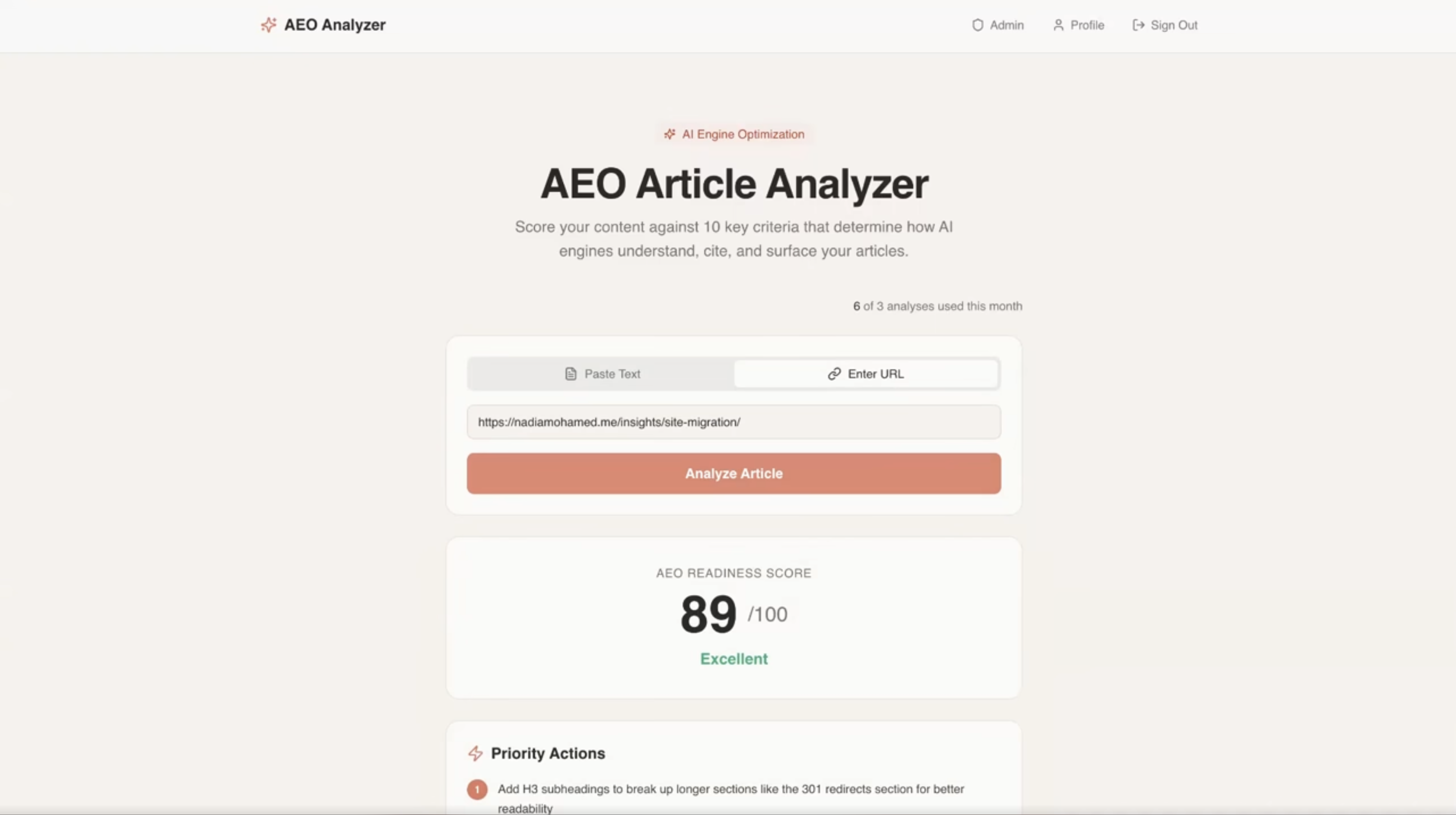
- The page-level readiness score. A single-page grade for how citable one URL is — the free AEO Analyzer does this, and a dedicated page-level AEO-score walkthrough is covered separately on the site.
If AI answers are already sending you traffic, the other half of measurement is attribution: see how to track AI referral traffic to connect citations to sessions in GA4. And if the underlying strategy is still fuzzy, start with what generative engine optimization is before spending on tooling.
This matters commercially because AI referral traffic is no longer a rounding error — AI platforms generated 1.13 billion referral visits in June 2025, up 357% year-on-year (Similarweb) — across top websites only, and against 191 billion visits to Google over the same period. If a channel that size is invisible in your reporting, a monitoring tool is how you turn the lights on.
Quick comparison: AI visibility monitoring platforms and what they cost
Every price and engine list below was read directly from the vendor’s own live pricing page in July 2026. “Custom” means the vendor does not publish a figure for that tier. Two vendors (Peec AI and Semrush) do not render machine-readable sticker prices on their public pages, so those cells are marked accordingly and their prices are omitted rather than guessed.
| Platform | Best for | Entry price (verified Jul 2026) | Engines tracked |
|---|---|---|---|
| Otterly.ai | Solo consultants, small agencies | $29/mo Lite (15 prompts) | ChatGPT, AI Overviews, Perplexity, Copilot (Claude / AI Mode / Gemini add-ons) |
| Peec AI | Marketing teams | Tiered (Starter→Enterprise); sticker price not public-rendered | ChatGPT, AI Mode, AI Overviews, Copilot, Perplexity, Gemini |
| Profound | Growing teams scaling AEO | $99/mo Starter · $399 Growth · Enterprise custom | ChatGPT (Starter); up to 10 engines incl. Perplexity, Gemini, Copilot, Claude, Grok, Meta AI, DeepSeek |
| Athena HQ | Teams wanting one unified platform | Free tier · $295/mo Starter · Enterprise custom | ChatGPT, Perplexity, AI Overviews, AI Mode, Gemini, Claude, Copilot, Grok (9 total) |
| Scrunch | Agencies, multi-persona brands | $250/mo Core (125 prompts, 3 personas) · Enterprise custom | ChatGPT, Perplexity, AI Overviews, Copilot (Core); +Claude, Gemini, AI Mode, Meta, Grok (Enterprise) |
| Goodie | Commerce brands wanting attribution | $399/mo Explorer (100 prompts) · Pro/Enterprise custom | ChatGPT, AI Overviews, Perplexity (Explorer); up to 11 engines on Enterprise |
| Ahrefs Brand Radar | Existing Ahrefs customers | $398/mo Select · $699 All Platforms | AI Overviews & AI Mode, ChatGPT, Perplexity, Copilot, Gemini, Grok, TikTok (beta) |
| Semrush AI Visibility | Existing Semrush customers | See Semrush pricing (not public-rendered) | AI-search visibility within the Semrush suite |
| Daydream | Teams wanting a managed service | Managed service — pricing on application | Google + ChatGPT, AI Overviews and other AI surfaces |
The best AI visibility tools, reviewed
Each tool below is grouped by the buyer it fits. Every capability and price is stated only where it was confirmed on the vendor’s live page as of July 2026 — where a figure wasn’t verifiable live, it’s omitted rather than estimated.
Otterly.ai — best for solo consultants and small agencies
Otterly.ai publishes the most transparent pricing in the category and does one job well: run your prompts, track daily, alert on changes. The Lite plan is $29/mo for 15 search prompts, Standard is $189/mo for 100 prompts, and Premium is $489/mo for 400 prompts, with roughly 15% off on annual billing. Core tracking covers ChatGPT, Google AI Overviews, Perplexity and Microsoft Copilot; Claude, Google AI Mode and Gemini are available as add-ons. All tiers include unlimited team members and 50+ country support.
Best for: solo consultants and small agencies tracking 15–100 priority prompts on a budget. Where it falls short: it doesn’t fold in traditional SEO data, so cross-analysis means switching between tools.
Peec AI — best for in-house marketing teams
Peec AI positions itself as AI-search analytics for marketing teams: track visibility, position and sentiment, benchmark competitors, and optimise your AI-search presence. Its live pricing page lists four tiers — Starter, Pro, Advanced and Enterprise — with unlimited seats and a free trial, and confirms coverage across ChatGPT, Google AI Mode, AI Overviews, Microsoft Copilot, Perplexity and Gemini. Peec’s public pages load prices dynamically and did not expose a machine-readable sticker figure at the time of verification, so exact tier prices are omitted here — check peec.ai/pricing for the current numbers.
Best for: in-house teams that want a clean, seat-unlimited dashboard focused purely on AI search. Where it falls short: you’ll need to open the pricing page to size a plan, since the entry price isn’t listed in a way that’s easy to compare at a glance.
Profound — best for teams scaling answer-engine optimization
Profound is an answer-engine-optimization platform that monitors how brands appear in AI systems, analyses competitor presence and surfaces the source URLs behind citations. Verified tiers: Starter at $99/mo (50 prompts, ChatGPT only), Growth at $399/mo (100 prompts, three answer engines, marked “Popular”), and Enterprise with custom pricing (up to 10 engines, multiple companies, SSO/SAML and SOC2). Capability spans ChatGPT, Perplexity, Google AI Mode, Gemini, Copilot, Meta AI, Grok, DeepSeek, Claude and AI Overviews, with engine access widening as you move up tiers.
Best for: teams graduating from spot-checks to a real AEO programme who want citation-source visibility, not just mention counts. Where it falls short: the $99 Starter is ChatGPT-only, so meaningful multi-engine coverage starts at the $399 Growth tier.
Athena HQ — best for a single unified platform with a free entry
Athena HQ combines cross-platform monitoring, competitive benchmarking, brand-sentiment intelligence and content recommendations in one place, and it’s one of the few with a genuine free tier. Verified pricing: an Essential free plan (with $25 / 300 credits to start), a Starter plan at $295/mo (3,600 credits, nine engines, unlimited seats, one country), and custom Enterprise pricing that unlocks its Citation Engine and Recommendation Engine. It tracks ChatGPT, Perplexity, AI Overviews, AI Mode, Gemini, Claude, Copilot and Grok.
Best for: teams that want monitoring, sentiment and optimization guidance under one login, and a free tier to trial first. Where it falls short: the credit model means real monthly spend depends on how aggressively you track — daily monitoring across several engines can burn through the Starter allocation well before month-end, so model your volume first.
Scrunch — best for agencies and multi-persona brands
Scrunch frames itself as an AI customer-experience platform: monitor and benchmark presence in AI search, find citation gaps, and even serve an AI-friendly version of your site to agents (its Agent Experience Platform). Verified tiers: a Core plan at $250/mo with 125 unique prompts, three personas, five user licences and five site audits a month, tracking four engines (ChatGPT, Perplexity, Google AI Overviews and Copilot); and custom Enterprise, which expands to nine engines (adding Claude, Gemini, Google AI Mode, Meta and Grok) with custom prompts, API access, SSO and its full Agent Experience Platform. Scrunch recently consolidated its self-serve pricing to this single Core tier.
Best for: agencies and brands that need to model multiple audience personas and manage prompts centrally across clients. Where it falls short: the self-serve Core tier caps you at 125 prompts, three personas and four engines — wider coverage (and Claude, Gemini or Grok) means moving to custom Enterprise.
Goodie — best for commerce brands that need revenue attribution
Goodie runs a closed-loop AEO system — research, monitor, optimise, and prove revenue impact — with commerce analytics and attribution built in. Verified pricing: Explorer at $399/mo (three engines: ChatGPT, AI Overviews, Perplexity; 100 prompts; 3,000 AI responses/month; three seats), with Pro and Enterprise on custom pricing that expand to six and up to eleven engines respectively (adding Gemini, Copilot, Amazon Rufus, Claude, AI Mode, Meta, DeepSeek and Grok). Yearly plans save 20%.
Best for: e-commerce and DTC brands that want to connect AI visibility to revenue, not just mentions. Where it falls short: the entry price is the highest self-serve sticker in this list, and the widest engine coverage sits behind custom Enterprise pricing.
Ahrefs Brand Radar — best if you already run Ahrefs
Ahrefs Brand Radar tracks brand visibility across AI answers (plus YouTube and Reddit) and sits alongside Ahrefs’ existing SEO data, so you can correlate AI mentions with backlinks, rankings and publish dates in one view. Verified pricing: Select Platforms at $398/mo and All Platforms at $699/mo, the latter including 2,500 custom-prompt checks per month drawn from a 411M+ monthly-prompt database. It covers AI Overviews and AI Mode, ChatGPT, Perplexity, Copilot, Gemini, Grok, and TikTok in beta.
Best for: teams already paying for Ahrefs who want AI visibility integrated with their SEO stack rather than in a separate tool. Where it falls short: the standard prompt database is broad — the real value comes from configuring custom prompts around your own priority queries.
Semrush AI Visibility — best if you already run Semrush
Semrush offers an AI Visibility layer within its wider suite, positioned to extend traditional SEO reporting into AI discovery. The offering is confirmed live, but Semrush does not render a standalone sticker price for the AI module on its public marketing page, and current engine coverage wasn’t machine-verifiable at the time of writing — so no price or engine list is asserted here. If you’re already a Semrush customer, check your plan’s AI features directly in-app.
Best for: existing Semrush customers who want AI visibility without adopting another vendor. Where it falls short: as a suite add-on, it’s harder to evaluate in isolation — confirm the current scope and cost inside your account before relying on it.
Daydream — best for teams that want a managed service, not software
Daydream is the odd one out: it’s an AI-native SEO/GEO agency, not a self-serve tool. It pairs dedicated human experts with SEO agents to run keyword strategy, technical and on-page work, programmatic SEO and AI-citation tracking across Google, ChatGPT, AI Overviews and other AI surfaces. There’s no public pricing — the site directs you to book a call or join a waitlist, consistent with a managed-service model.
Best for: teams that would rather outsource the whole visibility programme than operate a dashboard. Where it falls short: it’s a service engagement, so it’s not comparable on price with the self-serve platforms above, and you don’t get a login-and-go tool.
Where this list stops: regional answer engines
Every platform above monitors the same Western engines: ChatGPT, Perplexity, Google’s AI Overviews, Gemini, Copilot. That’s the right coverage for most readers here, and it’s also the boundary of what the comparison can tell you — if your market’s dominant answer surface sits outside that set, none of these tools see it.
Korea is the clearest example. Naver handles a large share of Korean search, and Naver AI Briefing is where generative answers surface there; no tool in the table above tracks it. Coverage there comes from local providers instead, such as GEOMIX, which monitors ChatGPT, Gemini, Google AI Overviews and Naver AI Briefing together, and runs as a managed service rather than software you log into. The same gap applies to Baidu in China and Yandex in Russia.
How to choose an AI visibility tool
Once you’ve filtered by buyer type, evaluate the shortlist on five practical dimensions:
Whichever tool you choose, hold it to a protocol: a fixed brand set, a fixed prompt set, repeats and confidence intervals, as set out in the AI share of voice methodology.
- Prompt capacity at your real volume. Pricing is driven almost entirely by how many prompts you track. Count the priority questions your ideal customer actually asks before picking a tier — over-buying prompts is the most common overspend in this category.
- Engine coverage that matches your audience. Everyone covers ChatGPT, Perplexity, AI Overviews and Gemini. If your buyers use Copilot, Claude, Grok or Meta AI, confirm those are in-tier and not a paid add-on.
- Pricing model, not just headline price. A credit-metered plan (like Athena’s) can cost more than a flat plan once you track daily across several engines. Convert everything to cost-per-prompt-per-month before comparing.
- Does it tell you what to do next? Some tools stop at “here’s your visibility”; others surface citation sources and optimization actions. Monitoring without a next step is measurement for its own sake.
- Fit with your existing stack. If you already run Ahrefs or Semrush, their native modules save a login and let you correlate AI mentions with SEO data — often worth more than a marginally cheaper standalone tool.
/assets/screenshots/aeo-analyzer-result.png Where visibility tools fit in the measurement stack
A monitoring platform is one layer of three. On its own it tells you whether AI engines mention you, but not why or what it’s worth:
- Detection — the tools in this guide, which record mentions and citations across engines over time. If you’re not ready to pay yet, the manual prompt-matrix method is the free version of exactly this.
- Diagnosis — a page-level readiness score that explains why a given URL isn’t being cited. Run priority pages through the free AEO Analyzer, then fix structure and schema using an optimization tool.
- Attribution — connecting citations to real sessions and revenue. Set up an AI source channel group as described in how to track AI referral traffic.
Buy a monitoring tool once you’re publishing at enough volume that manual checks stop scaling — and pair it with the diagnosis and attribution layers so the visibility data you’re paying for actually drives content decisions.
FAQ
What is the best AI visibility tool in 2026?
There’s no single winner — the best tool depends on scale. For solo consultants, Otterly.ai at $29/mo is the most defensible entry point. Growing marketing teams are well served by Profound ($99–$399/mo) or Athena HQ ($295/mo). Teams already running Ahrefs should look at Brand Radar ($398–$699/mo) so AI visibility sits next to their existing SEO data. All prices verified July 2026.
What’s the difference between an AI visibility tool and a GEO tool?
An AI visibility tool monitors whether AI engines mention or cite your brand — it measures the outcome. A GEO (generative engine optimization) tool improves a page’s readiness to be cited — it works on the input. You need both: visibility tools tell you where you stand, and optimization tools plus a page-level readiness score tell you what to change.
How much do AI visibility tools cost?
Verified July 2026 entry prices range from $29/mo (Otterly.ai) to around $399/mo (Goodie, Ahrefs Brand Radar’s Select tier at $398). Most platforms price by the number of prompts tracked and the number of engines covered, so cost scales with how much you monitor rather than reflecting fundamentally different capability.
Which AI engines do these tools track?
Nearly all of them cover ChatGPT, Perplexity, Google AI Overviews and Gemini as standard. The differentiators are Microsoft Copilot, Google AI Mode, Claude, Grok, Meta AI and DeepSeek — these are often gated behind higher tiers or sold as add-ons. Profound, Athena HQ and Goodie’s Enterprise tier reach the widest engine coverage (9–11 engines).
Can I check AI visibility for free?
Yes. Athena HQ offers a free tier, and you can measure visibility manually with a spreadsheet using the prompt-matrix method — run your priority prompts across ChatGPT, Perplexity and Gemini monthly and record which sources each cites. For a free page-level readiness score, use the AEO Analyzer. Paid monitoring earns its place once you’re publishing at volume and manual checks stop scaling.
Do I need a separate tool if I already use Ahrefs or Semrush?
Not necessarily. Both suites now include native AI-visibility modules — Ahrefs Brand Radar and Semrush AI Visibility — that let you correlate AI mentions with your existing SEO data in one place. If you’re already paying for either platform, start with its built-in module before adding a standalone monitoring tool.