 Nadia Mohamed
AI-SEO & GEO
Surfer SEO Review (2026): Features, Pricing and Whether It's Worth It
Surfer SEO is a content optimization platform that scores your draft against the pages already ranking for a keyword and tells you what to add. These days it also tracks how AI assistants mention your brand. It now sells itself simply as “Surfer”: Surfer’s own help centre calls it “the all-in-one platform for AI Search Optimization and visibility”. The content editor that made it famous is still at the centre.
I’m an SEO engineer. I build the technical and structured-data layer that gets SaaS sites ranked and cited by AI search. This review covers what Surfer does today, what it costs (read from Surfer’s own pricing page on 9 November 2026), how far it gets you on generative engine optimization, and who should not buy it.
Key takeaways
- Surfer SEO is a SERP-based content optimizer with a Content Score, an AI writer and, now, AI-visibility tracking across ChatGPT, Perplexity, Gemini and Google’s AI features.
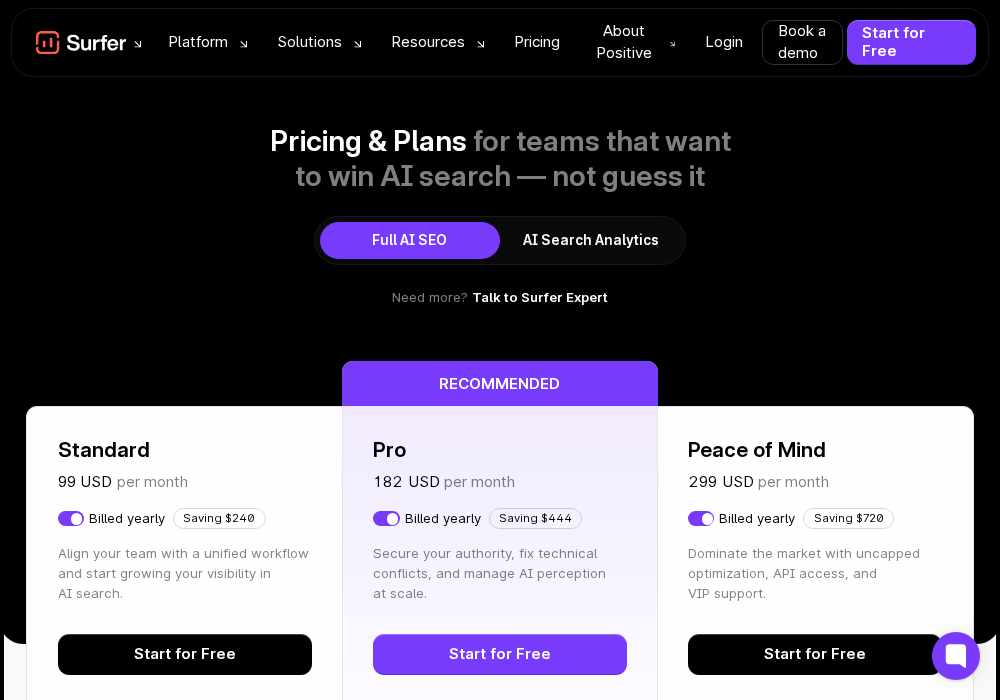
- Self-serve plans cost $49 to $299 a month billed yearly, and Enterprise is now custom-priced, according to Surfer’s pricing page.
- The free trial gives new accounts 7 days of the Pro plan, but you enter billing details first and it converts to a paid plan automatically.
- For GEO, Surfer measures and shapes content. It does not fix the crawl access, rendering or structured data that decide whether AI engines can cite you.
- Buy it if you publish regularly and will use most of the suite. If you need one capability, a focused tool is usually cheaper.
What is Surfer SEO (and why is it now just “Surfer”)?
Surfer started as a SERP analyzer and content editor. You enter a keyword, Surfer studies the pages that rank for it, and it turns them into targets for length, headings and terms. That is still the core. Around it, Surfer has added a content audit, a topical map, an AI writer called Surfy, a full-article generator (Surfer AI), a rank tracker and an AI Tracker that follows how AI models talk about your brand.
Two changes in the past year matter if you last looked at Surfer a while ago:
- New owner. On 28 October 2025, Positive Group’s announcement confirmed it had acquired Surfer, describing it as “a fast-growing Polish AI Search Optimization platform” with more than 150,000 active users and roughly 12,000 customers.
- New name and domain. The product now goes by Surfer, and surferseo.com redirects to surfer.ai. The app, help centre and billing still run on surferseo.com subdomains, so both names point to the same tool.
So if you search for “surfer seo”, “surferseo” or “surfer ai”, you are looking at one product. The positioning has moved from “rank on Google” to “rank on Google and get cited in AI answers”. The plans reflect that: AI prompt tracking now sits next to document credits on every tier above the entry plan.
Quick verdict
Surfer still does the core optimization job as well as anyone, and the editor is genuinely pleasant to work in. Its Content Score is the closest thing the category has to a shared standard: when an SEO says “optimize to a score”, this is usually the score they mean.
The catch is scope creep in the pricing. The lower tiers are metered on documents, tracked pages and AI prompts. Much of the newer breadth (daily AI tracking across every model, several brand workspaces, API access) only unlocks higher up. If you use the whole suite, it’s good value. If you use one part, a focused tool is usually cheaper, which is exactly why the Surfer SEO alternatives market is so busy.
Surfer’s own research is a real strength. Its study of 405,576 AI Overview searches found that 78% of overviews contain an ordered or unordered list. That kind of finding feeds straight into how its editor tells you to structure a page.
Surfer SEO features, tool by tool
According to Surfer’s feature comparison on its pricing page, every paid plan includes the Content Score, Surfy, the AI detector and humanizer, Content Audit, Topical Map, the cannibalization report, the SERP Analyzer, keyword research and rank-drop alerts. What changes between plans is volume: documents, tracked pages, prompts, seats and workspaces.
Content Editor and Content Score
This is the reason most teams buy Surfer. You write or paste a draft, and the editor scores it live against the top-ranking pages. It suggests a word-count range, a heading count, and the terms and entities competitors use, with how often they use them. “1-click” optimization will insert missing terms for you, and the editor also suggests internal links.
The score is a useful guide, not a ranking guarantee. It tells you your page now looks like the pages that already rank. It can’t tell you whether your page says anything those pages don’t.
Surfy, Surfer AI and the Humanizer
Surfy is the writing assistant inside the editor. It drafts sections, rewrites paragraphs and works through the editor’s suggestions. Surfer AI goes further and generates whole articles from templates, a brand voice and custom brand knowledge. Every plan also includes an AI detector and a “humanizer”. I’d treat the humanizer as a style tool, not a quality one: it changes how text reads, not whether the claims in it are true.
Content Audit, Topical Map and cannibalization
Content Audit connects to a site and flags pages that are slipping, with rank-drop alerts and suggestions for what to refresh. Topical Map plans clusters around a seed topic and shows coverage gaps. The cannibalization report finds pages competing for the same query. These turn Surfer from a single-article tool into a light content-strategy layer. The number of pages it watches is capped by plan, from 10 on Discovery to 500 on Peace of Mind.
AI Tracker
The AI Tracker monitors a set of prompts (the questions your buyers ask AI models) and reports where your brand is mentioned or cited, where competitors appear instead (the “mention gap”), and the sentiment of those mentions. I cover it in detail in the GEO section below.
Integrations, API and MCP
Surfer integrates with WordPress and Google Docs, adds Contentful on Pro and Zapier on Peace of Mind, and lists MCP support across its plans. MCP lets an AI assistant or agent pull Surfer’s data into its own workflow. Full API access is listed on Peace of Mind, the top self-serve plan. If you plan to automate content operations around Surfer, check that last point early, because it puts a firm floor under your price.
Surfer SEO for generative engine optimization: a review
Generative engine optimization (GEO) is the work of getting your content cited in AI answers from ChatGPT, Perplexity, Gemini and Google’s AI Overviews and AI Mode. Surfer has rebuilt its pitch around it. Here is what it actually gives you.
What it measures. Discovery tracks no AI prompts. Standard tracks 25 prompts in ChatGPT only, refreshed weekly. Pro tracks 50 prompts across all the models it supports, refreshed daily. Peace of Mind tracks 100 a day (the limits are listed in Surfer’s plan comparison). If tracking is all you want, Surfer’s AI Search Analytics plan costs $82 a month billed yearly. It covers 50 prompts refreshed daily across ChatGPT, Perplexity, AI Mode, AI Overviews and Gemini, plus mention-gap and sentiment reporting and five brand spaces.
What it shapes. The editor’s guidelines are built to reward the structures AI answers lift from, such as clear definitions, lists and direct answers. The Content Audit pushes you to refresh pages before they go stale. For a content team, that’s a sensible loop: track the prompts, find the gaps, and write or refresh the pages that should fill them.
What it does not do. In my audit work, the reasons a SaaS site fails to get cited are usually below the content layer. AI crawlers can’t reach the pages, the important content only appears after JavaScript runs, the structured data is missing or contradicts the page, or the brand’s entity signals are inconsistent. Surfer doesn’t fix any of that. It also can’t tell you whether ChatGPT is allowed to use your pages at all: that depends on letting OpenAI’s search crawler (OAI-SearchBot) reach the site, which is a server and robots.txt decision, not an editor setting.
My verdict for GEO. Surfer is a credible way to measure AI visibility and to write content in the shapes AI answers prefer. Treat the AI Tracker as a dashboard, not a fix. If your score is low even though your content is good, the problem is usually technical, and that’s the layer I deploy in a GEO and technical SEO audit. If you only need monitoring and want to compare options, my roundup of AI visibility tools covers the dedicated trackers.
Surfer SEO pricing (rechecked 9 November 2026)
These figures come from Surfer’s own pricing page, read on 9 November 2026. All per-month figures are billed annually, and monthly billing costs more. Two things changed since my August check: Enterprise no longer has a public price, and the standalone AI Search Analytics plan dropped to $82 a month.
| Plan | Price (billed annually) | Documents | AI prompts tracked | Pages tracked | Seats |
|---|---|---|---|---|---|
| AI Search Analytics | $82/mo | — | 50, daily, all models | — | 5 brand spaces |
| Discovery | $49/mo | 120 | None | 10 | 1 |
| Standard | $99/mo | 360 | 25, weekly, ChatGPT only | 50 | 3 |
| Pro (most popular) | $182/mo | 360 | 50, daily, all models | 200 | 5 |
| Peace of Mind | $299/mo | Unlimited* | 100, daily, all models | 500 | 10 |
| Enterprise | Custom | Custom | Custom | Custom | Custom |
*Subject to Surfer’s fair-usage policy. Enterprise adds SSO, white-label, an advisory programme and priority support.
Three billing details are easy to miss. According to Surfer’s billing FAQ, the annual plan is charged upfront for the whole year, it saves up to 17% compared with monthly payments, and credits reset yearly, not monthly. A heavy quarter can therefore use up a year’s document allowance early.
/assets/screenshots/tools/surfer.jpg Is there a Surfer SEO free trial?
Yes, but it’s not a free plan. According to Surfer’s trial terms, new accounts get full access to the Pro plan for 7 days. You choose a plan and enter billing details at checkout, and after day 7 the subscription converts to that plan and charges your card. The trial is for new accounts only.
To get real value from those 7 days, I’d test three things:
- Run your own money keyword through the editor. Optimize a page you already have, and judge whether the suggested terms make sense for your product or are just noise.
- Load your real AI prompts into the tracker. The trial runs on Pro, so you see daily tracking across all models. Note which plan you would actually need afterwards.
- Check the integration you will live in. Make sure the WordPress or Google Docs workflow fits how your writers actually work.
If you don’t plan to continue, cancel before day 7.
What Surfer SEO does well
- The Content Score is the category standard. It turns the ranking pages into concrete, checkable targets that writers understand without an SEO in the room.
- It covers most of a content team’s on-page workflow. Editor, writer, audit, topical map and cannibalization report live in one place, so teams don’t have to stitch together three tools.
- The research is real. Surfer publishes large studies on SERPs and AI Overviews, and its guidelines reflect them. I cite its work in my guide to how to show up in AI Overviews.
- It moved early on AI search. Prompt tracking across ChatGPT, Perplexity, Gemini, AI Overviews and AI Mode, plus mention-gap reporting, puts classic SEO and GEO measurement in one subscription.
- The UX is clean. Live collaboration, comments and the docs-style editor make it easy to roll out to writers who aren’t SEOs.
Where Surfer SEO falls short
- You pay for breadth you may not use. If you only want the content editor, the bundled writer, audit and tracker still shape the price.
- The limits bite. Documents, tracked pages and prompts are all metered, and annual credits reset only once a year.
- Useful AI tracking starts on Pro. Standard tracks 25 prompts weekly in ChatGPT only. Daily tracking across every model needs Pro ($182) or the standalone $82 plan.
- API access is gated high. Building Surfer into an automated content pipeline means Peace of Mind ($299 a month) or a custom Enterprise deal.
- It optimizes; it doesn’t verify. Like every tool in this category, Surfer tells you how to structure and word a page. It doesn’t check whether the facts you write are true, and AI writers make that gap wider, not smaller.
- It doesn’t touch the technical layer. Crawl access, rendering and structured data decide whether AI engines can use your content, and they’re outside Surfer’s scope.
Who Surfer SEO is for
Buy it if you produce content regularly and want best-in-class SERP scoring plus a broad on-page toolkit in one subscription. That covers in-house content teams, agencies and serious solo publishers. For most teams that also want AI tracking, Pro at $182 a month is the realistic tier.
Look elsewhere if you only need one capability, your budget is tight, or AI-visibility monitoring is your main goal. It’s also the wrong buy if your real problem is producing trustworthy content, not scoring drafts you already have, or if your AI visibility is held back by technical issues no editor can fix.
Surfer SEO alternatives, briefly
If Surfer isn’t the fit, these are the main options. I checked each price against the vendor’s own page on 9 November 2026:
| Tool | Starting price | Best for |
|---|---|---|
| NeuronWriter | $23/mo (Bronze) | Cheap SERP-based optimization |
| Page Optimizer Pro | $40/mo (Basic) | On-page optimization on a budget |
| Frase | $39/mo billed yearly (Starter) | A research-to-draft workflow |
| Scalenut | $59/mo billed monthly (Starter) | AI-led writing; annual plans currently discounted |
| Clearscope | $129/mo (Essentials) | Editorial teams that value simplicity |
I compare all of them in depth in the best Surfer SEO alternatives, and if you’re leaving Frase specifically, see my roundup of Frase alternatives.
Full disclosure: Optix is my own product. It sits in a different lane from Surfer. Instead of scoring drafts you write, Optix delivers finished articles, with every statistic checked against its source before writing starts. For the direct comparison, see my Optix vs Surfer SEO head-to-head, and the full head-to-head comparisons hub covers other tools.
FAQ
How much does Surfer SEO cost?
As of 9 November 2026, Surfer costs $49 (Discovery), $99 (Standard), $182 (Pro) or $299 (Peace of Mind) per month billed annually. Enterprise is custom-priced. A standalone AI Search Analytics plan costs $82 per month billed yearly. Monthly billing costs more, and annual billing saves up to 17%.
Is there a Surfer SEO free trial?
Yes. New accounts get 7 days of the Pro plan for free, but you choose a plan and enter billing details at checkout. After 7 days the subscription converts to the plan you chose and your card is charged, unless you cancel first.
Is Surfer SEO now called Surfer AI?
The product now brands itself simply as Surfer, and surferseo.com redirects to surfer.ai. It’s the same tool. Positive Group acquired Surfer in October 2025, and the Content Editor and Content Score work as before.
Is Surfer SEO worth it in 2026?
For teams that publish regularly and will use the editor, audit and AI tracking together, yes. It’s less worthwhile if you only need one feature, want the lowest price, or need technical fixes for AI visibility rather than content guidance.
Does Surfer SEO write content for you?
Yes. Surfy drafts and rewrites inside the editor, and Surfer AI generates full articles from templates and brand knowledge. Treat the output as a first draft and fact-check it: Surfer optimizes structure and terms but doesn’t verify claims.
Does Surfer SEO help with AI search and GEO?
Partly. It tracks AI prompts across ChatGPT, Perplexity, Gemini, AI Overviews and AI Mode (daily from Pro upwards) and shapes content toward formats AI answers cite. It doesn’t fix crawler access, rendering or structured data, which often decide whether you get cited at all.
What’s the best Surfer SEO alternative?
It depends on the job. NeuronWriter ($23/mo) is the budget optimizer, Clearscope ($129/mo) suits editorial teams, and Frase ($39/mo billed yearly) suits a research-to-draft workflow. If you’d rather receive finished, fact-checked articles than operate a scorer, my own Optix service is a different route, with plans from €190 a month.