 Nadia Mohamed
AI-SEO & GEO
The Best Writesonic Alternatives in 2026: 6 AI Content Tools Compared
What is a Writesonic alternative?
A Writesonic alternative is any tool that does the job people historically bought Writesonic for — generating marketing and SEO content with AI — without being Writesonic. That framing matters more than usual right now, because Writesonic has repositioned itself as an “AI Search Visibility Platform” rather than the AI copywriter it was known for. So “alternatives” splits two ways: cheaper, writing-first tools (Rytr, Copy.ai, Anyword, Jasper) if you want the old Writesonic job, and SEO-content platforms (Frase, Scalenut) or a citation-verified content engine (Optix) if you want finished, rank-ready articles.
Which Writesonic alternative should you use?
Decide by the job, not the feature list. For the cheapest capable AI writer, Rytr starts at $9/mo. For marketing/GTM copy, Copy.ai opens at $29/mo. For performance-scored copy, Anyword is $49/mo. For brand-governed writing at team scale, Jasper is $59/seat/mo. For research-to-published SEO articles, Frase ($39–$239/mo) or Scalenut ($59–$199/mo). And if you’d rather receive finished, citation-verified articles than operate a writer, that’s what Optix does. Every price below was read from each vendor’s own pricing page in August 2026.
TL;DR — key takeaways
- Writesonic isn’t really an “AI writer” tool anymore. Its current pricing page leads with AI-search-visibility tracking (ChatGPT, Gemini, Google AI Overviews), site audits and agentic workflows — Starter $79, Basic $199, Growth $399, Enterprise custom (billed annually). If tracking your brand across AI answers is the job, you want the best AI visibility tools, not this list.
- The writing-first alternatives are much cheaper. Verified August 2026 entry prices: Rytr $9, Copy.ai $29, Anyword $49, Jasper $59/seat — all well under Writesonic’s $79 floor.
- Copy.ai jumps fast after its entry tier. The $29 Chat plan is generous, but its workflow tiers leap to $1,000/mo — it’s now a GTM-automation platform, not just a copywriter.
- SEO content is a different category. If you want articles that rank, Frase and Scalenut score and optimize against the SERP; a pure AI writer won’t.
- Whatever you pick, verify its output. AI writers produce fluent copy fast; none of them fact-check by default. The one differentiator Optix leans on is a citation-verification step before anything publishes.
Wait — what Writesonic is now
Worth stating plainly, because it changes the shortlist: Writesonic has become an AI search visibility platform. Its plans — verified on its own page on 10 August 2026 — are Starter $79, Basic $199, Growth $399 and Enterprise (custom), all billed annually, and they’re priced around prompts tracked across ChatGPT/Gemini/Google AI Overviews, site audits and “Action Center” fixes, with a set number of AI articles bundled in.
If AI-visibility tracking is what you actually need, my roundup of the best AI visibility tools compares Writesonic-style platforms head-to-head. If you want to write and rank, read on.
Quick comparison: Writesonic alternatives and what they cost
Pricing read from each vendor’s own live page in August 2026 — Rytr, Copy.ai, Anyword (and Writesonic itself) on the 10th; Jasper, Frase and Scalenut on the 7th. “Custom” means the vendor doesn’t publish a figure for that tier.
| Tool | Best for | Entry price (verified Aug 2026) | Notable at entry |
|---|---|---|---|
| Rytr | Cheapest AI writing | $9/mo Unlimited ($7.50 yearly) | Unlimited generations, 1 tone; Free tier at 10k chars |
| Copy.ai | Marketing / GTM copy | $29/mo Chat ($24 yearly) | 5 seats, unlimited chat words |
| Anyword | Performance-scored copy | $49/mo Starter ($39 yearly) | Predictive performance scores, 1 seat |
| Jasper | Brand-governed writing at scale | $59/seat/mo (yearly; $69 monthly) | Brand voice, marketing agents |
| Frase | Research → published SEO articles | $39/mo Starter yearly ($49 monthly) | 10 articles, SERP + GEO scoring |
| Scalenut | AI-first SEO content workflow | $59/mo Starter | Keyword→draft, SERP editor |
| Optix (my product) | Citation-verified content, done for you | First article free · then from $200/mo | Fact-checked draft with sources |
The best Writesonic alternatives, reviewed
Grouped by the job each one fits. Strengths and prices are stated only where confirmed on the vendor’s live page in August 2026.
Rytr — best for the cheapest capable AI writing
Rytr is the budget pick and doesn’t pretend otherwise. Verified pricing: a Free tier (10,000 characters/month), Unlimited at $9/mo ($7.50/mo billed yearly) with unlimited generations and one tone match, and Premium at $29/mo ($24.16/mo yearly) adding 35+ languages, multiple tone matches and 100 plagiarism checks. It’s a lightweight short-form copy tool with a Chrome extension and 20+ preset tones.
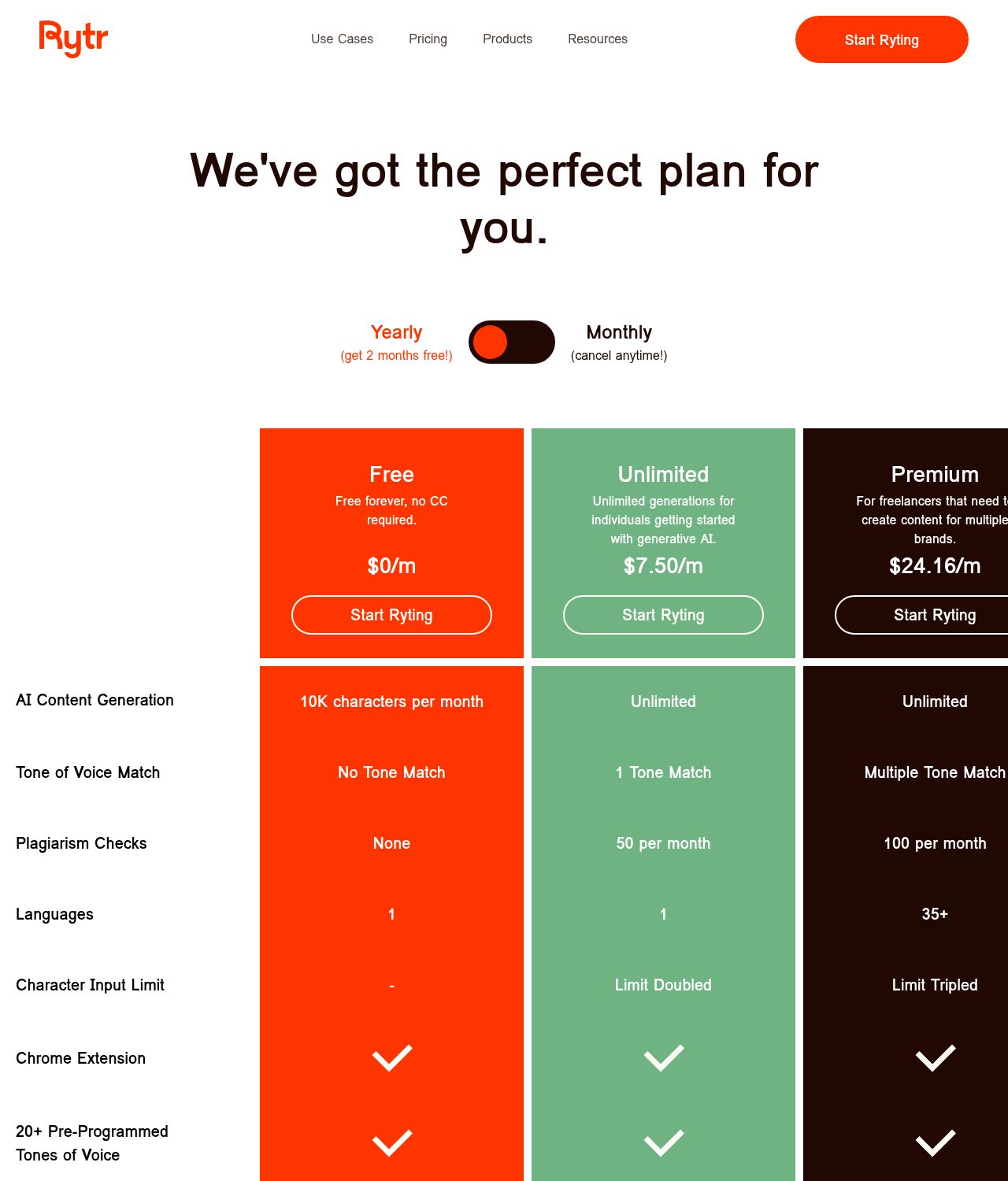
/assets/screenshots/tools/rytr.jpg Best for: freelancers and solos who want fast short-form copy for the lowest possible price. Where it falls short: it’s not built for long-form SEO articles or team workflows — no SERP scoring, thin brand controls, and quality needs a firm editorial hand.
Copy.ai — best for marketing and GTM copy
Copy.ai has moved upmarket into “GTM AI,” but its entry tier is still a capable copywriter. Verified pricing: a Chat plan at $29/mo ($24/mo billed annually) with five seats and unlimited chat words across OpenAI, Anthropic and Gemini models; then a steep jump to workflow-credit tiers — Growth $1,000/mo, Expansion $2,000/mo, Scale $3,000/mo — and custom Enterprise. Those upper tiers are automation platforms, not writing tools.
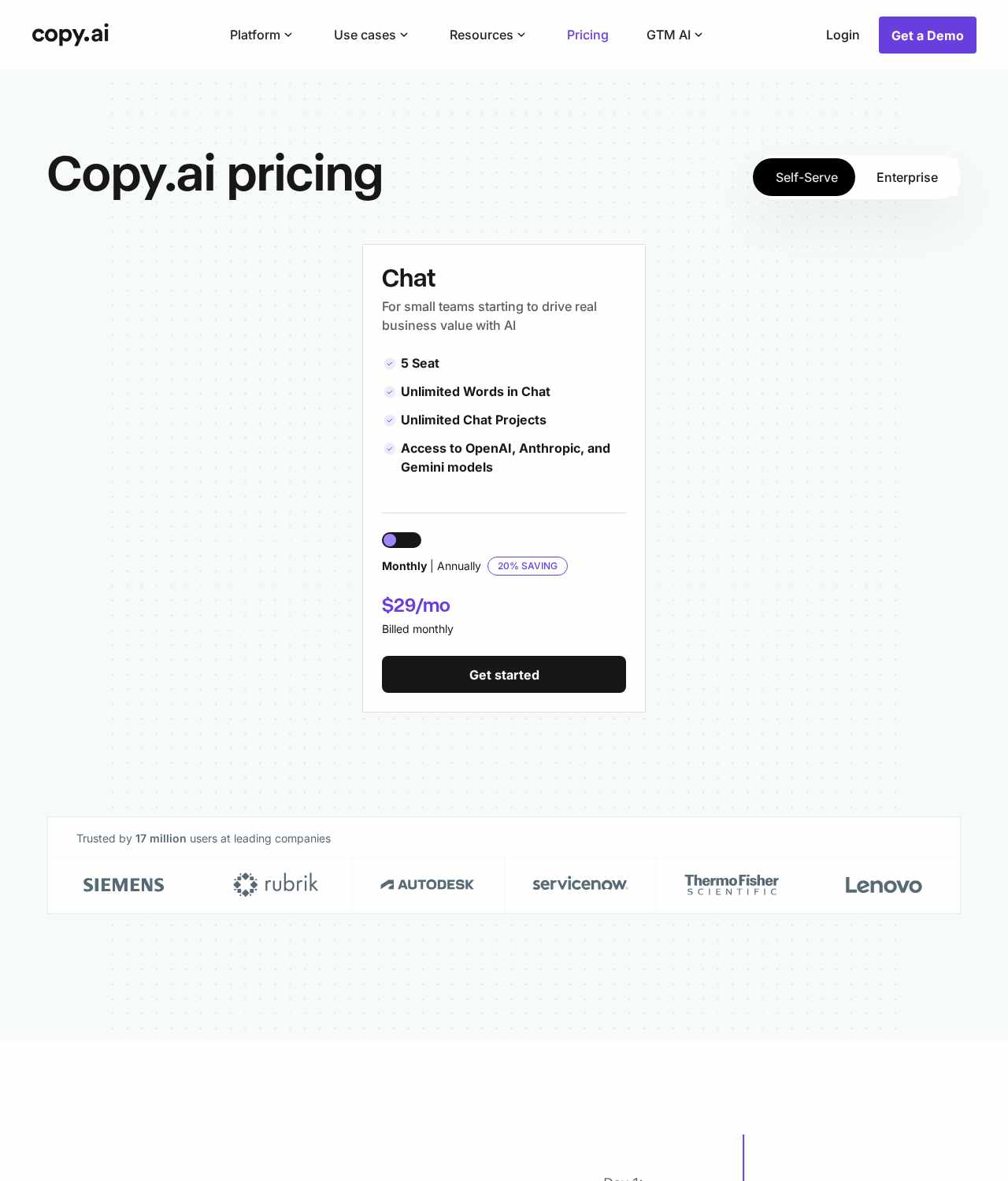
/assets/screenshots/tools/copy-ai.jpg Best for: small teams that want flexible marketing copy and light workflow automation at the $29 tier. Where it falls short: the gap between $29 and $1,000 is enormous — if you need real workflow volume, Copy.ai gets expensive fast, and the platform’s centre of gravity has shifted away from individual writers.
Anyword — best for performance-scored copy
Anyword’s hook is a predictive performance score on every piece of copy, trained on marketing data. Verified pricing: Starter $49/mo ($39 yearly; 1 seat, 50 performance predictions), Data-Driven $99/mo ($79 yearly; 3 seats, real-time scoring), and Business / Enterprise on custom pricing that add custom AI models and channel data. Copy generation is unlimited on every tier.
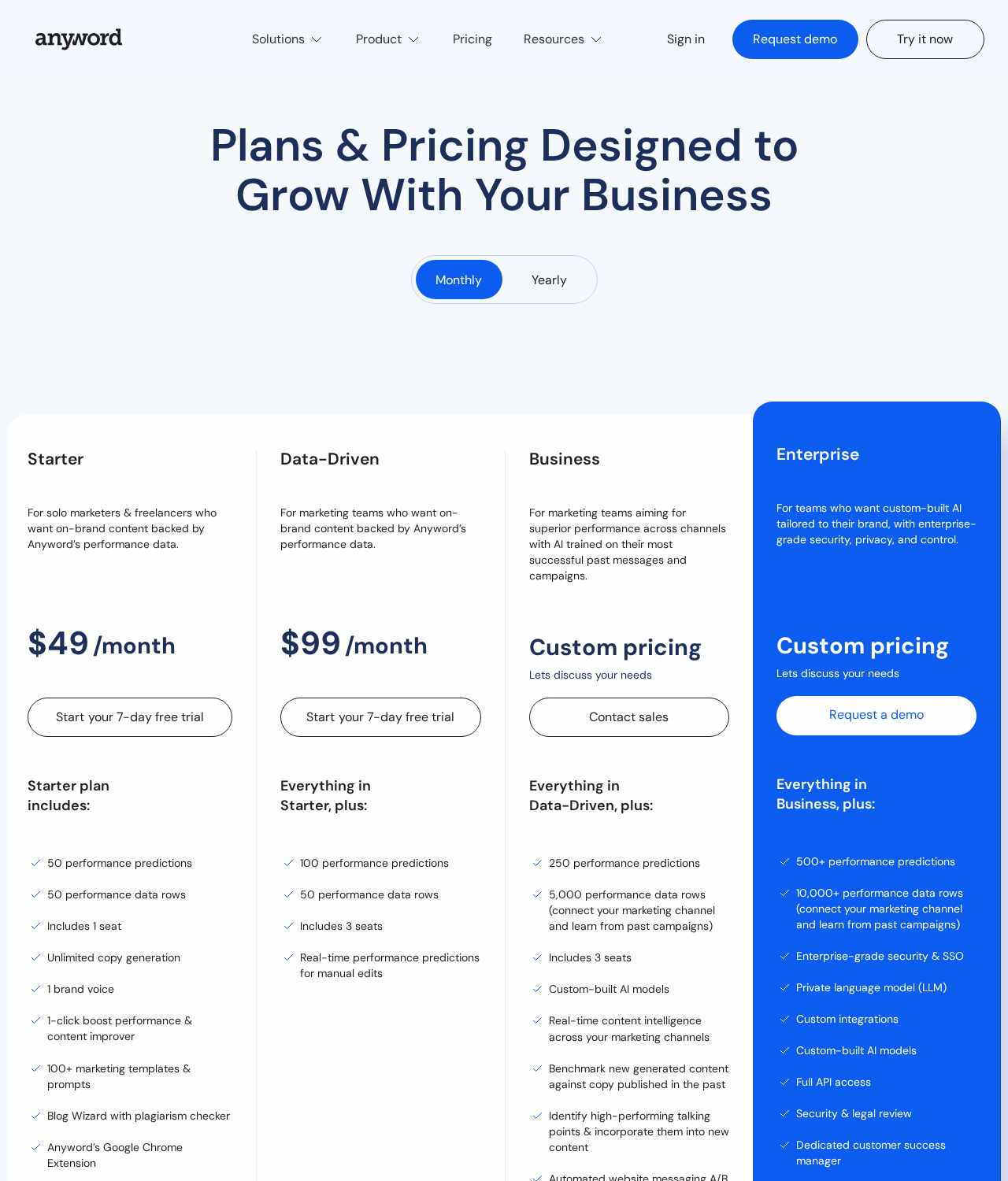
/assets/screenshots/tools/anyword.jpg Best for: performance marketers who want data-backed copy for ads, email and landing pages, and will use the scoring. Where it falls short: the performance data that makes Anyword special is capped low on entry tiers (50 rows), and it’s pricier than a plain writer if you won’t lean on the prediction feature.
Jasper — best for brand-governed writing at scale
Jasper is the enterprise-grade option: brand voices, style guides, knowledge assets, 100+ marketing agents and role-based controls. Verified pricing: Pro at $59/mo per seat billed yearly ($69 monthly), and a custom Business plan adding SSO, API access, GEO/translation agents and admin controls; some features run on credits alongside the seat price. If you want to weigh it directly, I keep an Optix vs Jasper head-to-head with verified pricing.
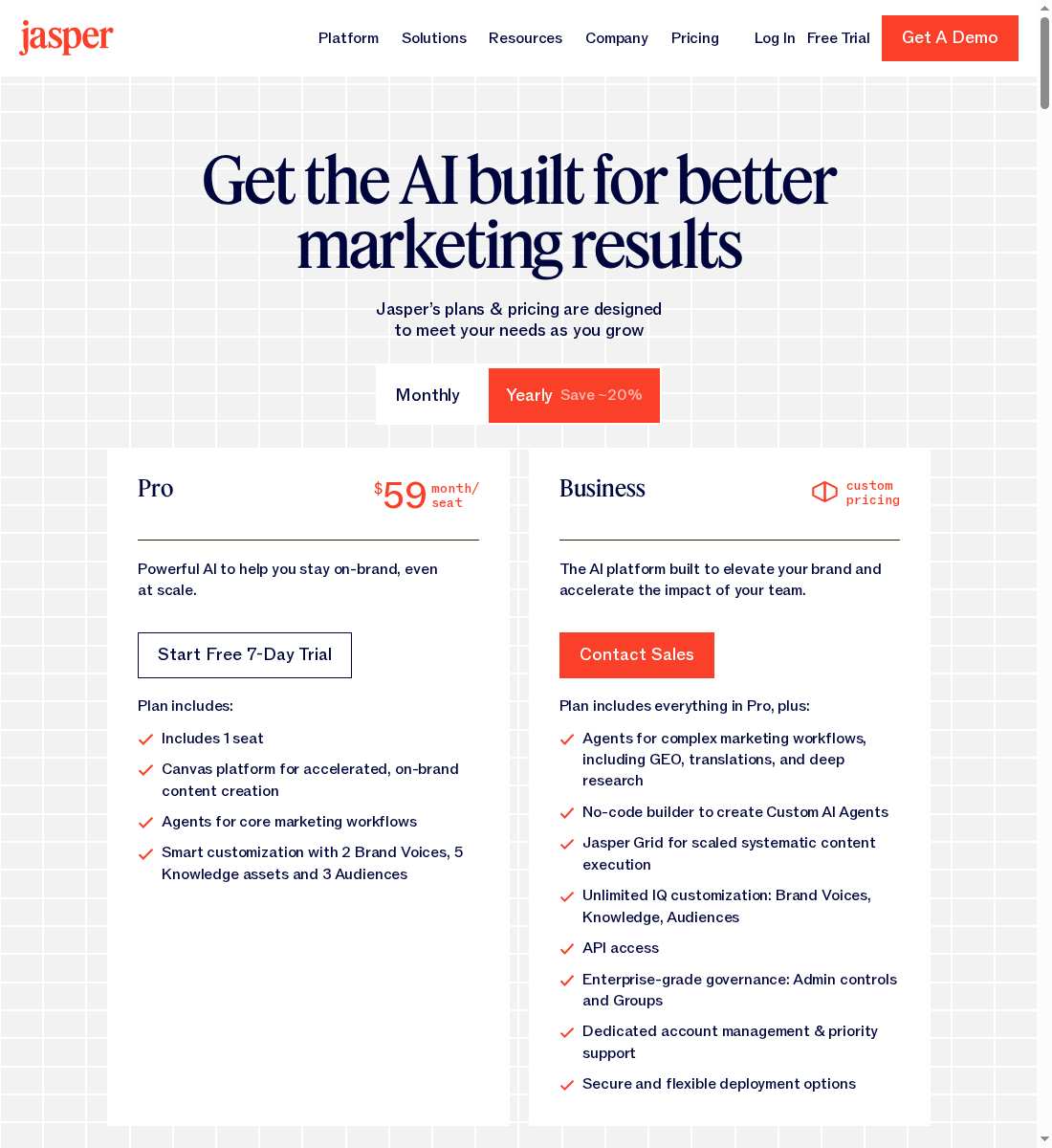
/assets/screenshots/tools/jasper.jpg Best for: marketing teams that need on-brand AI content across many channels with governance. Where it falls short: it’s more platform than you need for simple copy, and on-page SEO scoring isn’t as deep as a dedicated optimizer.
Frase — best for research-to-published SEO articles
If your real goal is articles that rank — not just copy — Frase is the more honest fit. It researches a topic, drafts in your voice, scores against the SERP for SEO and GEO, publishes to your CMS and monitors decay. Verified tiers: Starter $39/mo yearly ($49 monthly), Professional $103/mo yearly ($129 monthly) and Scale $239/mo yearly ($299 monthly), plus custom Enterprise.
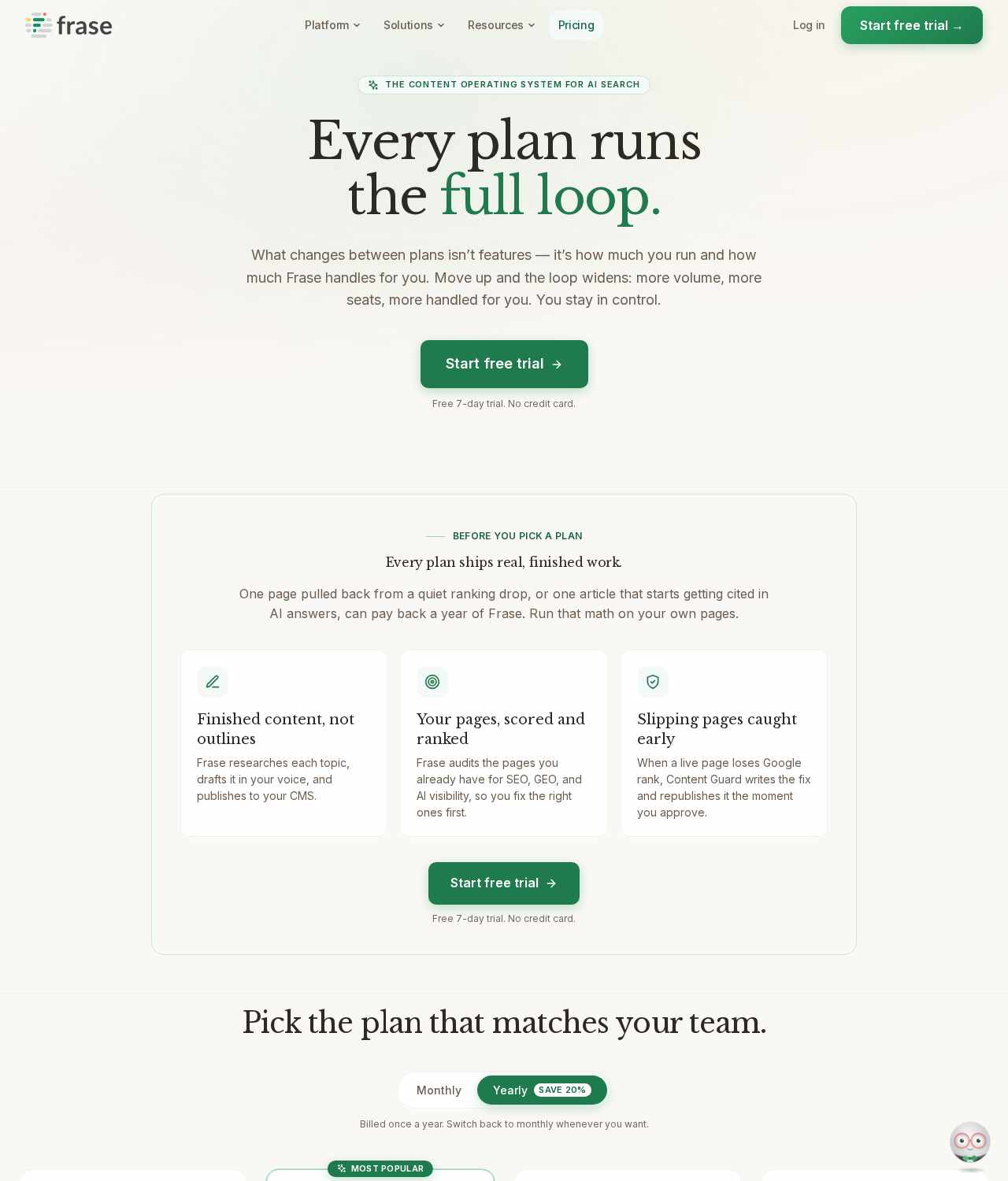
/assets/screenshots/tools/frase.jpg Best for: solos and lean teams who want the whole SEO-content loop, not just a text generator. Where it falls short: the monthly article/audit caps are real, and the pure editor is less deep than a specialist scorer like Clearscope.
Scalenut — best for an AI-first SEO content workflow
Scalenut bundles keyword clustering, a SERP-based editor and an AI long-form writer into one create-and-optimize flow. Verified tiers: Starter $59/mo, Plus $89/mo and Professional $199/mo, with a custom VIP service (promotional discounts were running at the time of checking). It’s covered in more depth in my Surfer SEO alternatives roundup.
Best for: teams that want to go keyword→published draft in one tool with SEO scoring baked in. Where it falls short: frequent lifetime-deal promos make pricing feel in flux, and the AI writer still needs editing before it ships.
Optix — best for citation-verified content, done for you
Full disclosure: Optix is my own product. Where the tools above hand you a draft or a score to act on, Optix runs the whole pipeline and returns a finished article with a citation-verification step baked in — every statistic and price checked against a primary source before it ships (the discipline behind this very article). If your problem with AI writers is that you still have to fact-check everything they produce, that’s the gap Optix targets. See the full head-to-head comparisons for like-for-like breakdowns.
Best for: consultants and lean teams who want trustworthy, sourced articles produced for them. Where it falls short: if you want cheap short-form copy or hands-on control of every draft, a writer like Rytr or a scorer like Frase fits better — and I’d point you there.
How to choose a Writesonic alternative
- Name the job first. Short-form copy → Rytr or Copy.ai. Performance-scored marketing copy → Anyword. Brand-governed team writing → Jasper. Ranking articles → Frase or Scalenut. Finished, verified content → Optix. AI-visibility tracking (Writesonic’s new job) → an AI visibility tool.
- Watch the tier cliffs. Copy.ai’s leap from $29 to $1,000 and Anyword’s low performance-row caps matter more than the headline entry price. Model your real volume.
- Don’t confuse fluent with correct. Every tool here writes quickly; none fact-checks by default. Budget editorial time, or use a workflow that verifies before publishing. The same AI content optimisation hygiene applies whoever — or whatever — drafted the page.
FAQ
What is the best Writesonic alternative in 2026?
It depends on the job. For cheap AI writing, Rytr from $9/mo. For marketing copy, Copy.ai from $29/mo. For performance-scored copy, Anyword from $49/mo. For brand-governed team writing, Jasper at $59/seat/mo. For SEO articles that rank, Frase ($39–$239) or Scalenut ($59–$199). All prices verified against each vendor’s own page in August 2026.
Is Writesonic still an AI writer?
Not primarily. Writesonic has repositioned as an AI search visibility platform — its plans (Starter $79, Basic $199, Growth $399, Enterprise custom, billed annually; verified 10 Aug 2026) centre on tracking your brand across ChatGPT, Gemini and Google AI Overviews, with a set number of AI articles bundled in. If AI-writing is your goal, the cheaper tools in this guide fit better; if visibility tracking is, see the AI visibility tools guide.
What’s the cheapest Writesonic alternative?
Rytr, at $9/mo for its Unlimited plan ($7.50/mo billed yearly), with a genuinely free tier (10,000 characters/month). It’s short-form-focused, so pair expectations accordingly — it’s not built for long-form SEO articles.
Which Writesonic alternative is best for SEO content?
For content designed to rank, Frase and Scalenut score and optimize against the live SERP, which a pure AI writer doesn’t. For finished, citation-verified articles produced for you, that’s what Optix does (full disclosure: Optix is my own product).
Do these tools fact-check their output?
No — none of them verify claims by default. AI writers produce fluent copy quickly, but statistics and prices need checking before you publish. Build editorial review into your process, or use a workflow with a verification step.
If you’d rather receive finished, fact-checked articles than run a writer yourself, your first article on Optix is free — a no-risk way to see the citation-verified output. And if one of the tools above fits your workflow better, take it — the goal is content that ranks and gets cited, whichever tool gets you there.