 Nadia Mohamed
AI-SEO & GEO
The Best Surfer SEO Alternatives in 2026: 8 Content-Optimization Tools Compared
What is a Surfer SEO alternative?
A Surfer SEO alternative is any tool that does the core job people buy Surfer for (analysing what already ranks for a query and telling you how to structure and word a page to compete) without being Surfer. The eight Surfer SEO alternatives compared here split into three groups: content-optimization editors that score a draft against the SERP (NeuronWriter, Page Optimizer Pro, Frase, Clearscope), strategy platforms and suites that plan or monitor a whole site (MarketMuse, Semrush), and AI-writing platforms that fold optimization into generation (Scalenut, Jasper). Which one fits depends on whether your bottleneck is scoring, planning or producing content.
Key takeaways
- You’re probably not paying for the same thing across tools. Surfer bundles SERP analysis, an AI writer, AI-visibility tracking and content auditing into one subscription. Focused alternatives like NeuronWriter or Page Optimizer Pro do the optimization job well and skip the rest, which is the point if you already have a writer and a rank tracker.
- Verified entry prices for the dedicated content tools span more than 5×. NeuronWriter starts at $23/mo, then come Frase ($39 billed yearly), Page Optimizer Pro ($40), Surfer’s own Discovery tier ($49), Scalenut and Jasper ($59 each), up to Clearscope at $129/mo. Price tracks scope (seats, article volume, AI-visibility coverage), not fundamentally better recommendations.
- Semrush is a different purchase. It’s a full SEO and AI-search suite, and content optimization appears on its Pro+ plan at $248.17/mo billed annually. It only beats Surfer on cost if you’d be paying for the suite anyway.
- The category has become “AI search”, not only Google. Surfer, Frase, Clearscope, Scalenut and NeuronWriter all now track AI answers alongside the classic content editor. If monitoring is the job you actually need, read the best AI visibility tools guide, because monitoring is a different product from optimization.
- Buy for the bottleneck. Scoring a draft → NeuronWriter or Clearscope. Planning a topic map → MarketMuse. Researching, writing, publishing and monitoring in one tool → Frase. On-page testing → Page Optimizer Pro. On-brand AI writing at team scale → Jasper. Already on an SEO suite → Semrush.
Which Surfer SEO alternative should you use?
Budget and the part of the workflow that actually hurts decide this, not a feature checklist. Every serious tool here now analyses the SERP and scores your draft against it. For the cheapest capable optimizer, NeuronWriter starts at $23/mo. For research, writing, auditing and publishing in one loop, Frase is the best value at $39–$239/mo billed yearly. For editorial teams that care most about output quality, Clearscope ($129/mo) is still the cleanest tool in the category. For content strategy, MarketMuse plans topic coverage better than anything else. If you test on-page changes rigorously, Page Optimizer Pro ($40/mo) is built for you. And if your team already lives in Semrush, its content optimization may make a separate optimizer redundant. I re-read every price below on the vendor’s own pricing page on 3 November 2026.
What Surfer actually is — and what you’re replacing
Surfer began as a SERP-analysis and content-scoring tool: paste a keyword, it reverse-engineers the pages that rank, and gives you a Content Score with word-count, heading and term targets to hit. In 2026 it’s broader. Its pricing page, which now lives on surfer.ai, leads with AI-search visibility. The plans are Discovery $49 · Standard $99 · Pro $182 · Peace of Mind $299 per month, all billed yearly, with Enterprise now on custom pricing (it carried a $999 sticker when I last checked in August). Enterprise is sold through Surfer’s Enterprise team and comes with a dedicated customer success manager. The standalone AI Search Analytics product, which tracks 50 prompts across ChatGPT, Gemini, AI Overviews and other models, now costs $82/mo billed yearly.
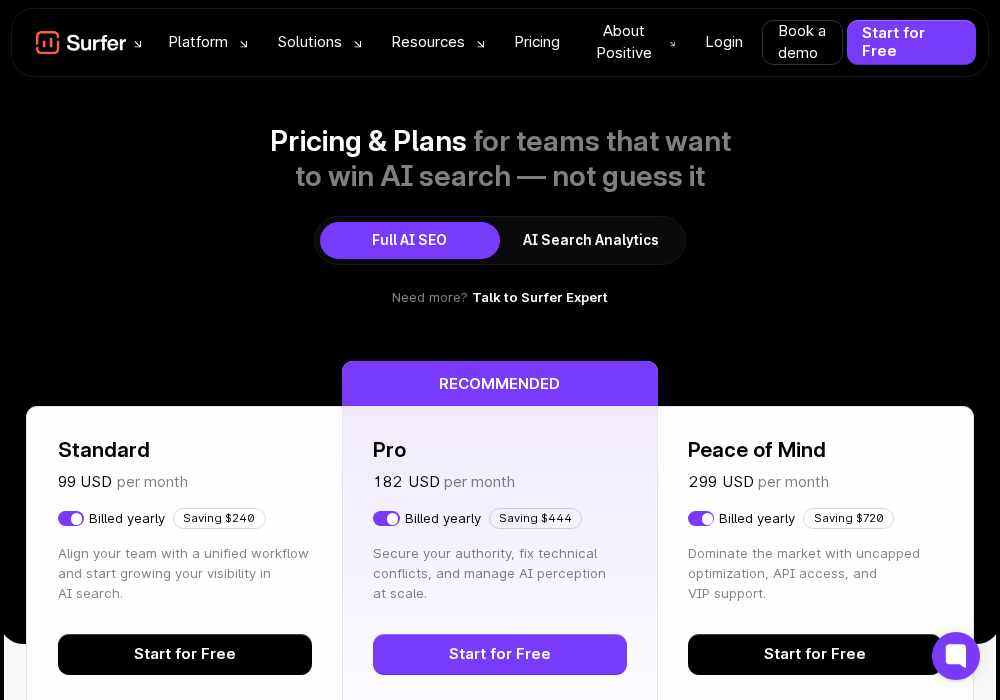
/assets/screenshots/surfer-seo-alternatives/surfer.jpg That breadth is exactly why people look for Surfer SEO alternatives. If you only use Surfer’s content editor, you’re paying for an AI-visibility tracker and content tooling you may never touch. If you want more strategy, more precise on-page guidance or a lower floor, a focused tool often fits better. The rest of this guide is organised by the buyer each alternative actually suits.
Why people look for Surfer SEO competitors (and when to stay)
Across the reviews and forum threads that rank for this query, the reasons for leaving Surfer come down to three things, and each one points to a different replacement.
1. You’re paying for layers you don’t use. Surfer’s Standard plan bundles 360 documents, weekly AI-prompt tracking, integrations, a plagiarism checker and rank-drop detection. That’s good value if you use all of it and poor value if you only open the editor. Unbundling is the reason the ranking reviews cite most, and it’s why NeuronWriter and Page Optimizer Pro exist as a category.
2. The billing model doesn’t match your cadence. Surfer’s yearly plans save up to 17% against monthly billing, but you’re charged for the entire year upfront. If your publishing volume swings month to month, a tool with a cheap monthly entry tier, or one like Frase whose Starter plan stops at its limits rather than billing overages, carries less risk.
3. You need a different job done. Some teams outgrow page-level scoring and need site-level planning (MarketMuse) or an all-in-one suite where content optimization sits next to rank tracking and technical audits (Semrush).
When to stay with Surfer: if you use the editor and the AI-visibility tracking and the internal-linking and cannibalization tools on Pro, assembling the same stack from separate subscriptions usually costs more and adds integration work. Switching makes sense when you can name the part of Surfer you’re not using. If you can’t, stay.
Quick comparison: Surfer SEO alternatives and what they cost
Every price and tier below was read from the vendor’s own live pricing page on 3 November 2026. “No public price” means the vendor doesn’t publish a sticker figure, so I’ve left it blank rather than guess.
| Tool | Best for | Entry price (verified 3 Nov 2026) | Notable limits at entry |
|---|---|---|---|
| NeuronWriter | Budget SEO optimization | $23/mo Bronze (2 months free on yearly) | 2 projects, 25 documents, 15,000 AI credits |
| Frase | Research-to-publish, all in one | $39/mo Starter billed yearly ($49 monthly) | 1 seat, 1 site, 10 articles, 50 audit pages |
| Page Optimizer Pro | On-page precision and testing | $40/mo Basic | 20 credits, 10 Watchdog pages |
| Scalenut | AI-first content and GEO workflow | $59/mo Starter (65% off yearly during current promo) | 10 tracked prompts, 1 workspace |
| Jasper | Brand-governed AI writing | $59/mo Pro billed yearly ($69 monthly), per seat | 1 seat, 2 brand voices |
| Clearscope | Editorial quality, content teams | $129/mo Essentials | 50 tracked queries, 50 pages, 20 drafts |
| Semrush | Teams already on an SEO suite | $139/mo SEO plan ($117.33 annually); content optimization from Pro+ at $299 ($248.17 annually) | Content optimization not on the two lower plans |
| MarketMuse | Content strategy and topic modelling | No public price; every tier is “Book a demo” | Free: 1 user, 10 queries/mo |
The best Surfer SEO alternatives, reviewed
These Surfer SEO alternatives are grouped by the buyer each one fits. I state strengths and prices only where I could confirm them on the vendor’s live page on 3 November 2026. Where a figure isn’t published, I say so instead of estimating.
NeuronWriter — best for budget SEO optimization
NeuronWriter is the closest like-for-like Surfer replacement at a fraction of the price. It does the core job (SERP-driven content analysis, an NLP term list, a scoring editor and AI drafting) and it’s transparent about limits. Verified pricing: Bronze $23/mo, Silver $45, Gold $69 (its “most popular” tier, which adds the Content Designer, GSC/WordPress/Shopify integrations, unlimited team members, an API/MCP and your own OpenAI key), Platinum $93 and Diamond $117, with two months free on yearly billing. Every tier now includes AI-monitored questions too (5 on Bronze), so it covers a small slice of AI-visibility tracking as well. The free trial runs 7 days on Gold terms.
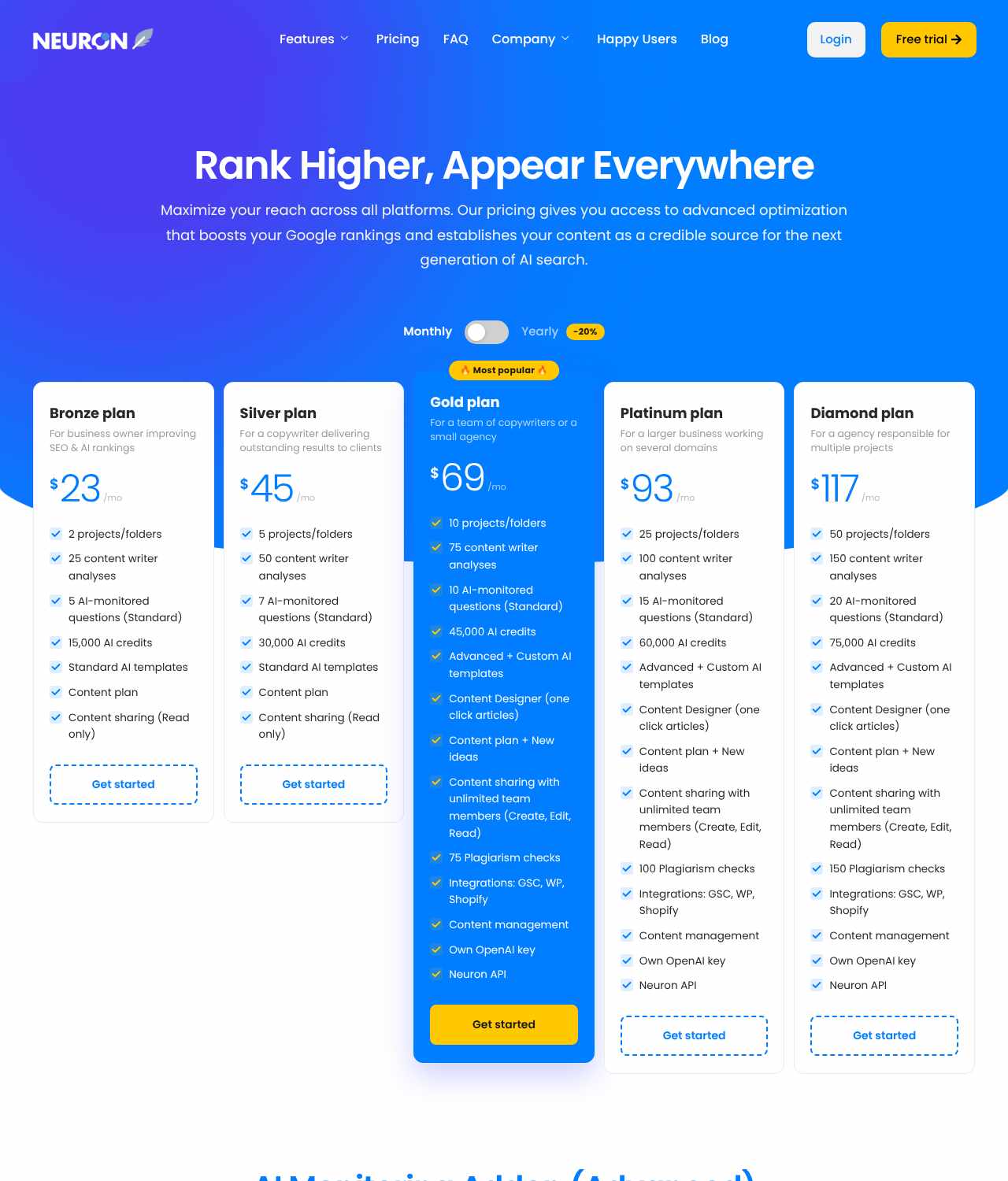
/assets/screenshots/surfer-seo-alternatives/neuronwriter.jpg Best for: solo SEOs, freelancers and small agencies who want Surfer-style optimization without Surfer’s price. Where it falls short: the UI is denser and less polished than Clearscope or Surfer, and every tier is metered on documents (25 on Bronze), so heavy months push you up the ladder faster than the sticker suggests.
Page Optimizer Pro — best for on-page precision and testers
Page Optimizer Pro (POP) is built for testers: its edge analysis shows where you can beat specific competitors, and it says outright that it doesn’t use correlation analysis. You get exact keyword placement guidance, NLP term targets, an EEAT analysis and Watchdog page monitoring. Verified pricing: Basic $40/mo (20 credits, 10 Watchdog pages), Unlimited $72/mo or $62 billed annually (100 Watchdog pages), and Teams $143/mo or $119 annually (500 Watchdog pages), plus a “White Glove” done-for-you service from $275. There’s a 7-day refund guarantee.
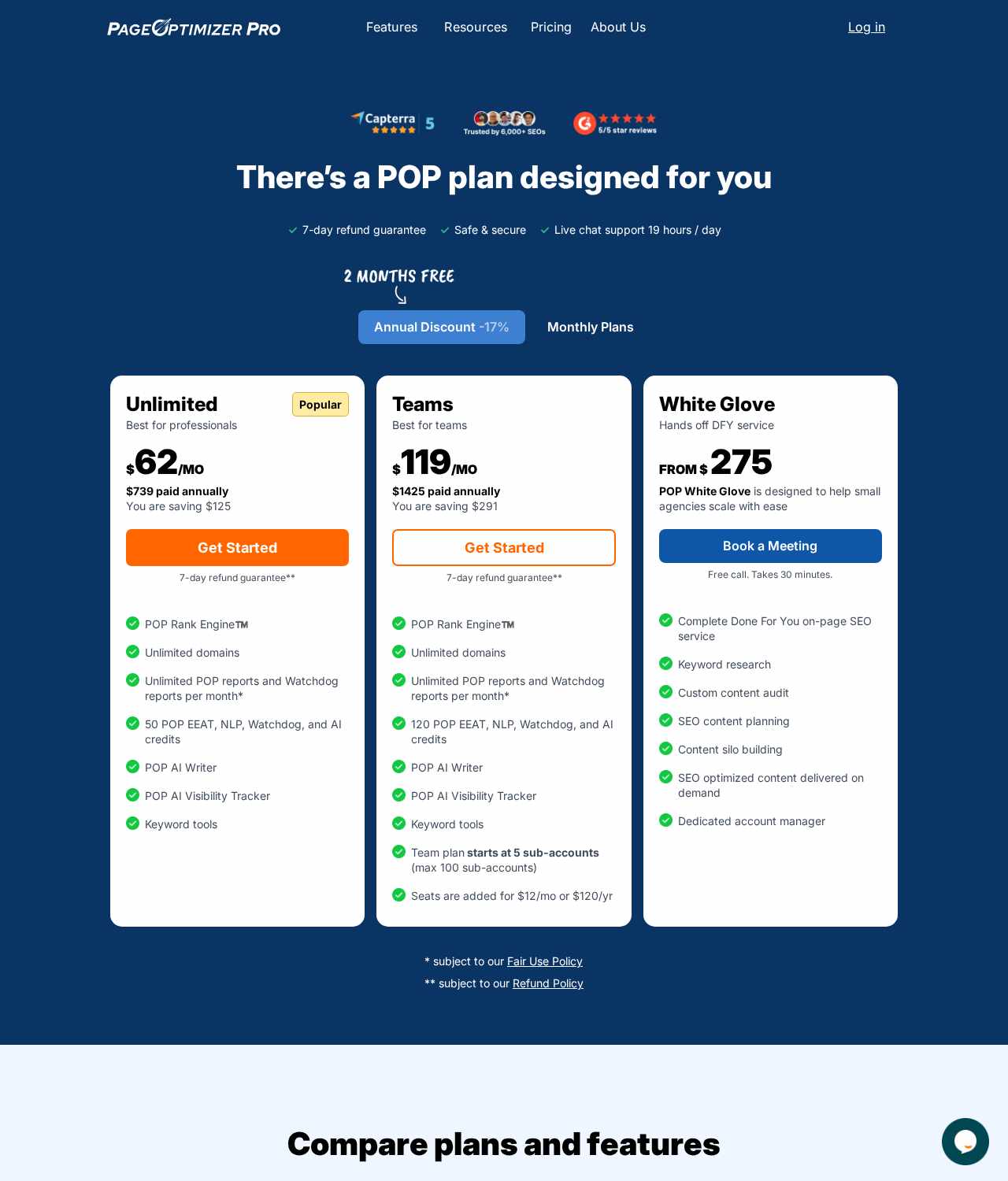
/assets/screenshots/surfer-seo-alternatives/page-optimizer-pro.jpg Best for: technical SEOs and testers who want granular, defensible on-page recommendations and page-change monitoring. Where it falls short: on Basic, the AI Writer, EEAT, NLP and Watchdog tools all draw down the same credit pool, so real cost depends on how many tools you lean on. The interface is utilitarian rather than a writing environment.
Frase — best for research-to-publish in one loop
Frase sells “one platform for the whole loop”: it researches a topic, drafts it, publishes to your CMS, audits existing pages and monitors AI visibility. That’s meaningfully more than Surfer’s editor, and the entry price is lower. Verified tiers: Starter $39/mo billed yearly ($49 monthly), with 1 seat, 1 site, 10 articles and 50 audit pages a month, plus AI Visibility on ChatGPT and Google AI. Professional is $103/mo yearly ($129 monthly), with 3 seats, 5 sites and Perplexity added. Scale is $239/mo yearly ($299 monthly), with 5 seats, up to 10 domains, and Claude and Gemini added. Enterprise is custom, and every plan has a 7-day free trial. One detail I like: Starter stops at its monthly limits instead of billing overages, so a surprise invoice can’t happen.
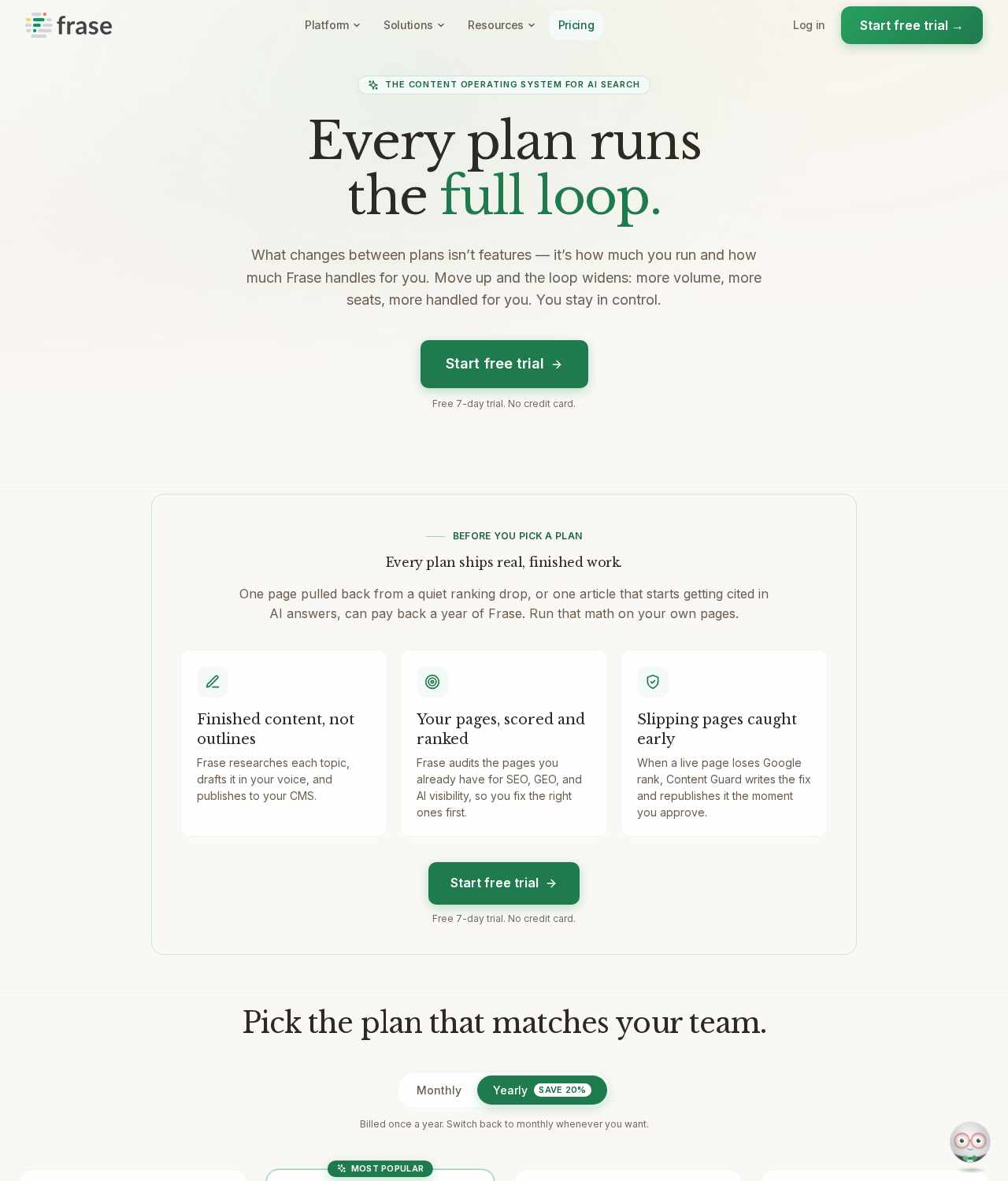
/assets/screenshots/surfer-seo-alternatives/frase.jpg Best for: solos and lean in-house teams who want research, writing, auditing and light AI-visibility tracking without stitching three subscriptions together. Where it falls short: the all-in-one loop means the pure content editor is less deep than a specialist like Clearscope, and the monthly article and audit caps are real. High-volume teams will hit the Starter ceiling quickly.
Clearscope — best for editorial quality and content teams
Clearscope has long been the tool editors trust when the priority is quality over volume: a clean content-grading editor, tight term recommendations, and reporting that non-SEOs can actually read. Every plan now also tracks queries across ChatGPT and Gemini and surfaces brand-visibility signals. Verified pricing: Essentials $129/mo (50 tracked queries, 50 pages, 20 monthly discoveries, 20 monthly drafts), Business $399/mo (300 tracked queries, 300 pages, a dedicated account manager) and custom Enterprise, with unlimited users and projects on every tier, no contract, and a 14-day free trial.
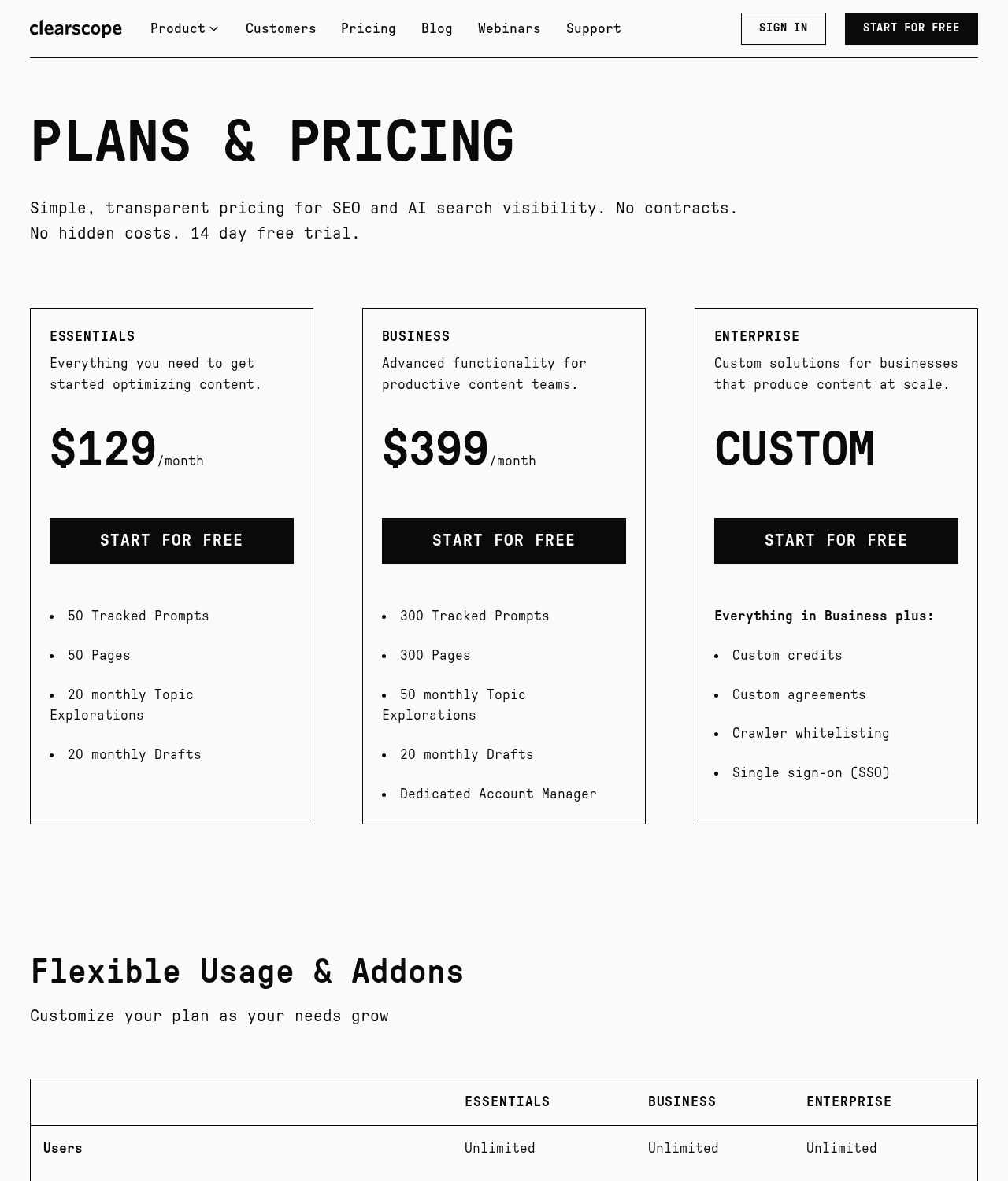
/assets/screenshots/surfer-seo-alternatives/clearscope.jpg Best for: in-house content teams and agencies where editorial standards and stakeholder-friendly reporting matter more than the lowest price. Where it falls short: it’s the most expensive entry point among the dedicated tools, and the value sits in the grading workflow. If you want an AI writer or programmatic scale, you’re paying premium prices for a tool used mostly as a scorer.
MarketMuse — best for content strategy and topic modelling
MarketMuse solves a different problem from Surfer: not “optimize this page” but “what should this whole site cover, and where’s my advantage?” Its topic modelling drives a site inventory with difficulty, topic-authority and competitive-advantage metrics, plus content briefs and strategy documents. The tiers are Free (1 user, 10 queries/mo), Optimize (100 tracked topics, 5 briefs/mo), Research (1,000 topics, 10 briefs, 3 users) and Strategy (10K topics, 20 briefs, 5 users). But MarketMuse publishes no dollar prices at all. Every tier says “Book a demo”, so I won’t quote a figure I can’t verify. Pair it with a topical-authority approach and it earns its keep.
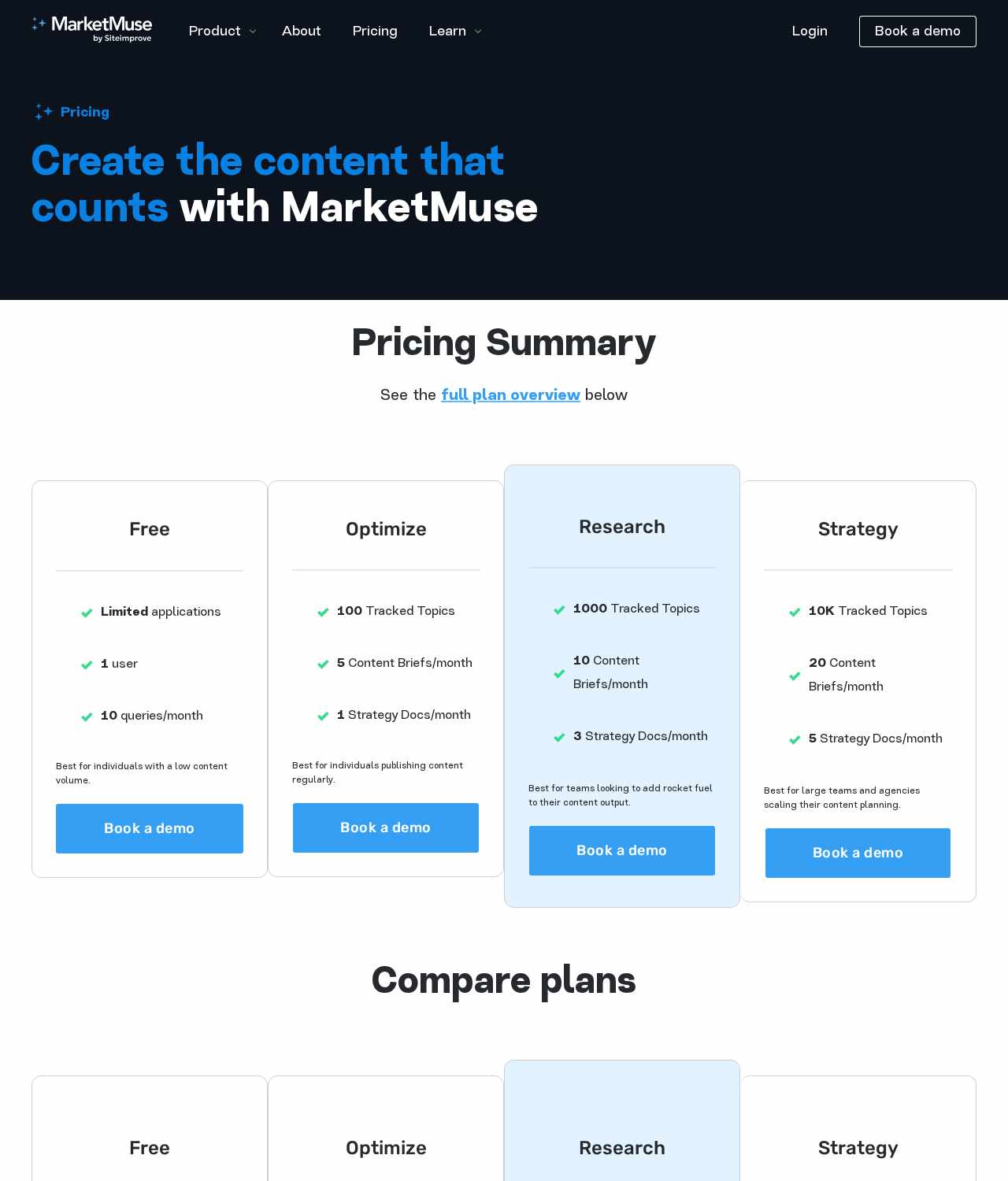
/assets/screenshots/surfer-seo-alternatives/marketmuse.jpg Best for: content strategists and larger teams planning topic clusters and prioritising a backlog with real inventory data. Where it falls short: without public pricing you can’t budget without a sales call, and it’s overkill if you only need to score individual drafts. The strategy layer is the point, and you pay for it.
Scalenut — best for an AI-first content and GEO workflow
Scalenut bundles keyword clustering, a SERP-based content editor, an AI long-form writer and a GEO/AI-visibility layer into a single “create and optimize” workflow. List prices are Starter $59/mo, Plus $89/mo and Professional $199/mo, with a custom VIP service. When I checked, a Black Friday early-access deal was taking 65% off yearly plans (about $21, $31 and $70 a month), so the sticker price is clearly negotiable if you time it. Starter tracks 10 prompts in one workspace. Plus adds internal linking, auto-publish to WordPress and Shopify and up to four team members. Professional unlocks unlimited workspaces.
Best for: teams that want to go from keyword to published draft inside one tool and value AI writing as much as scoring. Where it falls short: the recurring deep-discount promotions and the heavy repositioning towards “AI visibility” make the product feel in flux. Like every AI writer, it still needs a real editor before anything ships.
Jasper — best for brand-governed AI writing at scale
Jasper is the odd one out. It’s an AI writing platform first, with SEO and GEO layered on through agents, rather than a SERP-analysis tool that added writing. Its strength is brand governance (brand voices, knowledge assets, audiences and multi-seat controls), so large teams can produce on-brand content consistently. Verified pricing: Pro at $59/mo per seat billed yearly ($69 monthly), with 1 seat, 2 brand voices and 5 knowledge assets. The custom Business plan adds unlimited customization, agents for GEO, translation and deep research, and API access. There’s a 7-day free trial and a non-profit discount.

/assets/screenshots/surfer-seo-alternatives/jasper.jpg Best for: marketing teams that write a lot across channels and need brand consistency more than deep SERP scoring. Where it falls short: on-page optimization is less precise than a dedicated tool like Page Optimizer Pro or NeuronWriter, and the GEO agents sit on the custom Business plan, so total cost is harder to predict than a flat optimizer.
Semrush — best for teams already on an SEO suite
Semrush isn’t a content optimizer that grew a suite. It’s a suite that includes content optimization. Its current plans pair SEO with AI-search tracking: SEO at $139/mo ($117.33 billed annually), Starter at $199/mo ($165.17), Pro+ at $299/mo ($248.17) and a custom Advanced plan. The detail that matters for a Surfer comparison is that content optimization is listed on Pro+, alongside keyword cannibalization analysis, historical data and multi-location tracking. The lower plans give you keyword research, rank tracking, site audits and AI-visibility prompts (50 tracked daily on Starter), but not the content-optimization feature itself.
Best for: in-house teams and agencies that already pay for Semrush’s keyword, rank-tracking and audit data, and want content guidance in the same place. Where it falls short: bought only to replace Surfer’s editor, it’s the most expensive route on this list. The content tool is one feature among dozens, not the centre of the product.
Surfer SEO vs Semrush
If you’re weighing Surfer against Semrush, the honest answer is that they’re built for different purchases.
| Surfer | Semrush | |
|---|---|---|
| What it is | Content optimization and AI-search visibility platform | Full SEO and AI-search suite |
| Content optimization | The core product, on every plan | Listed from the Pro+ plan |
| Price for content optimization (billed yearly) | From $49/mo (Discovery) | $248.17/mo (Pro+) |
| AI-visibility tracking | 25 prompts weekly on Standard; 50 daily on Pro | 50 prompts daily on Starter; 100 on Pro+ |
| Keyword research, rank tracking, site audit | Limited; not the focus | Core strengths |
| Pick it if | Content is the bottleneck and you already have keyword data | You need the whole SEO data stack, and content is one part of it |
All figures are from Surfer’s pricing page and Semrush’s pricing page, checked 3 November 2026. In practice the decision comes down to what’s already paid for. A team with a Semrush contract rarely needs Surfer as well. A content team without one rarely needs to buy a whole suite to get a content editor.
How to choose a Surfer SEO alternative
Once you’ve narrowed the Surfer SEO alternatives by buyer type, decide on four practical dimensions:
- Name your bottleneck first. If drafts already exist and need scoring, buy an optimizer (NeuronWriter, Clearscope, POP) and skip the AI-writer bundles. If planning is the gap, MarketMuse. If you need the whole loop, Frase. Buying a suite to solve a single-step problem is the most common overspend here.
- Watch the metering, not only the sticker. Credits (POP), documents (NeuronWriter), monthly article and audit caps (Frase), and seat pricing (Jasper) all mean your real bill depends on volume. Convert everything to cost per article per month at your cadence before comparing.
- Decide whether you’re buying for Google, AI search, or both. Several of these now track AI visibility, but that’s a different job from optimizing a page. If monitoring is what you actually want, start with the AI visibility tools guide and the GEO optimization tools roundup, which cover that split in detail.
- Trust the recommendation, then verify the claims. Every scoring tool will confidently tell you to add terms and words. Pressure-test the output against real intent, and fact-check any statistic it writes for you. The same AI-content-optimisation hygiene applies whether a person or a model drafted the page.
Where these tools fit in the wider stack
A content optimizer is one layer, not the whole strategy. On its own it improves a page’s odds of ranking. It doesn’t tell you what to publish or whether AI engines are citing you:
- Strategy: what to cover and in what order. This is MarketMuse’s home turf, and it maps onto building topical authority for AI search. Get this wrong and no amount of on-page scoring saves you.
- Optimization: making each page competitive for its target query. That’s the core Surfer job, and every alternative above does it. Pick on price, workflow and how much writing you want bundled in.
- Visibility: whether Google and the answer engines actually surface you. Score a page’s readiness with the free AEO Analyzer, then track outcomes with a dedicated monitor rather than assuming a good Content Score equals citations.
Buy an optimizer once you’re publishing enough that eyeballing the SERP stops scaling. Pair it with a strategy layer above and a visibility check below, so the score you’re paying for actually turns into traffic.
A note on Optix (my product)
Full disclosure: I build Optix, so it isn’t counted among the eight above. It’s a different shape of tool: instead of handing you a score or a draft, it runs the pipeline from keyword to finished article. Sources are fetched and verified against the live page before any writing begins, and every article passes a 14-check quality gate (7 SEO and 7 GEO checks) before delivery. This article was refreshed under the same discipline. Optix never publishes anything itself; you review and publish. If you want a direct read on how it differs from Surfer, I keep an Optix vs Surfer SEO breakdown and a full comparison hub.
If your bottleneck is scoring drafts you write in-house, a self-serve editor like NeuronWriter or Clearscope gives you more hands-on control at a predictable monthly price. In that case I’d point you to one of them.
Related comparisons
If you’re evaluating a specific tool rather than the whole category, these companion guides go deeper, each with pricing checked against the vendor’s own page:
- Surfer SEO review: is Surfer itself worth it? Features, pricing and verdict.
- Frase alternatives: the same content-optimization market, seen from Frase.
- Jasper alternatives: if AI writing, not scoring, is the job.
FAQ
What is the best Surfer SEO alternative in 2026?
There’s no single winner among Surfer SEO alternatives; it depends on your bottleneck and budget. For the cheapest capable optimizer, NeuronWriter starts at $23/mo. For an all-in-one research-to-publish loop, Frase runs $39–$239/mo billed yearly. For editorial quality, Clearscope ($129/mo) is the cleanest tool in the category. For content strategy, MarketMuse leads, and for teams already on an SEO suite, Semrush’s Pro+ plan includes content optimization. All prices were checked against each vendor’s own page on 3 November 2026.
Is there a free Surfer SEO alternative?
Partly. MarketMuse has a limited free tier, and most tools here offer free trials rather than a permanently free plan: 7 days for NeuronWriter, Frase and Jasper, and 14 days for Clearscope. Surfer’s own Keyword Surfer Chrome extension is free and shows search volume and keyword ideas, but it’s a research aid, not a content editor. For a free page-level readiness check, use the AEO Analyzer. Genuinely free, unlimited content optimization doesn’t exist in this category.
How much does Surfer SEO cost, and are alternatives cheaper?
Surfer’s plans are Discovery $49, Standard $99, Pro $182 and Peace of Mind $299 per month billed yearly, with Enterprise on custom pricing (checked 3 Nov 2026). Several Surfer SEO alternatives are cheaper at entry, including NeuronWriter ($23), Frase ($39 billed yearly) and Page Optimizer Pro ($40), though they bundle less. Clearscope ($129) costs more but focuses on editorial quality. Compare on scope, not the headline number.
Surfer SEO vs Semrush: which should I choose?
Choose Surfer if content is your bottleneck: content optimization is its core product and starts at $49/mo billed yearly. Choose Semrush if you need keyword research, rank tracking and site audits as well, since content optimization comes on its Pro+ plan at $248.17/mo billed annually. If you already pay for Semrush Pro+, a separate Surfer subscription is usually redundant.
What’s the difference between a content optimizer and an AI visibility tool?
A content optimizer (Surfer, Frase, NeuronWriter, Clearscope) analyses the SERP and scores your page so it competes for a query, so it works on the input. An AI visibility tool measures whether ChatGPT, Perplexity, Gemini and AI Overviews actually mention or cite your brand, so it measures the outcome. Many tools now do a bit of both, but they’re different jobs. The AI visibility tools guide covers the monitoring side.
Do I still need Surfer if I have a good writer?
Often not, and that’s exactly when a cheaper, focused optimizer makes sense. If a capable writer already produces the drafts, you mainly need SERP-driven scoring, which NeuronWriter ($23/mo) or Page Optimizer Pro ($40/mo) deliver without Surfer’s AI-writer and visibility-tracking bundle. Pay for the wider suite only if you’ll use the extra layers.
Which Surfer SEO alternative is best if I mainly need to score drafts I already have?
Pick a focused optimizer such as NeuronWriter, Clearscope or Page Optimizer Pro. If drafts already exist and only need scoring, you can skip the AI-writer bundles and the AI-visibility layers. NeuronWriter starts at $23/mo, Page Optimizer Pro at $40/mo, and Clearscope at $129/mo for editorial teams that care most about quality.
Why do people switch away from Surfer SEO?
The article names three reasons. People pay for layers they don’t use, such as the AI-visibility tracker and bundled tooling. The yearly billing model charges the full year upfront, which suits uneven publishing cadences poorly. Or they need a different job done, like site-level planning with MarketMuse or an all-in-one suite like Semrush.
When should I stay with Surfer SEO instead of switching?
Stay if you use the editor, the AI-visibility tracking and the internal-linking and cannibalization tools on Pro together. Rebuilding that stack from separate subscriptions usually costs more and adds integration work. Switching makes sense when you can name the part of Surfer you’re not using. If you can’t, the article says to stay.
Which Surfer SEO alternatives track AI search visibility?
Surfer, Frase, Clearscope, Scalenut and NeuronWriter all now track AI answers alongside the classic content editor. Frase’s Starter plan covers ChatGPT and Google AI, and Clearscope tracks queries across ChatGPT and Gemini. Monitoring is a different job from optimization, so a dedicated AI visibility tool may suit you better if that is your main goal.