 Nadia Mohamed
AI-SEO & GEO
Best Keyword Clustering Tools in 2026: Free and Paid, Compared by the Method Each One Uses
The best keyword clustering tools in 2026 are Keyword Insights, KeyClusters and Keyword Cupid for dedicated clustering from live search results, Semrush, SE Ranking and Ahrefs if you already pay for one of those suites, and Zenbrief or a short script if you need a free option. The choice that matters more than the brand is the method: whether a tool groups keywords by the pages Google ranks for them, by one top-ranking page, or by what the words mean.
This article compares nine tools and one do-it-yourself route by method, list limit, export format and price, all read from each vendor’s own page on 24 September 2026. It also shows what those methods do to the same keyword list: I ran four clustering methods on one 34-keyword set and report the cluster counts, where they disagree, and the script, so you can repeat the test on your own export.
Key takeaways
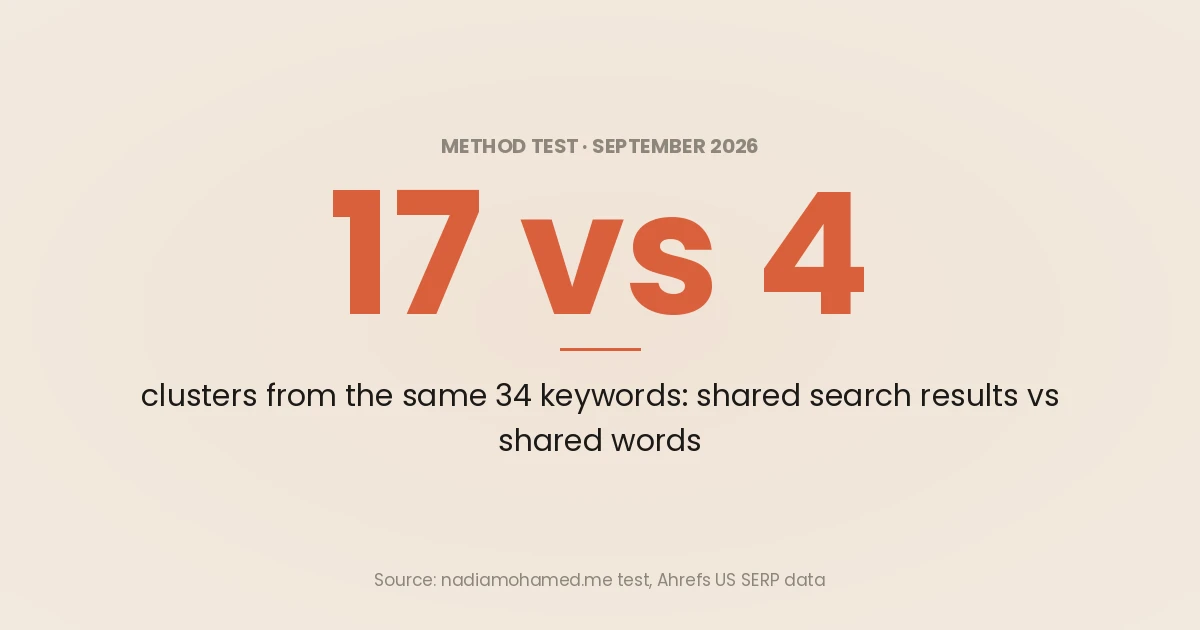
- Pick the method before the tool. On the same 34 keywords, grouping by shared search results produced 17 clusters, grouping by shared words produced 4, and word-vector similarity produced 7.
- SERP-based tools (Keyword Insights, KeyClusters, Keyword Cupid, SE Ranking, Semrush) are the ones to use for deciding which keywords belong on one page. Semantic grouping, the method behind the free tools, merged informational and commercial keywords in the test.
- Ahrefs clusters by Parent Topic, which reads only the top-ranking page. Ahrefs itself calls this “arguably less accurate” than full-SERP clustering, and in the test it kept only 41% of the pairs the full-SERP method put together.
- A one-off 500-keyword export does not need a subscription: KeyClusters sells 2,500 keyword credits for $19, and Keyword Insights’ $1 trial covers clustering up to 500 keywords.
- Check the SERP date. One keyword in the original test list had a stored search result from March 2024, and it was also the only one with no Ahrefs Parent Topic.
Keyword clustering tools compared
Every price, limit and method below comes from the vendor’s own pricing or product page, read on 24 September 2026. Where a page does not state something, the cell says so rather than guessing.
| Tool | Clustering method | Keywords per run | Export | Price (as of 24 Sep 2026) | Cost to cluster 500 keywords once |
|---|---|---|---|---|---|
| Keyword Insights | Live SERP overlap, adjustable threshold | Up to 200,000 | Google Sheets, Excel | Basic $58/mo (10,000 credits), 1 credit per keyword | $1 trial covers up to 500 |
| KeyClusters | Live SERP, 3 or more shared top-10 pages | No stated limit | Excel or CSV | $19 for 2,500 credits, no subscription | $19 (credits never expire) |
| Keyword Cupid | Live SERP plus a model that builds a hierarchy | 2,000 per report on Starter | Excel, CSV, mind map | Starter $9.99/mo (500 credits) | $9.99 |
| SE Ranking Keyword Grouper | SERP, you set minimum matching URLs | Not stated | Not stated on the page | Core plan from $103.20/mo, plus per-query cost | Plan plus per-query fee |
| Semrush Keyword Strategy Builder | Top-10 SERP similarity | 2,000 per list, 10,000 per account | Spreadsheet | Paid plan needed, from $139/mo | Inside a subscription or 7-day trial |
| Ahrefs Keywords Explorer | Parent Topic (the top-ranking page) and word terms | Up to 10,000 pasted | Not checked | Standard plan or higher, $249/mo | Inside a Standard subscription |
| LowFruits | SERP or semantic, from its own SERP extraction | Credit-limited | Not stated on the pricing page | $25 for 2,000 PAYG credits, or $29.90/mo | About 500 credits of a $25 pack |
| Zenbrief | Semantic (transformer embeddings) | 5,000 free, English only | Download | Free | Free |
| Keyword Clustering (this site) | Semantic (embeddings, hierarchical) | 1,000 | On-screen results | Free, sign-up required | Free |
| Your own script | Whatever you code; below it is SERP overlap | Unlimited | CSV | Free, plus the cost of SERP data | Cost of 500 SERP lookups |
What the method does to the same keyword list
Tool roundups rarely publish the list, the settings or the date of the search data, so their results cannot be compared or repeated. Running nine tools side by side would also mean buying every subscription. What can be run honestly is the four methods the tools are built on, on one list, with the list, settings, data dates and code published. That is what this section does.
The test set and the data
The list is 34 US keywords from Ahrefs’ matching-terms report for “keyword clustering”, “keyword grouping” and close variants, each with at least 100 searches a month. It mixes definitions (“what is keyword clustering”), tool searches (“free keyword clustering tool”), a Python query and four Google Ads questions (“how many keywords per ad group”), because a clustering method is only useful if it separates those.
The full list: keyword grouping, keyword clustering tools, cluster keyword, keyword clustering, keyword cluster, keyword clustering tool, keyword grouping software, keyword clustering seo, free keyword clustering tool, semantic keyword grouping, what is keyword clustering, how to group keywords, seo keyword cluster, keyword cluster tool, free keyword grouping tool, grouping similar keywords together in an ad group, semantic keyword clustering python, group similar keywords together in an ad group, how many keywords per ad group, keyword grouping tool, group keywords, how to do keyword clustering, semantic keyword clustering, cluster keywords, seo keyword clustering, best keyword clustering tool, cluster ai keyword, keyword grouping tools, keyword clustering example, number of keywords per ad group, seo keyword grouping, cluster ai keyword tool, keyword clustering examples, clustering keyword.
For each keyword I pulled the organic top-10 URLs from Ahrefs’ SERP Overview on 24 September 2026. Ahrefs had last refreshed 34 of the 35 original SERPs between 5 August and 24 September 2026. The 35th, “best keyword clustering tools”, had a stored SERP dated 3 March 2024, so I dropped it rather than cluster a stale result.
Three details from the raw data matter for anyone doing this:
- Fewer than ten organic URLs. SERP features take some of the ten positions, so Ahrefs returned 5 to 9 organic URLs per keyword, 8 on average. A threshold of “3 of the top 10” is really “3 of the 8 or so that are organic”.
- URLs need normalising. The same page arrived as
keyclusters.com/andwww.keyclusters.com/, some URLs had different letter case, and a few came back cut down to a section URL such assurferseo.com/blog. Without normalising, those count as different pages and overlap is undercounted. - Head terms can have odd SERPs. “keyword clustering” itself had an AI Overview at position 1 and several unrelated organic results, so it shared no URLs with “what is keyword clustering”.
The results
Each method was run on the same 34 keywords. “Agreement” is the share of keyword pairs (0 to 1) on which the method makes the same together-or-apart call as SERP overlap (hard, 3 URLs). “Pairs kept” is the share of pairs that SERP overlap puts together which the method also puts together.
| Method | Closest tool setting | Clusters | Single-keyword clusters | Largest cluster | Agreement | Pairs kept |
|---|---|---|---|---|---|---|
| SERP overlap, hard, 3 shared URLs | KeyClusters’ stated 3-URL rule | 17 | 9 | 7 | 1.00 | 1.00 |
| SERP overlap, soft, 3 shared URLs | Soft mode | 16 | 9 | 9 | 0.96 | 0.92 |
| SERP overlap, hard, 4 shared URLs | Stricter settings | 20 | 13 | 5 | 0.95 | 0.43 |
| SERP overlap, chained, 2 shared URLs | Loose settings | 8 | 5 | 25 | 0.53 | 1.00 |
| Parent Topic | Ahrefs | 17 | 10 | 5 | 0.93 | 0.41 |
| Shared words (Jaccard 0.5 or more) | Term and lemma grouping | 4 | 0 | 19 | 0.67 | 0.89 |
| Word vectors, cosine 0.8 or more | Semantic tools | 7 | 2 | 12 | 0.79 | 0.43 |
| Word vectors, cosine 0.7 or more | Loose semantic setting | 3 | 0 | 14 | 0.67 | 0.65 |
“Hard” means every keyword in a cluster shares at least three URLs with every other member. “Soft” means each keyword only has to share them with the cluster’s highest-volume keyword. “Chained” links any two keywords that share enough URLs and lets the links run on, so A joins C through B. The word-vector method averages the word vectors in spaCy’s medium English model (en_core_web_md) for each keyword, which is a basic form of semantic clustering; commercial semantic tools use stronger models, so treat that row as the direction of the effect, not its exact size.
What the numbers show
SERP overlap split the list by intent. At three shared URLs, the four tool searches (“keyword clustering tools”, “keyword clustering tool”, “free keyword clustering tool”, “best keyword clustering tool”) formed one cluster, and seven definition and how-to searches formed another. That is the split you want: a tools roundup and a method guide are different pages, and Google treats them that way.
Shared words lumped everything together. Grouping by words put 19 keywords into one cluster, tool searches and definitions alike, because they all contain “keyword” and “cluster”. It did correctly pull the four Google Ads questions into their own group, which is why its pair agreement is not lower.
Word vectors joined keywords Google keeps apart. “keyword clustering tools” and “keyword clustering examples” scored 0.89 similarity, and shared zero URLs. “how to group keywords” and “grouping similar keywords together in an ad group” scored 0.84, and also shared zero, because the first is an SEO question and the second a Google Ads one. Both pairs landed in the same semantic cluster.
The same words do not guarantee the same results. “keyword clustering tool” and “keyword grouping tool” shared one URL. “free keyword clustering tool” and “free keyword grouping tool” shared five. The free-tool searches return the same set of free tools, while the unqualified versions do not.
The threshold matters more than the tool. Moving from three to four shared URLs raised the cluster count from 17 to 20 and left 13 keywords on their own. Dropping to two with chaining collapsed 25 of 34 keywords into one cluster. Every SERP-based tool in the table exposes some version of this setting, and its default decides your content plan.
Parent Topic matched the count but not the membership. Ahrefs’ field produced 17 clusters, the same number as full-SERP overlap, but kept only 41% of the pairs full-SERP overlap put together. It grouped “keyword grouping” with “group keywords”, which share one URL, because both have the Parent Topic “keyword grouping”.
None of this means one method is correct in every case. It means the method is a decision you make when you pick the tool. The case for SERP overlap as the default for page planning is set out in the guide to keyword clustering by SERP overlap.
The tools, one by one
Keyword Insights: the most configurable SERP clustering
Keyword Insights uses “live, country-specific SERP data” and supports “up to 200,000 keywords to be clustered at a time”. You can change the URL overlap threshold and choose between centroid and agglomerative algorithms. It uses NLP only to relate finished clusters to each other, not to form them.
Its own page gives two defaults: the body text says keywords that share 30% or more of top-10 URLs are clustered, while the FAQ says 40% or more of the top 7. Set the threshold yourself rather than trusting either. Pricing is credit-based: Basic is $58 a month for 10,000 credits, clustering costs 1 credit per keyword, and a $1, 7-day trial includes clustering for up to 500 keywords.
Best for: agencies and in-house teams who cluster large lists often and want control over the algorithm. Watch out for: credits are shared with briefs and AI writing, so heavy writing use eats into clustering.
KeyClusters: pay-as-you-go SERP clustering with a fixed rule
KeyClusters runs each keyword through Google, analyses “the top 10 ranking pages, and cluster[s] keywords together that have 3 or more of the same pages in common”. You upload an Ahrefs, Semrush or custom file and get the result back as a spreadsheet. It supports desktop or mobile results and any geography.
There is no subscription. One credit is one keyword, packs start at $19 for 2,500 keywords, and credits never expire, which suits an occasional list better than a monthly allowance.
Best for: freelancers and teams who cluster a few lists a year. Watch out for: there is no keyword research built in, the result is a spreadsheet rather than an interactive report, and the three-URL rule is fixed, so check the output for over-split head terms.
Keyword Cupid: SERP data plus a hierarchy
Keyword Cupid scrapes live Google results for every keyword and, in its words, “calculates connection strength between keyword pairs, and builds a hierarchical tree of topic clusters”. The output is an interactive mind map and an Excel or CSV export that groups keywords into pages and pages into silos. Reports run in the background and email you when done.
Starter is $9.99 a month for 500 keyword credits and up to 2,000 keywords per report. Freelancer is $49.99 for 5,000 credits. Monthly credits reset each cycle.
Best for: planning site structure, where the page-to-silo hierarchy is the deliverable. Watch out for: the hierarchy comes from a model trained per report, so it is harder to explain a single grouping decision than with a fixed overlap rule.
SE Ranking Keyword Grouper: SERP clustering inside a suite
SE Ranking’s Keyword Grouper lets you “define the minimum number of matching URLs and clustering method”, with country, location and language settings. Each group is named after its highest-volume keyword, and the tool also returns the terms Google highlights in results for each keyword.
The grouper page lists the Core plan from $103.20 a month and says checking search volume adds $0.005 per query. It does not state the base per-query price for grouping, so check your account before running a large list.
Best for: teams already on SE Ranking. Watch out for: the grouping price is not on the grouper page, so the cost of a large list is hard to predict in advance.
Semrush Keyword Strategy Builder: SERP clustering if you already pay for Semrush
Semrush says its Keyword Strategy Builder “compares the top 10 organic results for each keyword, and when two keywords return similar URLs, they get grouped into a cluster”. You can start from up to five seed keywords or import a list and use “Cluster this list”.
Limits are 2,000 keywords per list and 10,000 across all lists in an account, and it needs a paid subscription or the 7-day trial. The SEO plan is listed at $139 a month on monthly billing. Imported lists do not get the topical overview map that seed-based runs produce.
Best for: existing Semrush users who want clusters with intent, volume and difficulty alongside. Watch out for: the 2,000-keyword list cap means a large export has to be split across lists.
Ahrefs Keywords Explorer: fast clustering by Parent Topic
Ahrefs clusters by Parent Topic: “we take the #1 ranking page for your keyword and find the keyword responsible for sending the most traffic to that page”. You can paste up to 10,000 keywords and open the “Clusters by Parent Topic” tab. There is also a “Clusters by terms” tab that groups by shared words.
It is fast because Parent Topics are precomputed. Ahrefs is candid about the cost of that speed: it is “arguably less accurate than some keyword clustering tools because it clusters by Parent Topic”, judging similarity “based on the top-ranking result, not the entire SERP”. Its help centre says clustering by Parent Topic is available only on Standard or higher plans, and only keywords with regularly updated SERPs have Parent Topic data. Standard is $249 a month.
Best for: a quick first pass on a large list while you are already in Keywords Explorer. Watch out for: keywords without a Parent Topic fall out on their own. In the original test list, the one keyword with no Parent Topic was also the one whose stored SERP dated from March 2024.
LowFruits: clustering as part of SERP weakness research
LowFruits is a keyword research tool built around finding weak sites in the SERP. Once it has extracted SERPs for a keyword list, LowFruits’ own guide says you can cluster the list by search intent (“SERP clustering”) or by semantics. You can import your own keywords as well as generate them.
One extracted SERP costs one credit. Pay-as-you-go packs start at $25 for 2,000 credits and expire after a year, and the Standard subscription is $29.90 a month for 3,000 credits.
Best for: niche and small-site research, where the difficulty data matters as much as the clusters. Watch out for: clustering is a feature of the research workflow rather than the product, so for very large imported lists a dedicated tool is the better fit.
Zenbrief: the most generous free semantic tool
Zenbrief’s free tool uses “a modern NLP, semantics-first pipeline (Transformer embeddings…)” and clusters up to 5,000 English keywords free. You can set minimum and maximum cluster size and a similarity threshold (default 0.70), and add volume and difficulty for filtering. Its FAQ also explains the difference between lemma, SERP and NLP clustering clearly.
Best for: a free first pass on a large list, or grouping keywords that have no search results history yet. Watch out for: it does not read the SERP, so validate any cluster you plan to build a page on.
Keyword Clustering on this site: free, semantic, sign-up required
The Keyword Clustering tool I built takes up to 1,000 keywords, embeds each as a vector, groups them with hierarchical clustering and labels each cluster from its most central keywords. You choose looser or tighter granularity. It is free, and sign-up is required so runs can be saved.
To be plain about where it sits: it is a semantic tool, not a SERP-overlap tool. It is useful for proposing topic groups quickly, including for new topics where the SERP is thin, and the test above shows why those groups should be checked against search results before they become a page plan.
Best for: fast topic grouping for pillar planning and AI-search content. Watch out for: the same limits as every semantic method in the test: it can merge informational and commercial phrasings that Google separates.
The free route: cluster by SERP overlap yourself
If you can export top-10 URLs for each keyword, from a rank tracker, an SEO MCP server or a SERP API, the clustering itself is under 30 lines. This is the hard-clustering rule from the test, and on the 34-keyword set it produces the same 17 clusters.
import csv
from collections import defaultdict

K = 3  # minimum shared top-10 URLs

def norm(url):
    url = url.strip().lower().split("://", 1)[-1]
    return url.removeprefix("www.").rstrip("/")

serps, volume = defaultdict(set), {}
with open("serps.csv", newline="") as f:  # columns: keyword, volume, url
    for row in csv.DictReader(f):
        serps[row["keyword"]].add(norm(row["url"]))
        volume[row["keyword"]] = int(row["volume"])

unassigned = sorted(serps, key=lambda k: -volume[k])
clusters = []
while unassigned:
    group = [unassigned.pop(0)]  # highest-volume keyword left seeds the group
    for kw in list(unassigned):
        if all(len(serps[kw] & serps[m]) >= K for m in group):
            group.append(kw)
            unassigned.remove(kw)
    clusters.append(group)

for group in clusters:
    print(sum(volume[k] for k in group), " | ".join(group))
It needs Python 3.9 or later. The input is one row per keyword and URL. Change K to test thresholds, and change all(...) to compare only with group[0] to get soft clustering. This is the core rule a SERP-overlap tool applies. What the paid tools add is fresh SERPs fetched at volume, tuned algorithms, an interface and the extra metrics.
This is also the step that makes most sense to automate first in a content pipeline, which is where it sits in the clustering stage of Optix and in the wider case for SEO automation.
How to test a clustering tool on your own list
Before you commit to a tool, run this check with its trial or smallest credit pack.
- Build a list of 30 to 50 keywords you already understand. Include at least two intents (a definition and a “best” or “free” search), a close synonym pair and a few keywords from a neighbouring topic that should not join.
- Write down the clusters you expect before running anything. This is your answer key.
- Record the settings: country, device, threshold and hard or soft mode. A result without its settings cannot be compared.
- Run the list and check three things: whether intents stayed apart, whether your synonym pair joined, and whether the neighbouring topic stayed out.
- Spot-check the disagreements in a private browser window. Where the tool and your answer key differ, look at the two SERPs. If the results really are different pages, the tool is right and your expectation was wrong.
- Check the SERP dates if the tool shows them. A stale stored result can leave a keyword sitting alone.
Keep the answer key and rerun it when a tool changes its defaults. The same list also makes a sound pass condition for the “primary keyword and cluster” field in an SEO content brief.
Which keyword clustering tool to choose
- You cluster large lists every month and want control: Keyword Insights.
- You cluster a few lists a year: KeyClusters, because credits never expire.
- You are planning site architecture and silos: Keyword Cupid.
- You already pay for a suite: use its clustering first (Semrush or SE Ranking for SERP-based, Ahrefs for a quick Parent Topic pass) and only add a dedicated tool if it falls short.
- You need a free option: Zenbrief or this site’s Keyword Clustering tool for semantic grouping, or the script above if you already have SERP data.
Whichever you pick, the clusters are only the start of the plan. Each one becomes a page, and a set of pages on one topic is how a site builds topical authority for AI search. Where the clusters share a repeatable pattern, they are also the seed list for programmatic SEO.
If you would rather have clustering wired into your own content pipeline, with your SERP source, thresholds and review step built in, that is the kind of internal tooling I build under AI tools and software.
Frequently asked questions
What is the best keyword clustering tool?
For deciding which keywords belong on one page, a SERP-based tool: Keyword Insights if you want control and volume, KeyClusters if you want pay-as-you-go, Keyword Cupid if you want a site hierarchy. If you already pay for Semrush or SE Ranking, their built-in SERP clustering is a sound place to start.
Is there a free keyword clustering tool?
Yes. Zenbrief clusters up to 5,000 English keywords free and this site’s Keyword Clustering tool takes up to 1,000 with a free account. Both are semantic, so they group by meaning rather than by shared search results. The free SERP-based route is the Python script in this article, which needs top-10 URLs for each keyword from another source.
What is the difference between SERP-based and semantic keyword clustering?
SERP-based clustering groups keywords when Google ranks the same pages for them. Semantic clustering groups keywords whose meaning is similar, using language models or word vectors. In the test on 34 keywords, semantic grouping merged keywords with zero shared search results, including an SEO question and a Google Ads question, which SERP-based grouping kept apart.
How many shared URLs should keywords have to be clustered?
Three shared URLs in the top 10 is a sensible starting point: it is KeyClusters’ fixed rule and close to Keyword Insights’ 30% setting. In the test, moving from three to four raised the cluster count from 17 to 20, and dropping to two with chaining merged 25 of 34 keywords into one group. Start at three and adjust based on the check described above.
How does Ahrefs cluster keywords?
Ahrefs Keywords Explorer clusters by Parent Topic, which it finds by taking the top-ranking page for a keyword and the keyword sending that page the most traffic. It is fast because the data is precomputed, but it reads one page rather than the whole top 10. Ahrefs says clustering by Parent Topic needs the Standard plan or higher.
Can I use ChatGPT or another LLM to cluster keywords?
For short lists and for naming clusters, yes, but not as the method that decides pages. A language model groups by meaning, like the semantic tools in the test, and does not see the live search results. Zenbrief’s documentation also notes that language models are non-deterministic, so cluster boundaries can shift between runs.