 Nadia Mohamed
AI-SEO & GEO
Cluster AI SEO: Group Keywords by Topic and Intent
Cluster AI SEO means using AI models to sort a keyword list into groups that one page can rank for, then labelling each group with its search intent. Embeddings measure how close two keywords are in meaning. An LLM names the groups and assigns intent. SERP overlap checks whether Google already ranks the same pages for them. I ship a lot of these pipelines, and the version that holds up treats the model as one component in a fixed sequence of stages, not as the whole system.
Key takeaways
- One page should serve a cluster, not a keyword: the average #1 page also ranks top 10 for nearly 1,000 other keywords, per Ahrefs’ 2017 study of 3M searches.
- Embeddings are cheap and fast to group with, but they measure meaning, not ranking, so two similar-sounding keywords can still need separate pages.
- LLMs are best at naming clusters and labelling intent. Give them the full list in one prompt and they drop keywords, add new ones and change their answers between runs.
- SERP overlap is the final check: keywords that share ranking URLs belong on one page, whatever the embedding score says.
- Every AI clustering run needs a coverage check: each input keyword appears in exactly one cluster, nothing invented, nothing dropped.
What cluster AI SEO means (and what it does not)
Cluster AI SEO is the grouping step that comes before the content plan. You start with a raw list from a keyword tool or Search Console. You end with groups, each mapped to one URL and one intent. In my map of what to automate in SEO, keyword clustering sits in the assist bucket: software proposes the groups, a person decides.
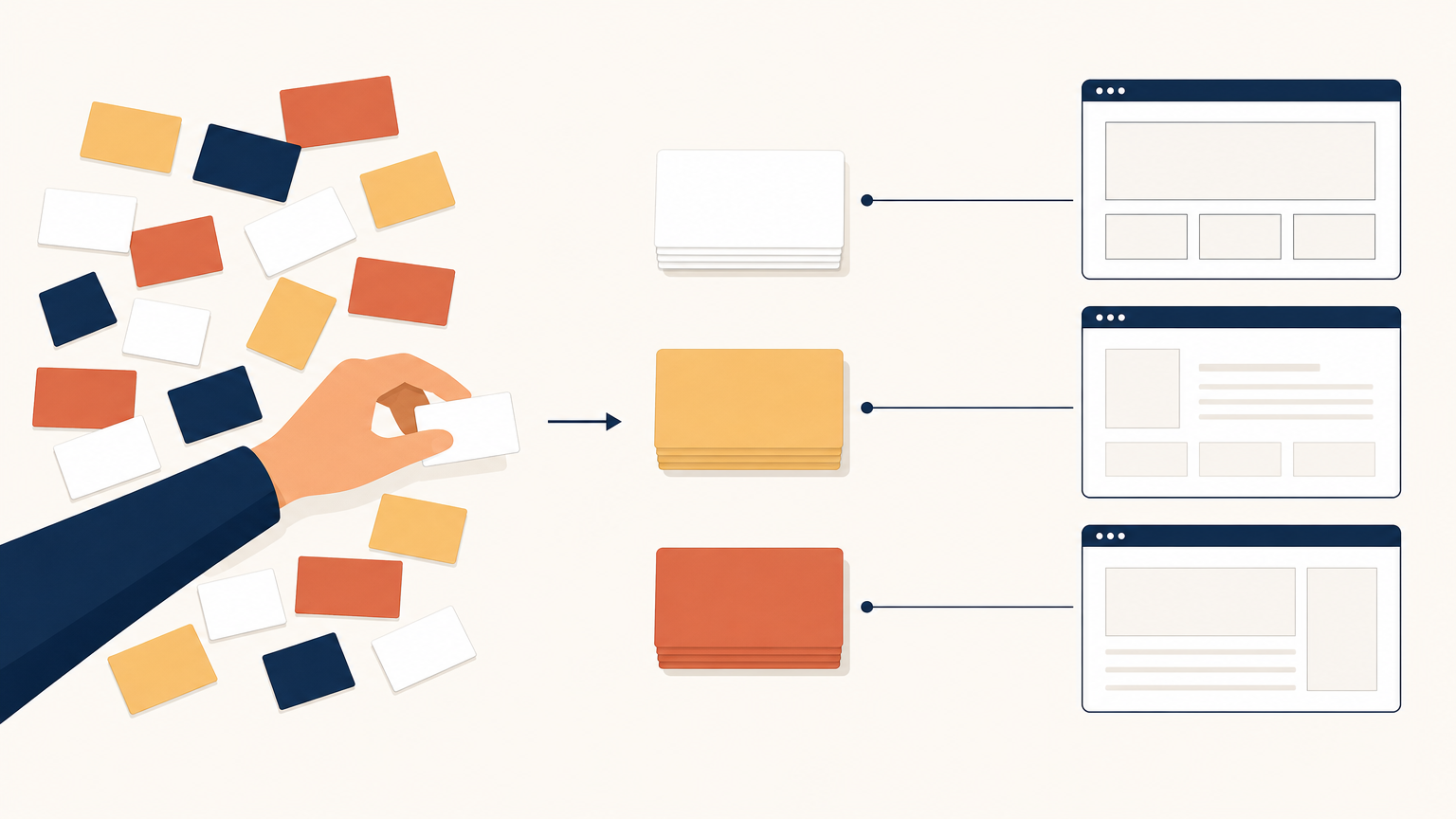
The reason to cluster at all is that pages rank for groups, not single terms. The same Ahrefs study looked at the top-ranking pages for 3 million random searches and found the average #1 page also ranks in the top 10 for nearly 1,000 other relevant keywords, with a median of around 400. The gap between average and median comes from outliers, so plan for the median.
What it is not: a topic-cluster site architecture with pillar pages and hub links. That comes later. AI keyword clustering produces the input to that plan; it does not replace the editorial call about which clusters deserve a page.
Three ways AI groups keywords: SERP overlap, embeddings and LLMs
Most tools sold as “AI clustering” use one of three engines, or a mix. Each answers a different question, and that difference decides where each one belongs in the pipeline.
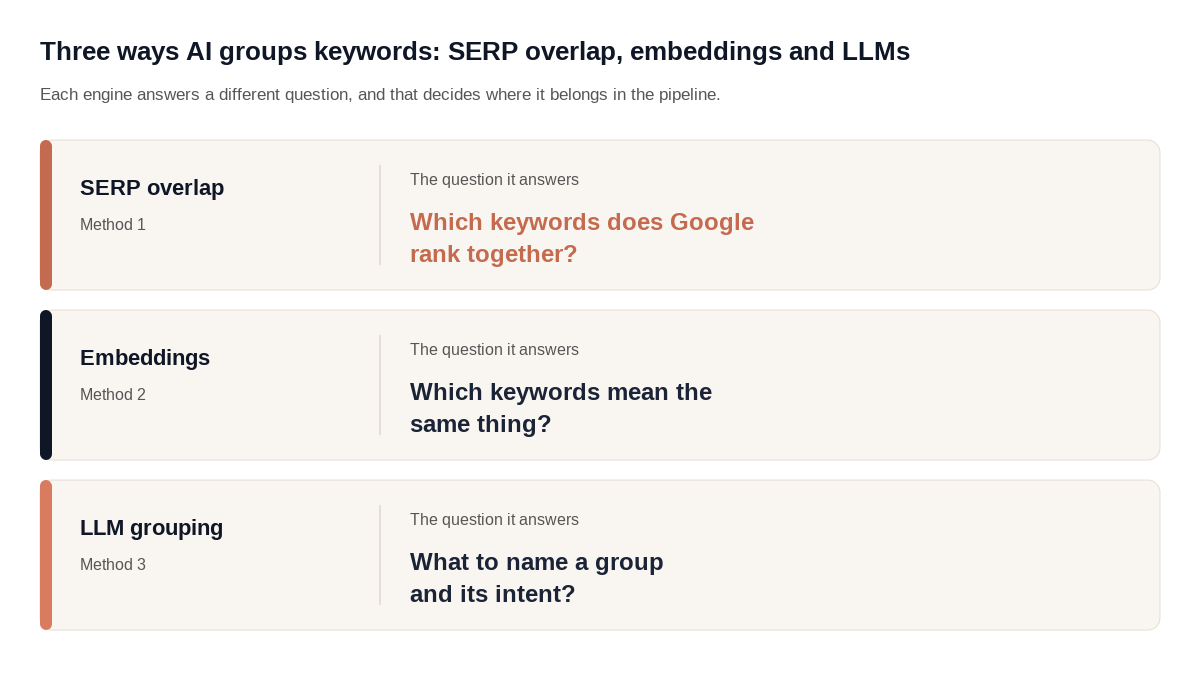
Each method answers a different question, so each belongs at a different point in the pipeline.
SERP overlap: what Google already ranks together
SERP overlap compares the top 10 results for each pair of keywords. If two keywords share enough ranking URLs, Google treats them as one need, and one page can rank for both. It is the only method that measures ranking behaviour directly. I covered the method, a Python script and threshold choices in my guide to keyword clustering by SERP overlap, so I will not repeat it here.
The cost is one SERP call per keyword. Keywords with no data, such as new terms or low-volume questions, cannot be grouped this way.
Embeddings: meaning as vectors
An embedding model turns each keyword into a vector, and keywords with similar meanings land close together. The cost is low: OpenAI’s January 2024 embeddings release priced text-embedding-3-small at $0.00002 per 1,000 tokens at launch. If a 1,000-keyword list comes to roughly 5,000 tokens, embedding it costs about $0.0001. Check the current price before you budget for it.
The model matters more when you cluster in several languages. In the same OpenAI release, the MIRACL multilingual retrieval average rose from 31.4% for text-embedding-ada-002 to 44.0% for text-embedding-3-small and 54.9% for text-embedding-3-large.
No single model wins everywhere. The MTEB benchmark paper, published in 2022, tested embeddings across 8 tasks, 58 datasets and 112 languages and found that no particular method dominates across all tasks. Test two models on a sample of your own list rather than guessing from a leaderboard.
The weakness is that embeddings measure meaning, not ranking. “CRM for startups” and “startup CRM pricing” sit close in vector space and can still need two pages.
LLM grouping: names and intent, at a cost
An LLM can read a keyword list and return named groups with a reason for each. That is useful for labelling and for spotting intent shifts that embeddings miss. It is also where most AI clustering goes wrong.
Long prompts are the first problem. The Lost in the Middle study, published in 2023, measured multi-document question answering and key-value retrieval, and performance degraded significantly when the relevant information sat in the middle of a long input. A 1,000-keyword list in one prompt puts most keywords in that middle.
| Method | What it measures | Cost per 1,000 keywords | Typical failure | Best job |
|---|---|---|---|---|
| SERP overlap | Shared ranking URLs | 1,000 SERP calls | No data for new or rare terms | Confirming page-level groups |
| Embeddings | Closeness in meaning | Fractions of a cent | Merges terms Google splits | Pre-grouping large lists |
| LLM | Meaning plus a stated reason | Highest, grows with list length | Drops or invents keywords | Naming clusters, labelling intent |
Pick by job: embeddings to pre-group, SERP overlap to decide what shares a page, an LLM to name and label.
A hybrid pipeline: fixed stages, the model as one component
The pipeline I build is a fixed-stage workflow, not an open-ended agent. Each stage has one job, a defined input and an output you can check. Keeping grouping, generation and verification separate means a bad stage shows up as a failed check rather than as a confident-looking spreadsheet.
The academic work points the same way. A paper on LLM-assisted clustering, published in 2023, tested three stages where an LLM can join a clustering job: before clustering to improve input features, during clustering as constraints, and after clustering as correction. It found the first two routinely improved cluster quality.
The five stages
- Clean. Lowercase, deduplicate, merge plurals and close variants, and drop branded terms you will not target. This step is deterministic and needs no model.
- Embed and pre-group. Embed every keyword and group by cosine similarity. This handles the full list cheaply.
- Confirm with SERP overlap. Pull SERPs for the head keyword of each pre-group plus any borderline members. Split groups whose heads share few ranking URLs.
- Name and label with an LLM. Send one cluster per call with its SERP evidence. Ask for a name and one intent label from a fixed list.
- Human checkpoint. A person approves the cluster-to-URL map before any brief is written.
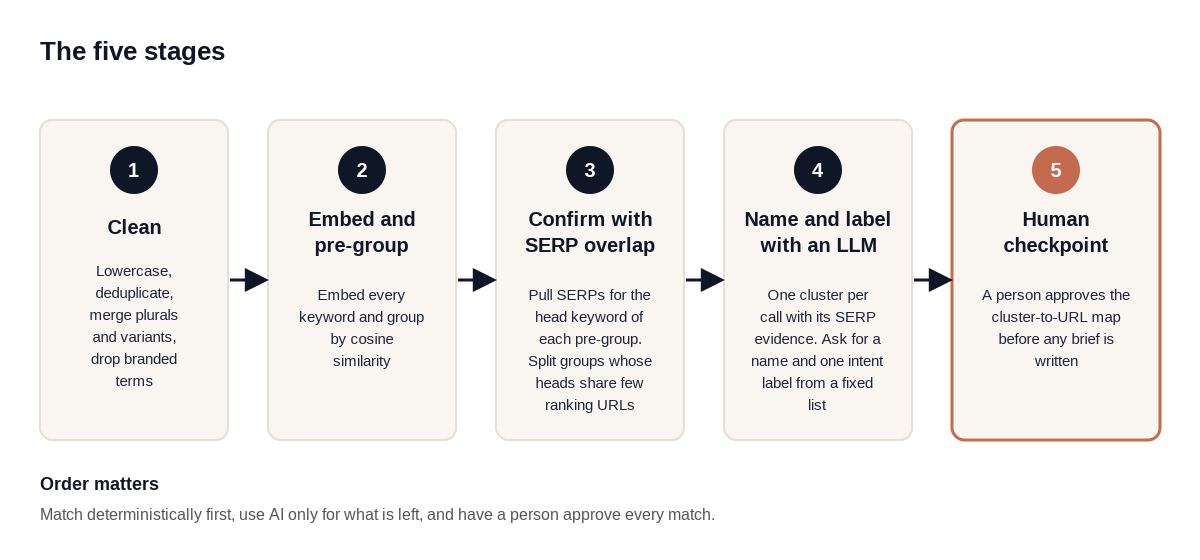
Each stage has one job and an output you can check.
Order matters. It is the rule behind Riconcilia, the matching system from my SGM Lektra work: match deterministically first, use AI only for what is left, and have a person approve every match. If you already script Claude for meta tags and schema, as in my Claude AI SEO automation workflows, clustering slots in as a separate job with its own checks.
A minimal Python sketch
Stages 2 and 3 fit in a few lines once you have vectors and SERP URLs:
import numpy as np


def pre_group(keywords, vectors, threshold=0.82):
    """Greedy grouping on cosine similarity of embedding vectors."""
    vectors = vectors / np.linalg.norm(vectors, axis=1, keepdims=True)
    groups, assigned = [], set()
    for i in range(len(keywords)):
        if i in assigned:
            continue
        sims = vectors @ vectors[i]
        members = [j for j in np.argsort(-sims)
                   if sims[j] >= threshold and j not in assigned]
        assigned.update(members)
        groups.append([keywords[j] for j in members])
    return groups


def serp_overlap(urls_a, urls_b):
    """Share of top-10 ranking URLs two keywords have in common."""
    return len(set(urls_a[:10]) & set(urls_b[:10])) / 10
The 0.82 threshold is a starting point for tuning, not a standard. Set it against 50 to 100 keywords you have grouped by hand.
Intent classification with an LLM
Intent labelling is where an LLM earns its cost, provided you constrain it. I give the model a closed label set (informational, commercial, transactional, navigational), the cluster’s keywords and a short summary of its SERP: result types, whether there is a People Also Ask box, whether product pages rank. I also allow an “unsure” label, because a forced choice hides the clusters a person should look at.
{
  "cluster": "llm keyword clustering",
  "intent": "informational",
  "evidence": ["top results are how-to guides", "People Also Ask box present"],
  "confidence": "medium"
}
There is evidence that LLM labels can be good, though not for this exact task. A paper on LLM labelling at Bing, published in 2023, reported accuracy as good as human labellers for search relevance labels. That paper measured relevance labelling, not intent, and it also found that paraphrasing the prompt changed accuracy.
The label set itself needs a human check. A paper on LLM intent taxonomies from the same year built its pipeline with human-in-the-loop review to produce, refine and apply intent labels, because, as the authors note, a taxonomy generated by an LLM is not externally validated. In practice I review every “unsure” and every commercial or transactional label by hand, since those decide which clusters get a sales page.
Five checks before you trust AI clusters
AI clustering output looks finished even when it is wrong. These checks catch the failures I see most often, and each one gives a pass or a fail rather than a judgement call.

- Coverage. Every input keyword appears exactly once. Nothing dropped, nothing invented, nothing in two clusters.
- Run it twice. A study of LLM non-determinism, published in 2024, ran five LLMs set to be deterministic on eight tasks, 10 times each, and saw accuracy vary by up to 15% between runs. If two runs of your LLM stage disagree on a cluster, that cluster goes to review.
- Batch size. Keep LLM calls to one cluster or a small batch. Long lists put most keywords in the middle of the prompt, the position where performance degraded most in the Lost in the Middle tests.
- SERP spot-check. Pull SERPs for the five largest clusters. If the head keyword and the third-largest member share few ranking URLs, split the cluster.
- Cannibalisation. Match every cluster against your existing URLs and Search Console queries before you plan a new page. A cluster that already has a ranking page is a refresh, not a brief.
For buying a tool rather than building one, the same logic applies to vendors: test keyword grouping software on a hand-labelled set before you trust its output.
A coverage check in Python
def coverage_report(input_keywords, clusters):
    """Compare clustered output against the original keyword list."""
    source = {k.strip().lower() for k in input_keywords}
    output = [k.strip().lower() for group in clusters.values() for k in group]
    return {
        "dropped": sorted(source - set(output)),
        "invented": sorted(set(output) - source),
        "duplicated": sorted({k for k in output if output.count(k) > 1}),
    }
Any non-empty list fails the run. Fix the stage that caused it rather than editing the spreadsheet by hand.
From clusters to pages, and why AI search cares
Each approved cluster becomes one page with one primary keyword, one intent and a heading for each sub-question in the cluster. Clusters that share a parent topic become a hub, linked both ways.
AI search makes the sub-questions matter more. Google’s AI features documentation says AI Overviews and AI Mode may use a “query fan-out” technique, issuing multiple related searches across subtopics and data sources to build a response. A page that covers the whole cluster has more chances to match those related searches than a page built for one phrase. ChatGPT runs its own version, which I tracked in my note on ChatGPT query fan-out.
Measure each cluster per engine, not as one blended AI score. Across the 3 sites we track, Perplexity cited the site in 49% of tracked questions, Claude in 0%. A blended average would hide both numbers, and they call for different fixes. I report them as a dashboard, not the raw data, with one row per engine.
Where to start
Buy for the bottleneck. If you cluster a list once a quarter, a tool is enough: the free Keyword Clustering tool I built in-house groups up to 1,000 keywords, and my comparison of keyword clustering tools covers the paid options.
If clustering runs every week, feeds briefs and needs the checks above, build it as a pipeline. That is the work I do under AI Tools & Software: custom AI apps and n8n pipelines with the verification stages built in.
Frequently asked questions
What is cluster AI SEO?
Cluster AI SEO is the use of AI models to group a keyword list into clusters that one page can rank for, and to label each cluster’s intent. Embeddings and LLMs do the grouping and naming, and SERP overlap confirms which keywords share a page.
Is SERP-based clustering better than AI clustering?
For deciding which keywords share a page, SERP overlap is more reliable, because it reflects what Google already ranks together. Embeddings and LLMs are cheaper and work on keywords with no SERP data. Use them to pre-group and name, then confirm with SERP overlap.
Can ChatGPT or Claude cluster keywords on their own?
They can produce plausible groups, but on long lists they drop keywords, invent new ones and give different answers between runs. Use them for naming and intent labels inside a fixed pipeline, and run a coverage check on every output.
How many keywords can you cluster with AI at once?
Embedding models handle tens of thousands of keywords cheaply, so the limit is the LLM stage. Send it one cluster or a small batch per call, and check coverage after every run.