 Nadia Mohamed
AI-SEO & GEO
Cluster Search Engine: What It Is and How It Works
A cluster search engine is a search engine that sorts the results of a query into labelled topic groups, so you browse folders instead of scrolling one long ranked list. Search “jaguar” and a cluster search engine can put the car, the animal and the sports team into separate groups, each named after the phrases its pages share. The grouping happens after retrieval, on the fly, from the titles and snippets the engine already holds.
Key takeaways
- Clustering happens after retrieval. A cluster search engine groups the top results by shared phrases or meaning, then names each group with a label.
- The label is the product. An algorithm that finds good groups but names them badly gives the searcher nothing to click on.
- Public clustering engines faded, the idea did not. Clusty passed to Yippy, Vivisimo’s technology moved into enterprise search, and AI search now splits questions into subtopics.
- The usage evidence is thin and old. The most-cited log data comes from a small 1990s deployment, so treat any claim of big speed gains with caution.
- You can build one today. Open-source Carrot2 clusters snippets, and embedding models plus a clustering step handle grouping by meaning.
What is a cluster search engine?
A cluster search engine retrieves results like any other engine, then groups them into topics before showing them. The classic example comes from Vivisimo: per Wikipedia’s Vivisimo entry, its clustering could split results for “cell” into groups including “biology”, “battery” and “prison”. The searcher picks the meaning they wanted and ignores the rest.
That is the meaning this article covers: search result clustering. The phrase has two other meanings, and the search results for “cluster search engine” mix all three, so it helps to separate them early.
The other two meanings of “cluster search engine”
A distributed search cluster. Large engines run on clusters of machines, not on one server. Google’s 2003 cluster architecture paper describes combining more than 15,000 commodity-class PCs with fault-tolerant software. Search platforms use the same word for their infrastructure: Elastic’s cross-cluster search documentation describes running a single search request against one or more remote clusters. That is about where the index lives, not how results are presented.
Topic clusters in SEO. Content teams group related pages around a pillar topic so search engines and AI assistants see depth on a subject. That is a site-architecture practice, covered in the guide to building topic clusters for topical authority in AI search. It shares the word “cluster” and nothing else with result clustering.
A useful test: if the grouping happens to the searcher’s results at query time, it is a cluster search engine in the sense of this article.
How search result clustering works
Search result clustering runs as a short pipeline after the normal retrieval step. The engine does not need a separate index or a pre-built taxonomy; it works on whatever the query returned.
- Retrieve. Fetch the top results for the query, with their titles and snippets.
- Clean. Strip markup, tokenise, remove stop words and normalise word forms.
- Group. Find documents that share phrases or sit close together in meaning.
- Label. Pick a short, readable phrase that describes each group.
- Present. Show the groups as folders or a tree next to, or instead of, the ranked list.
Why snippets are enough
The surprising early finding was that the engine does not need to download full pages. Zamir and Etzioni’s 1998 STC paper reported that clusters built from snippets are almost as good as clusters built from the full text of the documents. That matters because fetching hundreds of full pages per query is slow and expensive.
Speed is a hard requirement
Clustering has to finish while the searcher waits. The same paper set its own bar: a very patient user might sift through 100 documents in a ranked list, so the method ought to cluster up to one thousand snippets in a few seconds. Those are 1998 design targets for an algorithm, not measurements of how people search today.
Labels decide whether it works
Grouping is the easier half of the job. A cluster named “information, page, home” is useless even if its documents genuinely belong together. That is why the algorithms below are worth judging as much on label quality as on grouping accuracy: a searcher clicks a label, not a cluster.
The algorithms behind result clustering: STC, Lingo, k-means and embeddings
Four families of algorithm cover most cluster search engines. They differ in how they form groups, how they name them and how far they scale.
Suffix Tree Clustering (STC)
STC treats each snippet as a sequence of words rather than a bag of words. It builds a suffix tree over the snippets, finds the words and phrases that occur often, and merges groups of documents with high overlap. The shared phrase doubles as the cluster label. The original paper describes STC as a linear time algorithm built on phrases common to groups of documents, which made it practical for live search.
Lingo
Lingo works out the structure of topics first, using term-document matrix dimensionality reduction, and names each group with a phrase. Its labels tend to read naturally, and the guide’s authors call it typically the default algorithm to use. The cost is scale: the Carrot2 algorithm guide warns that for more than about 1000 documents, Lingo clustering will take a long time and large memory.
Bisecting k-means and embedding clustering
Bisecting k-means is generic cluster analysis applied to text: it splits the documents into smaller and smaller groups until further splits stop making sense. The same guide notes two weaknesses for search: it creates single-term labels, often weaker than the phrase labels STC or Lingo produce, and each document can belong to only one cluster, while Lingo and STC allow overlap. Plain k-means has a second catch, per scikit-learn’s clustering guide: it requires the number of clusters to be specified, though it scales well to large numbers of samples.
Embedding clustering replaces word overlap with meaning. Each snippet becomes a vector from a language model, and a clustering algorithm groups vectors that sit close together. It handles synonyms that phrase-based methods miss, but it still needs a separate step to produce readable labels.
| Algorithm | How it groups | Labels | One document in several groups? | Scales to |
|---|---|---|---|---|
| STC | Shared phrases (suffix tree) | Phrases | Yes | Large result sets |
| Lingo | Topic structure first | Readable phrases | Yes | About 1,000 documents |
| Bisecting k-means | Repeated two-way splits | Single terms | No | Large sets |
| Embeddings + clustering | Vector similarity | Needs a labelling step | Depends on algorithm | Large sets |
My rule for choosing: pick Lingo when labels matter and the result set is small, STC when speed matters, and embeddings when the same meaning hides behind different words.
Clustering search engines you may have used: Grouper, Clusty, Yippy and Carrot2
Grouper was the research prototype. The Grouper paper cited in the next section describes it as a document clustering interface to the HuskySearch meta-search service, grouping results with STC as they arrived.
Vivisimo took the idea to market. The company came out of Carnegie Mellon, and TechCrunch’s report on the IBM deal put its funding at $6 million, raised as a spin-off applying clustering technology to enterprise search. Its public web engine was Clusty.
Wikipedia’s Yippy entry records that Vivisimo released Clusty in 2004, and that Yippy Inc. bought it for $5.55 million in May 2010. The same entry says the site then drew 100,000 unique visitors a month, a small audience next to the mainstream engines. The entry also records that from late April 2021 the site redirected to DuckDuckGo.
Vivisimo itself went to IBM. IBM’s May 2012 completion announcement states that the deal closed on May 29, 2012 and that approximately 120 Vivisimo employees joined IBM’s Software Group.
The open-source survivor is Carrot2. Per Wikipedia’s Carrot2 entry, its first version was implemented in 2001 and Lingo was added in 2003.
It is still maintained, and the Carrot2 documentation describes it as a library that can automatically discover groups of related documents and label them with short key terms or phrases. Its public demo shows clustered results for any query.
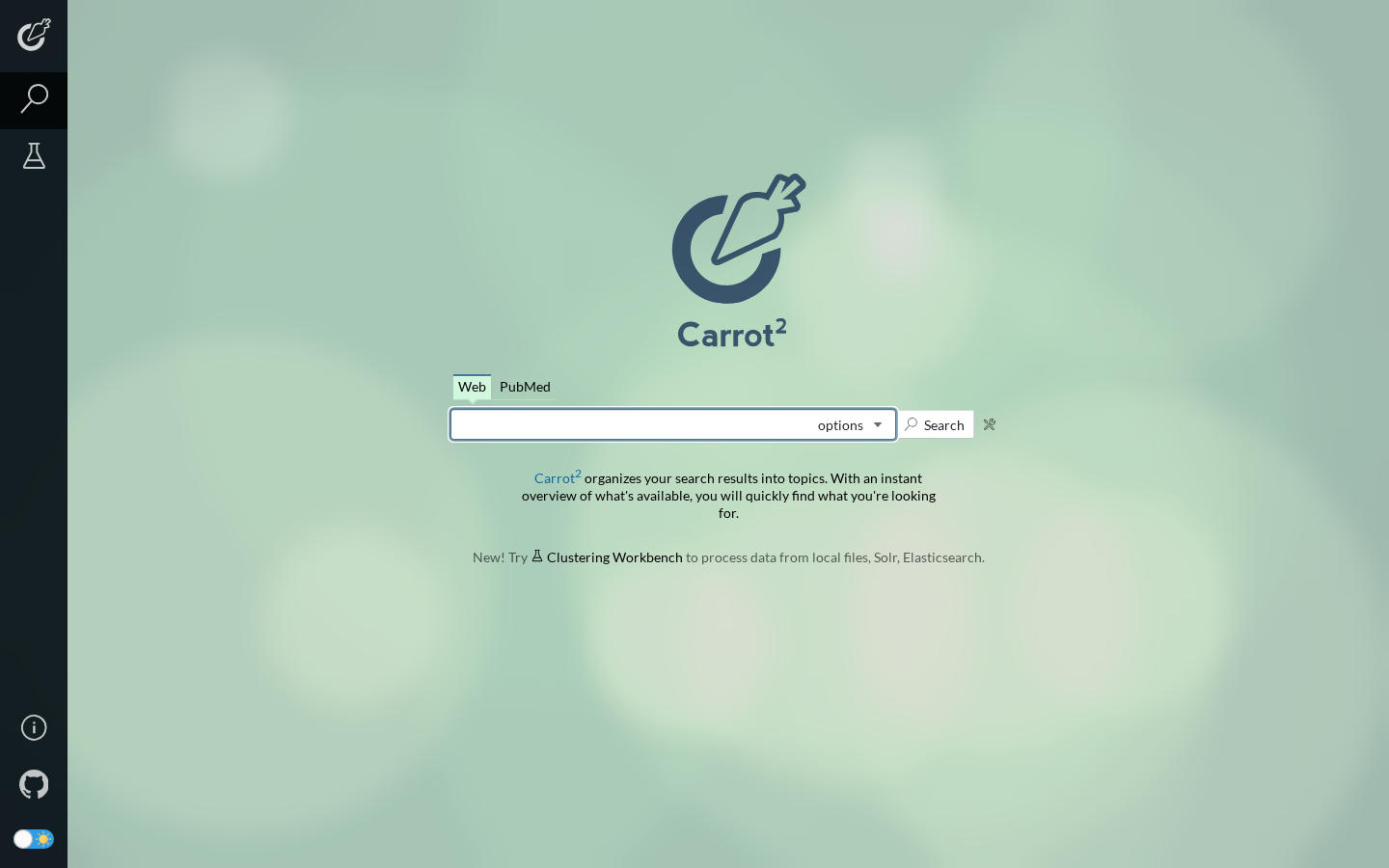
The Carrot2 demo groups search results into labelled topics next to the result list.
Does clustering actually help searchers?
The best-known evidence comes from Grouper’s own logs, and it is encouraging but narrow. The 1999 Grouper study by Zamir and Etzioni found that in 80% of the cases where users chose the “Refine Query” option, they used the phrases the system suggested. The same logs showed that in approximately 21% of sessions, users followed documents from index-clusters, the loose groups at the bottom of the cluster list.
Read those figures with their limits. The service received approximately 65 queries a day, per the same paper, so the sample is one small academic deployment from the late 1990s. It shows that people used the clusters when offered them. It does not show that they found answers faster than with a ranked list.
Clustering helps most when a query is ambiguous or exploratory, such as a name shared by a company, a place and a product. It adds little to navigational queries, where the searcher already knows which site they want and the first result is usually it.
How Google and AI search relate to result clustering
Google’s main results page is still a ranked list, not a set of labelled folders. Public clustering engines never displaced that format, and the commercial value moved to enterprise search. When IBM bought Vivisimo, the same announcement listed more than 140 clients in sectors such as government, life sciences and manufacturing, which tells you where buyers saw the use.
The idea came back inside AI search. Google’s May 2025 AI Mode announcement explains that AI Mode uses a query fan-out technique, breaking a question into subtopics and issuing many queries at once. The same post says Deep Search can issue hundreds of searches before writing a report.
That is clustering moved upstream. A cluster search engine grouped results after retrieval and let the searcher choose a subtopic. An AI answer engine splits the question into subtopics before retrieval and writes one answer that covers them. To see how the main assistants differ in practice, the comparison of AI search engines covers them one by one.
For publishers, the consequence is practical. A page that covers each subtopic of a question clearly, under its own heading, gives a fan-out system more places to match. A page that answers one narrow angle only matches one of the many queries.
Building a cluster search layer today
You have two practical routes, and the right one depends on whether you need phrase labels or meaning.
First route: snippet clustering with Carrot2. Carrot2 runs as a Java library or a REST service and clusters result titles and snippets with Lingo, STC or bisecting k-means. Its documentation notes that Apache Solr has had built-in support for clustering search results via Carrot2, and that an elasticsearch-carrot2 plugin provides the same for Elasticsearch, with version caveats worth checking before you plan around either.
Second route: embeddings plus a clustering step. OpenAI’s embeddings guide lists clustering, where text strings are grouped by similarity, as a standard use of embeddings. Open-source tooling packages the full pipeline: the BERTopic algorithm documentation describes a five-step default pipeline, and BERTopic uses HDBSCAN as its default clustering model, so you do not have to fix the number of clusters in advance.
The same pattern is useful inside SEO and GEO work, not only on a search box. Grouping the pages that rank for a set of questions, or a site’s own articles, by subtopic shows which subtopics are covered and which are missing. That is a fixed-stage job a script can run on a schedule, and it is the kind of internal tool I scope under AI tools and software.
Rules for picking:
- Labels for people: use Carrot2 with Lingo on result sets under about a thousand documents.
- Grouping by meaning: use embeddings with HDBSCAN, then add a labelling step.
- Unknown number of topics: avoid plain k-means, which needs the cluster count up front.
Frequently asked questions
Is a cluster search engine the same as keyword clustering?
No. A cluster search engine groups the results of one query into topics for the searcher. Keyword clustering groups a list of search terms by shared intent so that one page can target them, a different job covered in keyword clustering by SERP overlap.
Is Carrot2 free?
Yes. Carrot2 is open source and distributed under the BSD licence, as its Wikipedia entry records. It can cluster search results or other short texts and runs as a library or a REST service.
Why did clustering search engines disappear?
Public clustering engines such as Clusty never displaced the ranked list, and the technology moved into enterprise search through Vivisimo’s sale to IBM. The underlying idea survives in AI search, which splits a question into subtopics before it answers.
Does Google group results by topic?
Google’s standard results page remains a ranked list rather than labelled folders. Its AI Mode breaks a question into subtopics and runs many searches at once, so the grouping now happens before the answer is written rather than after the results appear.