 Nadia Mohamed
AI-SEO & GEO
AEO Analyzer: Score Pages for AI Citation Readiness
The AEO Analyzer is a free AEO audit tool that checks per-page AI citation readiness. Paste an article or a URL and it returns a 0–100 score for how easy that one page is for answer engines such as ChatGPT, Perplexity and Google AI Overviews to extract and quote. It checks 10 content signals, gives each a pass/fail and a 0–10 score, and lists the three fixes that matter most, quoting your own text. You get three free analyses per calendar month after a free sign-up, with no credit card.
Key takeaways
- It scores one page, not your brand. The analyzer checks how a single article is written and structured. Whether your brand shows up across AI engines over time is a separate job: AI visibility monitoring.
- Readiness is not citation. A high score means the page is easy to quote. It does not mean an engine can reach the page or will choose it. Crawler access and ranking come first.
- The engines disagree with each other. Across the 3 sites I track, Perplexity cited the site in 49% of tracked questions and Claude in 0%. The same pages got two very different results.
- Pick a checker for the bottleneck you have. If you’re not sure AI crawlers can reach the page, run a tool that checks access first. If they can and the page still isn’t quoted, score the content.
Open the analyzer
The analyzer runs on its own subdomain. Sign up once, then paste an article or enter a URL. A Claude model scores it against the 10 criteria and returns the report in under 30 seconds. Your three free analyses reset on the 1st of each month.
Open the AEO Analyzer (opens in a new tab; sign-up required)
Sample output: what a result looks like (sample data, not a real client page)
https://example.com/how-to-set-up-faq-schema scored 72/100: good, citable with three priority fixes. It is strong on heading hierarchy, question-based titles and data-backed claims. The three lowest scores (author credibility, source attribution and section modularity) are the highest-impact fixes. Each comes with a specific suggestion that quotes the original text.
| # | Criterion | Score |
|---|---|---|
| 01 | Question-based headlines | 9 / 10 |
| 02 | Direct answer up front (40–60 words) | 8 / 10 |
| 03 | Clear heading hierarchy (H1/H2/H3) | 9 / 10 |
| 04 | Modular sections (75–300 words) | 6 / 10 |
| 05 | FAQ coverage (5+ questions, 40–80 word answers) | 8 / 10 |
| 06 | Source attribution (named experts) | 5 / 10 |
| 07 | Data-backed claims (concrete figures) | 8 / 10 |
| 08 | Original insight | 7 / 10 |
| 09 | Zero filler content | 8 / 10 |
| 10 | Author credibility signals | 3 / 10 |
What does the AEO analyzer check on a page?
It checks 10 content signals that decide how easily an answer engine can lift a passage from your page and attribute it. Each one gets a pass/fail, a 0–10 score and a fix that quotes your actual text. Some thresholds, such as 40–60 words and 75–300 words, are working rules I score against, not limits any engine has published. Treat them as targets, not laws.
1. Question-based headlines
Headlines phrased the way people prompt an AI engine: questions, comparisons and “how to” framings, not internal labels like “Overview” or “Our approach”. A heading that matches the question makes the section below it an obvious candidate answer.
2. Direct answer up front
A clear answer in the first 40–60 words. If someone asks the question your page targets, the first paragraph should answer it on its own, without the reader needing the rest of the page.
3. Clear heading hierarchy
One H1, with H2 and H3 nested properly and no skipped levels. A parser walking the page should be able to rebuild its outline from the headings alone.
4. Modular sections
Chunks of 75–300 words under each subheading, each self-contained enough to be quoted as a standalone passage. A section that starts with “As mentioned above” breaks as soon as it is pulled out of context.
5. FAQ coverage
Five or more questions with 40–80 word answers, phrased the way users would type them into ChatGPT or Perplexity. These are the cheapest passages on the page to extract.
6. Source attribution
Named sources and named experts cited inline, not “experts say”. This signal has the strongest research behind it. In the original generative engine optimization study, Aggarwal et al., GEO: Generative Engine Optimization found that “GEO can boost visibility by up to 40% in generative engine responses”, measured on their GEO-bench benchmark. Adding citations, quotations and statistics were among the methods tested. That result comes from a research benchmark, not from production ChatGPT, so read it as a direction, not a promise.
7. Data-backed claims
Concrete figures with a named source and, ideally, a date, rather than a vague appeal to unnamed research. A sentence with a specific number in it is easier to quote and easier to check.
8. Original insight
Frameworks, test results and first-hand observations a model can’t generate from the rest of the web. This is what makes a page worth citing instead of just paraphrasing.
9. Zero filler content
No padding, no generic takes without a point of view, no throat-clearing intros. The analyzer scores how much of each paragraph is useful content.
10. Author credibility signals
A visible author with a bio, credentials and relevant experience, on the page or on a linked author profile. If the page doesn’t say who wrote it, nobody can judge the source.
Readiness is not citation: what a per-page score can’t tell you
A per-page score measures what you control: the words and structure on the page. It can’t measure whether an engine can reach the page or whether it will pick you over a competitor. Wellows puts it plainly on its own checker: whether a page is cited “depends on search ranking and off-site authority, which this check does not measure” (Wellows’ AI citation readiness checker). The same is true of mine.
Two eligibility checks come before any content score:
- Google: Google’s AI features documentation says that to appear in AI Overviews or AI Mode, “a page must be indexed and eligible to be shown in Google Search with a snippet”. It also says there are no additional requirements and no special schema to add. A
nosnippettag or a page that isn’t indexed caps you at zero, whatever the score says. - ChatGPT: OpenAI’s crawler documentation states: “Sites that are opted out of OAI-SearchBot will not be shown in ChatGPT search answers.” Check robots.txt and your CDN’s bot rules for OAI-SearchBot before rewriting anything. Blocking GPTBot (training) is a separate decision from blocking OAI-SearchBot (search).
Then there is the engines themselves. Across the 3 sites I track, Perplexity cited the site in 49% of tracked questions and Claude in 0%. Those are the same pages with the same readiness, so a single “AI visibility” number would hide the most useful fact in that data: where the gap is. Score the page to fix the writing, and track citations per engine to see whether it worked.
Which AEO audit tools check per-page AI citation readiness?
Several free tools score a single URL, but they don’t check the same things. Here are three side by side, as described on each vendor’s own page (checked 20 November 2026):
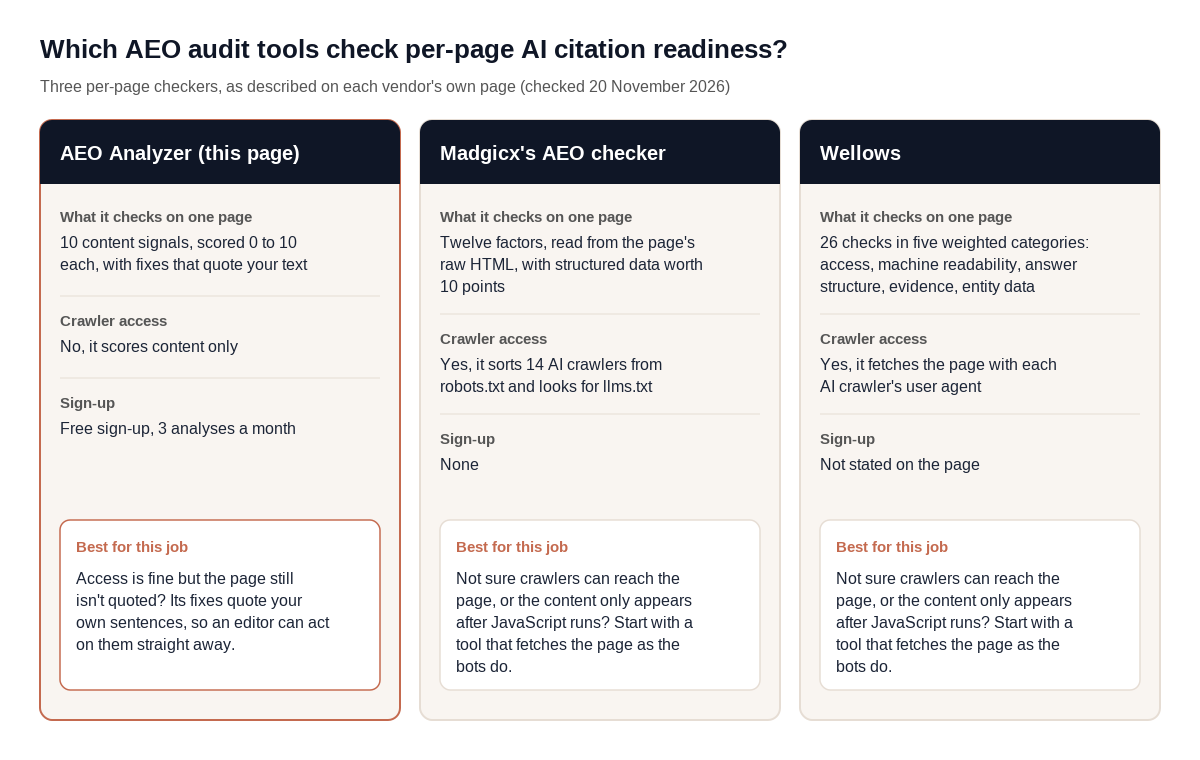
Three per-page checkers, and which job each one suits.
| Tool | What it checks on one page | Crawler access | Sign-up |
|---|---|---|---|
| AEO Analyzer (this page) | 10 content signals, scored 0–10 each, with fixes that quote your text | No, it scores content only | Free sign-up, 3 analyses a month |
| Madgicx’s AEO checker | Twelve factors, read from the page’s raw HTML, with structured data worth 10 points | Yes, it sorts 14 AI crawlers from robots.txt and looks for llms.txt | None |
| Wellows | 26 checks in five weighted categories: access, machine readability, answer structure, evidence, entity data | Yes, it fetches the page with each AI crawler’s user agent | Not stated on the page |
Pick by job:
- Not sure crawlers can reach the page, or the content only appears after JavaScript runs? Start with a tool that fetches the page as the bots do.
- Access is fine but the page still isn’t quoted? Use the AEO Analyzer. Its fixes quote your own sentences, so an editor can act on them straight away.
- Need the same check across hundreds of URLs, every week? A free tool is the wrong shape. That’s a pipeline job: fetch, score, store, alert. I build those as AI tools and automation in the client’s own stack.
How do I check whether a page actually gets cited?
Measure citations separately from readiness, one engine at a time, and don’t blend them into one headline number.
For Microsoft surfaces, Bing Webmaster Tools is the closest thing to a Search Console for AI answers. Bing’s AI Performance announcement (10 February 2026) describes a report that “shows how publisher content appears across Microsoft Copilot, AI-generated summaries in Bing, and select partner integrations”. It shows total citations, average cited pages and the grounding queries the AI used. Its data stops at Microsoft and its partners. It does not show ChatGPT citations, and Bing indexing doesn’t replace allowing OAI-SearchBot.
For ChatGPT, Perplexity and Claude, you need your own tracking: a fixed set of questions, run on a schedule, with the cited URLs logged per engine. If a page stops getting cited, re-run the analyzer to see whether the content changed. Then check crawler access and whether a competitor’s page now answers the question more directly. For a wider comparison of brand-level trackers, see my guide to AI visibility tools. More on automating these checks is in SEO automation.
AEO Analyzer FAQ
What is AEO (Answer Engine Optimization)?
AEO is the practice of structuring content so AI answer engines like ChatGPT, Perplexity and Google AI Overviews can extract and cite it. It overlaps with SEO but puts more weight on a clear answer up front, self-contained sections, and quotable, well-sourced passages. Ranking and crawler access still matter, because engines can only cite pages they can reach.
Is there an analyzer that scores my pages for answer engine readiness?
Yes. The AEO Analyzer scores one page at a time from 0 to 100 against 10 signals, from question-based headlines to author credibility. Each signal gets a pass/fail, a 0–10 score and a fix that quotes your text. Paste the article or enter its URL, and the report comes back in under 30 seconds.
Is the AEO checker free?
Yes. You get three free analyses per calendar month after a free sign-up, with no credit card, and the count resets on the 1st. It’s built for SaaS marketers and SEO teams who want to sanity-check content before or after publishing. For more pages than that, a scheduled pipeline is the better tool than a free checker.
How is this different from a normal SEO audit?
A traditional SEO audit checks technical and keyword factors that affect ranking: crawlability, speed, canonicals, links. The AEO Analyzer checks how the content itself is written for extraction: answer up front, modular sections, sources and figures. You need both, because a page that can’t rank or be crawled won’t be cited however well it’s written.
Can I analyze a URL, or do I have to paste the text?
Both work. Paste the article text directly, which is useful for drafts before they go live, or enter a URL and the tool fetches and scores the live page. Either way you get the same report: the overall score, the 10 criteria scores and the three highest-impact fixes.
Does a high AEO score guarantee AI citations?
No. The score measures readiness, which you control. Citation also depends on whether the engine can crawl the page, whether it ranks for the question, and what competing pages say. Google requires the page to be indexed and eligible for a snippet, and ChatGPT search needs OAI-SearchBot access. Check those first.
Why did a page stop getting cited?
Look at three things in order. First, access: did a robots.txt, CDN or noindex change block the crawler? Second, content: re-run the analyzer to see whether an edit lowered the score. Third, competition: did another page start answering the same question more directly? Track citations per engine so you can see which surface the drop came from.
Other free tools
I build these tools in-house, and all four are free: the AEO Article Analyzer (scores articles against 10 AI readiness signals), Keyword Clustering (up to 1,000 keywords), the AI Tool Ideas Generator and the Internal Link Graph mapper.
Want a full audit?
The AEO Analyzer scores one article. The free SEO + GEO health check scores your priority page across five dimensions, including AI readiness, with the top three fixes, in 48 hours and with no sales call. For the full architecture review, followed by deploying the fixes, see the GEO & Technical SEO audit.