 Nadia Mohamed
AI-SEO & GEO
Content Optimization Tools: How to Choose and Test One
A content optimization tool scores a draft against the pages that already rank for a query and tells you which topics, terms and sections you’re missing. Pick one for the job you actually need done, whether that’s scoring drafts, writing briefs or refreshing old pages, and not for the size of its feature list. Then make it prove itself on your own pages in a free trial before you commit to a year. The score is useful as a check on topic coverage. As a ranking forecast it’s weak, and even Surfer’s Content Score study puts the correlation at only 0.28.
I build content pipelines for SaaS and tech teams, and a content optimization tool is usually one stage in them, not the whole system. This guide covers what these tools can and can’t see, what the evidence on scores actually says, how to choose one, current prices and limits, and a four-week test you can run in Search Console instead of guessing.
Key takeaways
- Content scores are weak ranking signals. Ahrefs’ content score study tested five tools on 20 keywords and found weak correlations everywhere.
- The strongest number comes from a vendor. Surfer reports a 0.28 correlation for its own score. Surfer ran that study on its own score, and it measures correlation, not cause.
- Buy for the bottleneck. A tool that’s great at scoring drafts won’t fix slow briefs, unverified facts or a publishing backlog.
- Compare cost per document, not the sticker price. Entry plans range from about $23 to $129 a month, and their document limits differ even more.
- Test against a control group. A refresh isn’t automatically a win: across the sites I work on, 13 refreshed pages changed their clicks from Google by −17%.
What a content optimization tool does (and what it can’t)
A content optimization tool (also sold as content optimization software or a content optimization platform) pulls the top-ranking results for your keyword, extracts the terms, entities, headings and lengths they share, and grades your draft against that model. Most also generate a brief from the same data, and many now add an AI writer and some form of AI-search tracking.
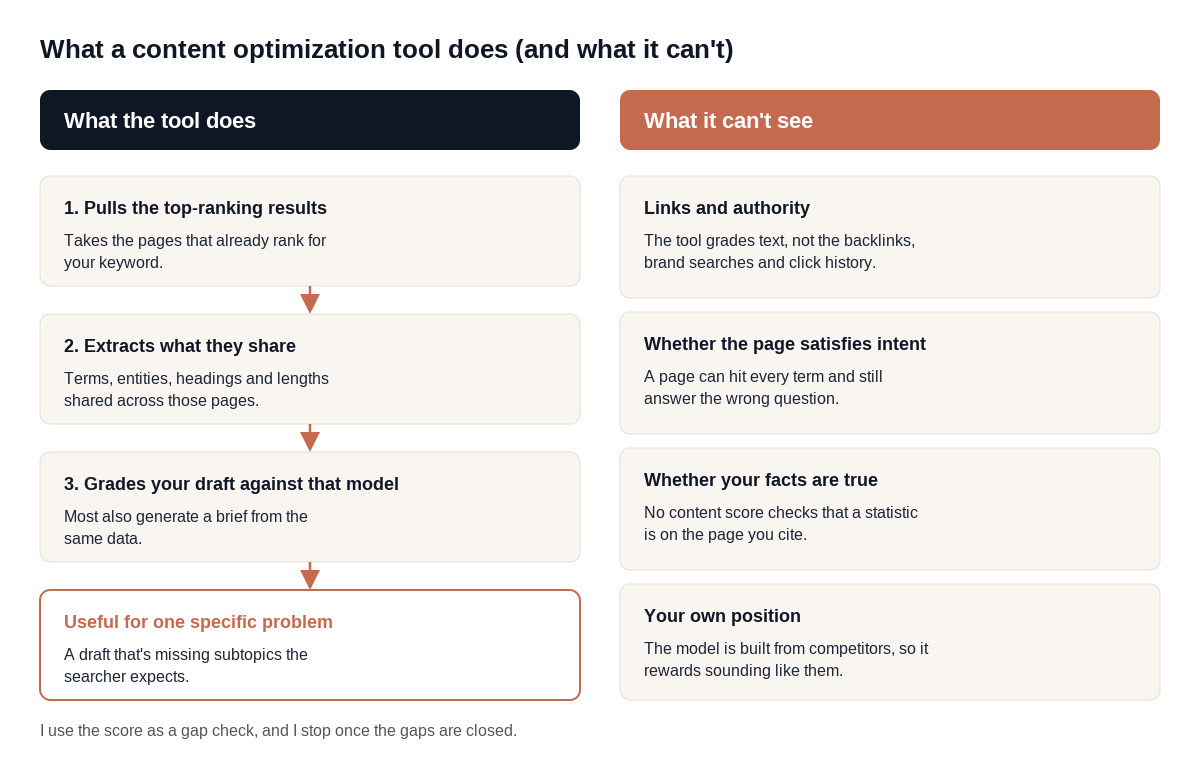
A score reflects topic coverage, not everything that moves a ranking.
That’s useful for one specific problem: a draft that’s missing subtopics the searcher expects. If every page on page one explains pricing and yours doesn’t, the tool will tell you in seconds.
What it can’t see matters just as much:
- Links and authority. The tool grades text, not the backlinks, brand searches and click history that a ranking page has built up.
- Whether the page satisfies intent. A page can hit every term and still answer the wrong question.
- Whether your facts are true. No content score checks that a statistic is on the page you cite.
- Your own position. The model is built from competitors, so it rewards sounding like them, not having something they don’t.
Ahrefs’ advice on using these tools puts it bluntly: “Keyword density is not topic coverage,” and you shouldn’t “spend hours trying to get a perfect score; scoring in the same ballpark as top-ranking pages is enough.” I use the score as a gap check, and I stop once the gaps are closed.
Do content scores predict rankings? What the evidence says
This is the question that decides how much to pay, and the evidence is thinner than the marketing suggests. Each study defines “works” differently, so read each one for what it actually measured.
Ahrefs (updated May 2025). Si Quan Ong selected 20 random keywords, ran them through five tools (Surfer, Frase, NeuronWriter, Clearscope and Ahrefs’ own AI Content Helper) and correlated each URL’s score with its position. The finding: Ahrefs’ content score study found “weak correlations everywhere.” NeuronWriter and Ahrefs’ own tool fared best, and the other three “only had very weak correlations.” Twenty keywords is a small sample, and Ahrefs sells one of the five tools it tested.
Surfer (last updated September 2026). Surfer’s data scientist ran 10,000 queries, took the top 100 organic results for each (1,000,000 SERP entries) and used Spearman correlation. The study reports that its Content Score “correlates with Google rankings at 0.28.” For context, the same page cites an Ahrefs backlink study at an average 0.17 correlation with rankings.
How I read the two together:
- Both measure correlation, not cause. A high-ranking page that already earned links and clicks will also tend to cover its topic well. Neither study tests whether raising a score on your page moves it.
- Both were run by companies that sell a scoring tool. Treat the headline numbers as marketing evidence with a method attached. They aren’t independent measurements.
- 0.28 vs 0.17 isn’t a like-for-like contest. The backlink figure comes from a different study with a different sample, quoted on Surfer’s page. Don’t conclude from it that content beats links.
What the data supports is narrower: pages that rank tend to cover their topic thoroughly, and a tool can show you where your coverage is thin. What no study here shows is that chasing a score from 70 to 90 earns positions. That gap is why the test protocol below matters.
How to choose: buy for the bottleneck
Most lists of the best content optimization tools rank features. I’d start from the job that’s slowing your team down, because that’s the only thing the tool will change. Buy for the bottleneck.
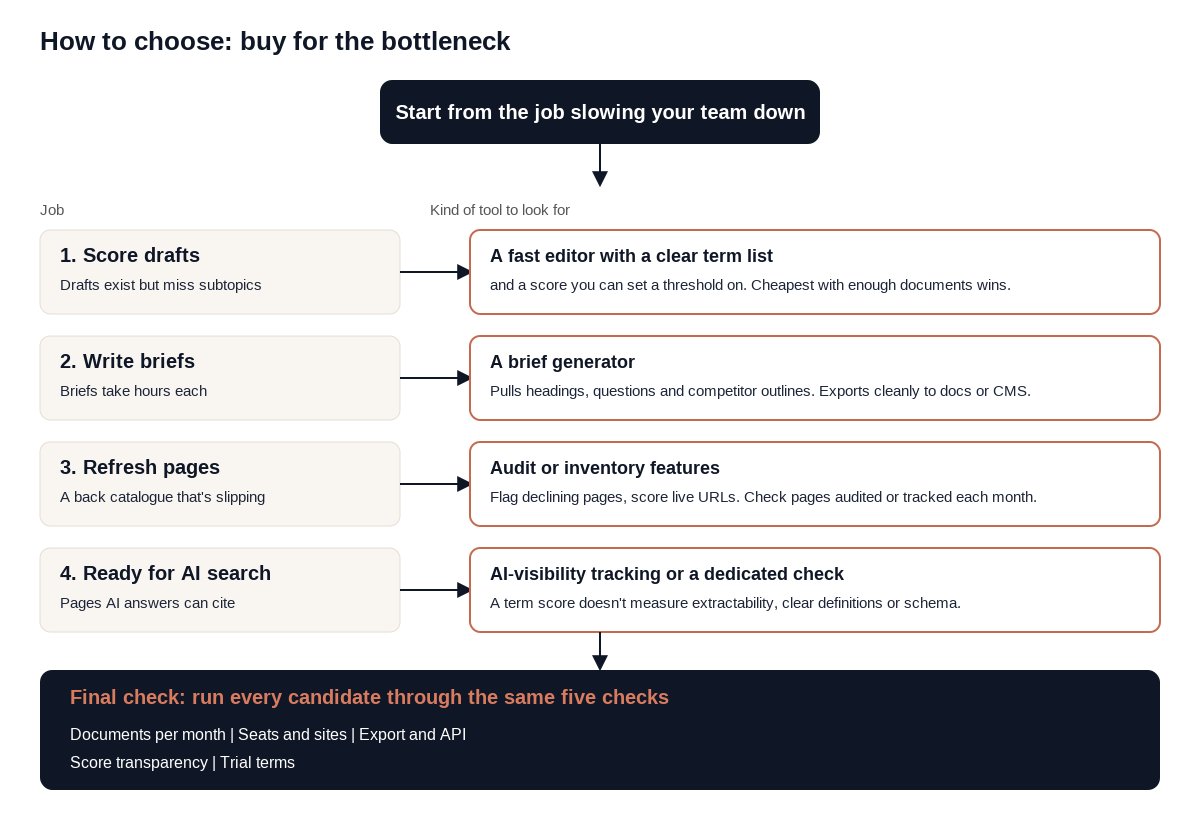
Pick the job that slows you down first, then check limits, seats and export.
1. Scoring drafts that already exist. Your writers produce solid drafts but miss subtopics. You need a fast editor with a clear term list and a score you can set a threshold on. Almost any tool does this, so the cheapest one with enough documents wins.
2. Writing briefs. Briefs take your team hours each. Look for a brief generator that pulls headings, questions and competitor outlines into a format your writers will actually use, and check whether it exports cleanly to your docs tool or CMS.
3. Refreshing existing pages. You have a back catalogue that’s slipping. You need audit or inventory features that flag declining pages and score live URLs, not just drafts. Check how many pages the plan lets you audit or track each month, because that limit is usually tighter than the draft limit.
4. Readiness for AI search. You want pages that ChatGPT, Perplexity and Google’s AI answers can cite. Several tools now bundle AI-visibility tracking. Remember that a term score doesn’t measure extractability, clear definitions or schema. For that, a dedicated check like my free AEO article analyzer or the approaches in my guide to AI content optimisation fits better.
Once you know the job, run every candidate through the same five checks:
| Check | What to look for | Why it matters |
|---|---|---|
| Documents per month | The real limit and its period (month or year) | Decides your cost per article |
| Seats and sites | Users and domains included | Teams often outgrow the entry plan on seats first |
| Export and API | Google Docs, WordPress, API access | Whether it fits an automated pipeline |
| Score transparency | Can you see why a term is suggested? | Opaque scores encourage keyword stuffing |
| Trial terms | Length, credit card, usage caps | Whether you can run a real test before paying |
If you’re specifically replacing Surfer, my Surfer SEO alternatives comparison reviews eight tools one by one. This guide is about the decision method, not the ranking.
Prices and limits, checked 19 November 2026
These are entry plans for four widely used content optimization tools, as shown on each vendor’s own pricing page on the date above. Prices change often, so recheck before you buy.
| Tool | Entry plan | Included | Trial | Cost per document |
|---|---|---|---|---|
| Surfer | Discovery, 49 USD/month billed yearly | 120 documents (period not stated) | Not stated on the page | Can’t calculate without the period |
| Clearscope | Essentials, $129/month | 20 monthly drafts | 14-day free trial | $6.45 per draft |
| Frase | Starter, $39/month ($468 billed yearly) | 10 articles and 50 audit pages each month | 7 days, no credit card | $3.90 per article |
| NeuronWriter | Bronze, $23/month | 25 documents (period not stated) | 7 days on Gold plan terms | Can’t calculate without the period |
Sources: Surfer pricing, Clearscope pricing, Frase pricing, NeuronWriter pricing.
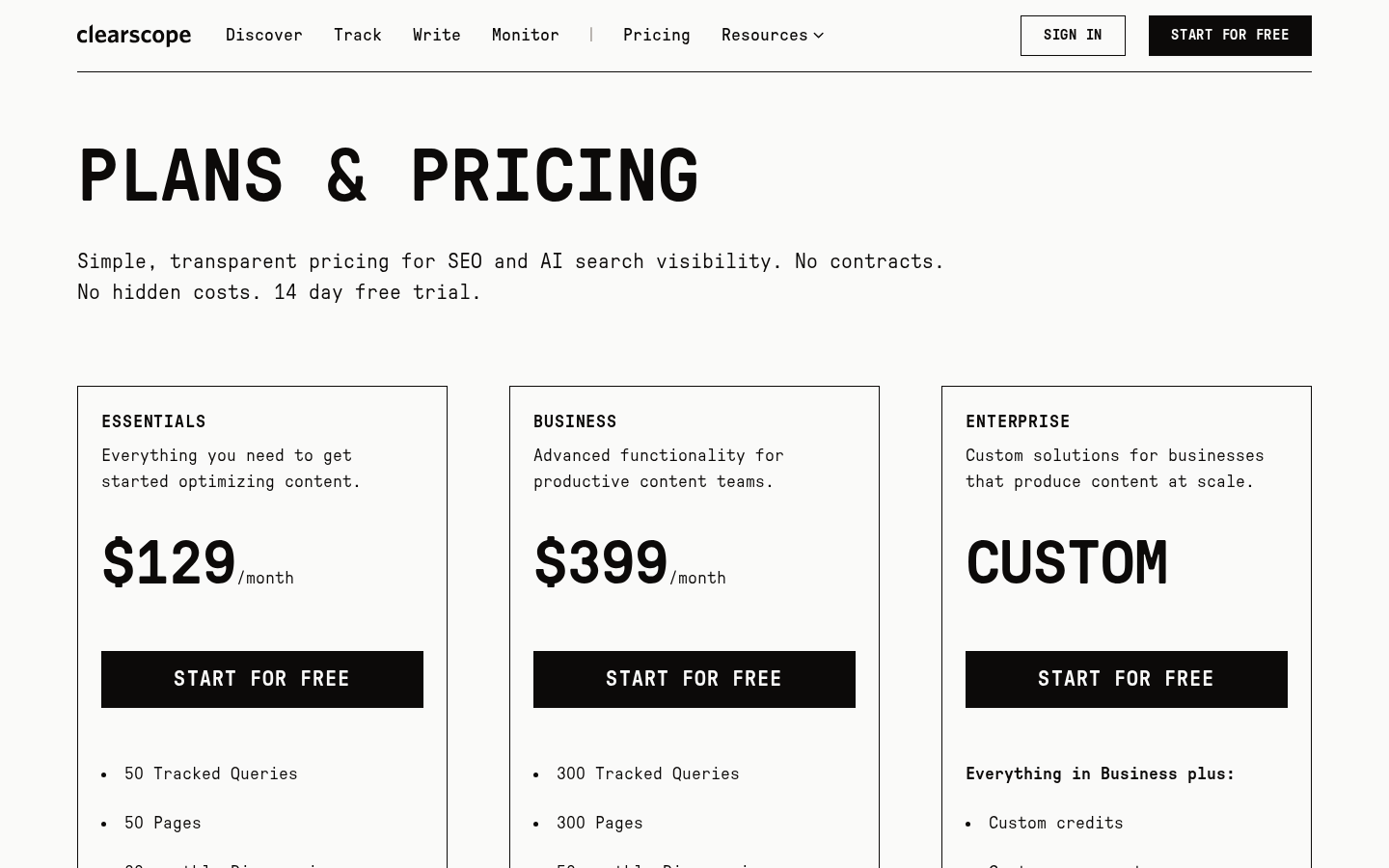
Clearscope lists its monthly draft limit next to each plan’s price.
Three things stand out:
- The sticker price hides the limit. Clearscope Essentials costs more than five times NeuronWriter Bronze, but it’s built around tracked pages and team workflows, not document volume. Divide by what you’ll actually produce.
- Annual billing changes the comparison. Surfer’s annual plan is up to 17% cheaper than paying monthly, and Frase’s $39 is the yearly-billed rate. Compare the same billing period across tools.
- Read the period on every limit. Two of the four pages above don’t say whether the document count is per month or per year. Ask before you assume.
For your own numbers, multiply your monthly publishing volume by the per-document cost, and count refreshes separately if the plan has a separate audit limit. A team publishing 15 new articles a month outgrows Frase Starter’s 10 articles, while Clearscope’s 20 drafts cover it.
How to test a content optimization tool in four weeks
Most content optimization tools come with a trial. Almost nobody uses it to measure anything. Here’s the protocol I’d run, built so the result means something instead of confirming whatever you hoped.
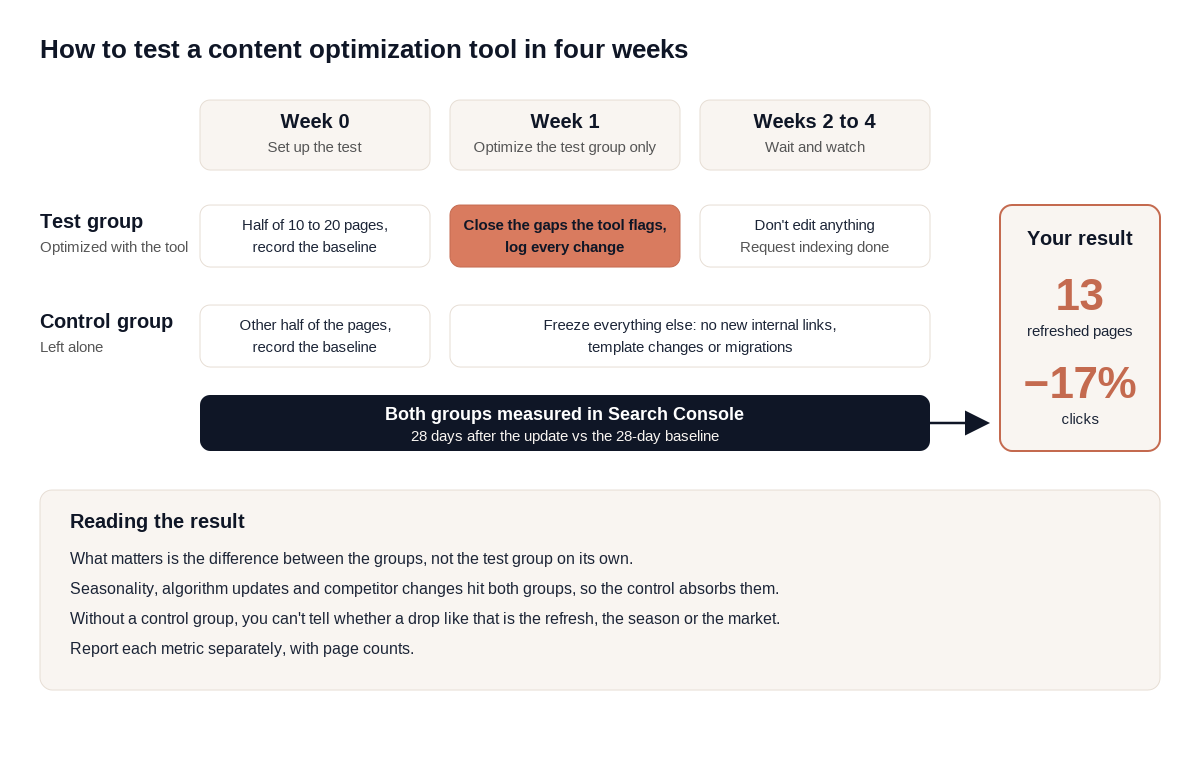
Compare optimized pages against a control group instead of trusting the score.
Week 0: set up the test (one afternoon).
- Pick 10–20 existing pages that rank between positions 5 and 30 for their main query and get steady impressions. Pages with near-zero impressions won’t show a change in four weeks.
- Split them in two. Half are your test group (optimized with the tool), half your control group (left alone). Match the groups roughly on impressions and position.
- Freeze everything else. No new internal links, template changes or migrations on either group during the test. Otherwise you can’t attribute the result.
- Record the baseline from Search Console for the previous 28 days: clicks, impressions, average position and CTR per page, plus each page’s score in the tool before you touch it.
Week 1: optimize the test group only. Close the gaps the tool flags until you’re in the same range as the top-ranking pages. Don’t chase 100. Log every change per page: sections added, terms added, words before and after. Request indexing for each updated URL.
Weeks 2–4: wait and watch. Don’t edit anything. Pull Search Console data per page at the end of week 4 and compare the 28 days after the update with the 28-day baseline.
Reading the result. What matters is the difference between the groups, not the test group on its own. Seasonality, algorithm updates and competitor changes hit both groups, so the control absorbs them.
This is where most teams fool themselves. A refresh isn’t automatically a gain. Across the sites I work on, 13 refreshed pages changed their clicks from Google by −17%. Without a control group, you can’t tell whether a drop like that is the refresh, the season or the market. With one, you can.
Report each metric separately, with page counts. Don’t roll clicks, position and score into one “improvement” figure. Pooled numbers hide the page that went backwards. If the test group beats the control on clicks and impressions, the tool earned its subscription for that job. If the two groups move together, the tool isn’t your bottleneck, and the trial cost you nothing.
Free trials are long enough to set up the test, not to finish it. The trials above run 7 or 14 days, so plan to optimize the test group inside the trial and measure afterwards. If you need the tool to keep scoring after the trial, budget one month of the entry plan.
When the tool isn’t the bottleneck
I ship a lot of content pipelines, and the slow stage is rarely “the draft is missing terms.” It’s usually one of these:
- Verification. Nobody checks that each statistic is on the page it’s cited from, so errors ship and get corrected later.
- Briefs and approvals. Drafts wait days for a brief, then days for sign-off.
- Publishing and refresh triage. Finished articles sit in a doc, and declining pages go unnoticed for months.
Content optimization tools fix none of those. They’re workflow problems: fixed stages with a machine check between each one and a human checkpoint where judgment matters. If that’s where your time goes, look at SEO automation before buying another seat. When the workflow is specific to your stack, I build it as an AI tool or n8n pipeline in your own repo, with the content scoring step as one stage among several.
FAQ
Is there a free content optimization tool?
Not a fully free one with real limits among the tools above, but you can test each one before paying. Frase offers 7 days with no credit card, NeuronWriter 7 days on Gold plan terms, and Clearscope 14 days. That’s enough to optimize a test group of pages.
Do I need a content optimization tool if I already use Semrush or Ahrefs?
Possibly not. Ahrefs’ own AI Content Helper was one of the five tools in its score study, and other suites offer similar features. Run the four-week test with the scoring feature you already pay for before adding a separate subscription.
Does a higher content score mean higher rankings?
Not reliably. Ahrefs found weak correlations across five tools, and Surfer’s 0.28 comes from its own study. Use the score to close topic gaps, then stop.
Which content optimization tool helps with visibility in AI search?
Several now bundle AI-visibility tracking, but a term score doesn’t measure whether an AI engine can extract and cite your answer. Check that separately with a page-level AI-readiness check, and compare dedicated trackers in my guide to AI visibility tools.
How long should I test a content optimization tool?
Four weeks after the update, against a control group, measured in Search Console. Shorter windows mostly show noise, and longer ones pick up more outside changes.
Should I aim for a perfect content score?
No. Get into the same range as the pages that already rank, then spend the remaining time on what the score can’t see: original data, clear answers and accurate sources.