 Nadia Mohamed
AI-SEO & GEO
AI Workflow Automation for Content Teams: A Reference Architecture
An AI automation workflow for a content team is a fixed sequence of stages (intake, research, verification, draft, QA, publish and monitor) in which models do bounded jobs, code checks what they produce, and a named person signs off at set points. The model is one component in it, not the workflow.
This article is the architecture, not the argument for automating: why a content pipeline should be a workflow rather than an agent, what each of the seven stages hands on, which tool does the work, and where people sign off. It then shows the build layer (n8n, the Claude API and plain code) and maps the Optix pipeline behind this site onto the diagram.
If you want the definitions first, what content automation is and what Google permits, start with content automation. This page assumes you have decided to build.
Key takeaways
- Build a content pipeline as a workflow with fixed stages, not an open-ended agent. Anthropic’s own guidance says workflows “offer predictability and consistency for well-defined tasks”, and an article is a well-defined task.
- Put verification before drafting. Fetch every source and confirm the figure is on the page, then give the writing model only that closed set of citations.
- Five human checkpoints are enough: accept the request, approve the brief, sign the finished draft, release it, and decide what to refresh. Everything between them should be a machine job with a machine check.
- One JSON record should travel through every stage. If a stage cannot write its output into the record, it is not finished.
- Orchestration (n8n), generation (the Claude API) and verification (your own code) are three separate layers. Do not let the orchestrator or the model do the checking.
Workflow or agent: choose the shape first
The first design decision is not the tool. It is whether the model decides what happens next, or the pipeline does.
Anthropic’s engineering team draws the line cleanly in Building effective agents: workflows “are systems where LLMs and tools are orchestrated through predefined code paths”, while agents “dynamically direct their own processes and tool usage”. The same post recommends “finding the simplest solution possible, and only increasing complexity when needed”.
A content pipeline is the textbook case for a workflow. The stages are known in advance, their order does not change, and each has an output you can test. The pattern Anthropic calls prompt chaining, where each call processes the output of the previous one with “programmatic checks” as gates between steps, is almost exactly the shape of the diagram below.
Agents have a place inside the pipeline: a research step that decides which pages to read next is an agent-shaped job. They are the wrong shape for the pipeline as a whole, because nobody should be approving a publish step the model chose to take. The broader list of what agents do well in marketing, and where they still fall down, is in AI agents for marketing.
The reference architecture at a glance
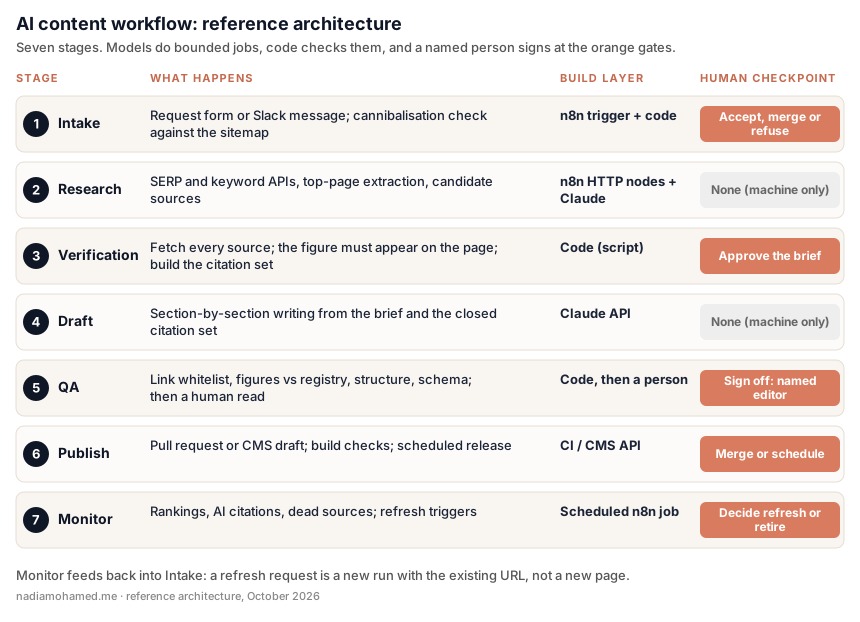
The same architecture as a table, with what each stage must hand on:
| Stage | Input | Output handed on | Done by | Human checkpoint |
|---|---|---|---|---|
| 1. Intake | A request (keyword, topic or refresh URL) | Accepted request with a cannibalisation verdict | Trigger plus a sitemap check in code | Accept, merge into an existing page, or refuse |
| 2. Research | Accepted request | Research file: ranking pages, headings, candidate sources | HTTP calls to SEO APIs, model summarisation | None |
| 3. Verification | Candidate sources | Closed citation set and a brief | Code that fetches and checks each source | Approve the brief |
| 4. Draft | Brief and citation set | Draft, section by section | Model API | None |
| 5. QA | Draft | Pass or fail report, then a signed draft | Code checks, then an editor | Named editor signs |
| 6. Publish | Signed draft | Live URL | CI or the CMS API | Merge or schedule |
| 7. Monitor | Live URL | Refresh request or no action | Scheduled job | Refresh, leave, or retire |
Two stages have no human gate, and that is deliberate. Research and drafting are the steps where a person adds least by watching, because their output is checked mechanically by the next stage anyway.
The seven stages
1. Intake: the cheapest place to say no
Intake takes a request from wherever your team already asks for work, usually a form or a chat message, and turns it into a record with an ID. Before anything else runs, a script checks the requested topic against every URL in your sitemap.
The verdict is one of three: new page, refresh an existing URL, or refuse because the site already answers it. Getting this wrong costs a whole pipeline run and then a second page competing with the first. The method for grouping keywords by the pages that rank for them is in keyword clustering by SERP overlap.
Human checkpoint: a content lead accepts, redirects to a refresh, or refuses. It takes a minute, and it is the only decision in the pipeline that can save a full run.
2. Research: machine work, machine-checked
Research pulls the current results for the target query, extracts the headings and claims from the ranking pages, and collects candidate sources. This is HTTP calls to SEO and SERP APIs plus a model to summarise what it reads; the best SEO APIs compares the data sources, and connecting the Ahrefs API to Google Sheets shows the simplest version of the plumbing.
The output is a research file, not prose: the ranking URLs, a heading matrix, the questions people ask, and a list of candidate statistics with the URL each one was seen on. Nobody needs to read it yet. The next stage checks it.
3. Verification: the stage that makes the rest safe
Verification is where most content pipelines are thinnest, and it is the one this architecture is built around. Every candidate source is fetched, the page must return a success status, and the figure must appear in the page’s visible text with its context words nearby. Anything that fails is dropped before a word is drafted.
That ordering is the point. A model asked to write with sources produces citations the same way it produces any other text, so checking afterwards means chasing every one of them. Checking first means the draft can only use claims that already passed. The case for this ordering is set out in full on the Optix page.
The check itself is short enough to own. This is a minimal version in standard-library Python:
import re
import urllib.request
from html.parser import HTMLParser


class _TextExtractor(HTMLParser):
    """Collect visible text, skipping <script> and <style>."""

    def __init__(self):
        super().__init__()
        self.parts, self._skip = [], 0

    def handle_starttag(self, tag, attrs):
        if tag in ("script", "style"):
            self._skip += 1

    def handle_endtag(self, tag):
        if tag in ("script", "style") and self._skip:
            self._skip -= 1

    def handle_data(self, data):
        if not self._skip:
            self.parts.append(data)


def page_text(html: str) -> str:
    parser = _TextExtractor()
    parser.feed(html)
    return re.sub(r"\s+", " ", " ".join(parser.parts)).strip()


def fetch(url: str) -> tuple[int, str]:
    req = urllib.request.Request(url, headers={"User-Agent": "content-verifier/1.0"})
    with urllib.request.urlopen(req, timeout=20) as resp:
        return resp.status, resp.read().decode("utf-8", errors="replace")


def verify_claim(html: str, figure: str, context: list[str], window: int = 250) -> dict:
    """Pass only if the figure appears on the page with every context word nearby."""
    text = page_text(html)
    for match in re.finditer(re.escape(figure), text):
        start, end = max(0, match.start() - window), match.end() + window
        nearby = text[start:end].lower()
        if all(word.lower() in nearby for word in context):
            return {"status": "verified", "snippet": text[max(0, match.start() - 120):match.end() + 120]}
    return {"status": "rejected", "snippet": None}
Run against a saved page containing “All usage is charged at 50% of the standard API prices”, verify_claim(html, "50%", ["standard API prices"]) returns verified with that sentence as the snippet. The same figure with an unrelated context word returns rejected, and a “50%” that only appears inside a <script> block is ignored. Store the snippet: it is the evidence a reviewer, a client or a lawyer will ask for later.
Two limits are worth knowing. Pages that render their text with JavaScript will fail this check and need a headless browser or a fetching service instead. And a page that merely repeats someone else’s figure verifies as present but is not the source; the check proves the number is on the page, not that the page is the right one to cite.
Verification ends by assembling the brief: angle, section plan, and which verified claims each section may use. The fields that make a brief checkable are in the SEO content brief template.
Human checkpoint: someone approves the brief, including the list of source domains. This is the last cheap moment to change the angle.
4. Draft: the model writes, inside a fence
In this architecture drafting is the least interesting stage. The model receives the brief and the closed citation set per section, writes one section at a time, and returns structured output: the section text plus the IDs of the citations it used.
Structured output matters here because the next stage parses it. Anthropic’s structured outputs feature constrains responses to a JSON schema you supply, which removes a class of “the model returned malformed JSON” failures between stages. The same page notes the exceptions: a refusal or a response cut off at max_tokens may not match the schema, so the orchestrator still needs a failure branch.
No human checkpoint. A person reading drafts as they stream is doing QA without a checklist.
5. QA: code first, then a signature
QA runs in two passes, in a fixed order. First the mechanical pass: every external URL in the draft must be in the citation set, every figure must match the verified snippet, internal links must resolve against the sitemap, headings and schema must parse, and the brief’s pass conditions must hold. Failing sections go back to stage 4 with the reason attached, not to a person.
Then a named editor reads for what code cannot judge: whether the argument holds, whether the voice is right, whether the page says something the ranking pages do not. The three-gate design, and why a fluent AI draft needs a different review from a rough human one, is in the content approval workflow.
Human checkpoint: the editor signs, by name, in the record. Unsigned drafts do not reach publish.
6. Publish: a merge, not a paste
Publishing should be a machine action gated by a person: a pull request into the site’s content repository, or a draft created through the CMS API and scheduled. Either way, build-time checks run again (dead links, description length, schema validity) and a failed check blocks the release.
On this site, publish is a pull request, and the build refuses to ship a dead internal link. The general version of this handoff, and where it breaks in real teams, is in the content production workflow.
Human checkpoint: merge or schedule.
7. Monitor: close the loop
A scheduled job watches each live URL for three things: rankings and clicks, AI assistant citations, and whether its sources still say what they said. Any of them can raise a refresh request, which re-enters at intake with the existing URL.
The citation side needs its own method, because there is no Search Console for assistants; one approach is the AI share of voice methodology. For the run itself, keep a trace of which prompt and model version produced each page, as described in LLM observability for content teams.
Human checkpoint: someone decides whether a flagged page is refreshed, left alone or retired. Google’s helpful content guidance lists “changing the date of pages to make them seem fresh when the content has not substantially changed” as a warning sign, so a refresh that changes nothing should not change the date either.
The handoff record: one object through every stage
The simplest way to keep seven stages honest is to make them write to one record. Each stage adds its output and its status, and a stage is not done until its fields are filled. A trimmed, illustrative example:
{
  "id": "req-2026-10-0412",
  "request": {
    "type": "new",
    "keyword": "ai automation workflow",
    "requested_by": "content-lead",
    "cannibalisation": { "verdict": "new", "closest_url": "/insights/content-automation/" }
  },
  "research": { "status": "done", "file": "runs/req-2026-10-0412/research.json" },
  "verification": {
    "status": "done",
    "claims": [
      {
        "id": "c1",
        "figure": "50%",
        "url": "https://docs.anthropic.com/en/docs/build-with-claude/batch-processing",
        "http_status": 200,
        "snippet": "All usage is charged at 50% of the standard API prices.",
        "checked_at": "2026-10-20T09:14:02Z"
      }
    ],
    "rejected": 3
  },
  "brief": { "status": "approved", "approved_by": "content-lead" },
  "draft": { "status": "done", "model": "recorded-per-run", "sections": 9 },
  "qa": {
    "mechanical": "pass",
    "failures": [],
    "signed_by": "editor-name",
    "signed_at": "2026-10-21T15:40:00Z"
  },
  "publish": { "status": "scheduled", "url": "/insights/ai-workflow-automation-content-teams/" },
  "monitor": { "next_check": "2026-11-28", "refresh_triggers": ["rank_drop", "source_changed"] }
}
The record answers the two questions every published mistake raises: where did this number come from, and who approved it. Keep it outside the orchestrator, because execution history is not an audit log.
The build layer: n8n, the Claude API and your own code
The architecture is tool-agnostic, but it has to be built in something. The split that works is three layers, each doing only its own job.
Orchestration: n8n
n8n runs the sequence, holds the record between stages, and pauses for people. Three features map directly onto the diagram.
The Wait node pauses an execution and can resume “On Webhook Call” or “On Form Submitted”. The resume URL is exposed as $execution.resumeUrl, so an approval message can carry a link that restarts that exact run. While it waits, n8n “offloads the execution data to the database”, which matters when a brief sits unapproved over a weekend. This is how the brief approval and the QA signature are built.
For steps where an AI Agent node calls tools, n8n’s human-in-the-loop for tools can require a person to approve or deny a specific tool call, through channels including Slack, Microsoft Teams and email. Use it on anything irreversible, such as creating the CMS entry.
And every workflow can name an error workflow that starts with the Error Trigger node and runs when an execution fails. Point every stage’s workflow at one error handler that posts the failed stage and the record ID to the team channel. A pipeline that fails silently is worse than no pipeline.
Generation: the Claude API
The model layer does research summarisation, brief drafting and section writing, and nothing else. Two API features fit a content pipeline in particular.
Structured outputs, covered above, keep the handoff between the model and the next stage parseable. For work that does not need an immediate answer, such as regenerating meta descriptions across a library or re-drafting sections for a batch of refreshes, the Message Batches API is billed at “50% of the standard API prices”, as of October 2026. The trade-off is time: Anthropic says most batches finish within an hour, but results are only guaranteed once processing ends or after 24 hours, and requests still unprocessed at 24 hours expire. It suits the monitor stage’s bulk refreshes, not the live path from request to draft.
To connect the model to your own tools through MCP instead of HTTP nodes, see building an MCP server for a marketing stack.
Verification: code you own
The checks in stages 3, 5 and 6 should be code in your repository, versioned and tested, not a prompt asking a model whether a claim is true. A model asked to verify its own citation is using the same mechanism that produced it. An orchestrator node can call the script, but the logic should live where you can read its history.
Worked example: the Optix pipeline on this architecture
The articles on this site, including this one, come out of a pipeline called Optix. I built it, so treat this as one implementation rather than a neutral benchmark. It has eight phases, and they map onto the seven stages like this:
| Architecture stage | Optix phase | What it does there |
|---|---|---|
| 1. Intake | Research (first step) | A full-sitemap cannibalisation check that must pass before anything else runs |
| 2. Research | Research, Clustering | Live SERP and keyword data, page extraction, SERP-overlap clustering and intent |
| 3. Verification | Brief, Citation registry | Brief approved by a person; every candidate statistic fetched and checked, with snippet and timestamp |
| 4. Draft | Internal links, Writing | Link targets from the live sitemap; writing section by section from allocated citations only |
| 5. QA | Audit | URL whitelist, citation format, structure, FAQ pairs, code-block validation, a claims ledger |
| 6. Publish | Export | MDX into the site’s content collection; a pull request whose build refuses dead links |
| 7. Monitor | Performance | Rankings and AI citations against a baseline, plus a quarterly re-check of dated sources |
Two things carry over to any team. First, the verification phase is the bottleneck, and it should be: throughput is capped by how fast sources can be checked, not by how fast a model can write. Second, the lesson from early versions was that prompting for honesty does not work and structure does. When the writer was allowed to invent internal links it did, to pages that did not exist; the fix was handing it a list of real URLs and checking every link it placed. The longer write-up of that pipeline is in SEO content automation.
Where teams get the architecture wrong
Most failed builds break one of the rules above in a predictable way.
- Verification after drafting. The team builds generation first and bolts on a fact-check prompt. Every citation becomes a manual chase, the reviewer becomes the bottleneck, and the pipeline is abandoned.
- A human at every stage. If someone has to click “continue” after research and after drafting, the pipeline is a queue with extra steps. Put people where judgement is needed and let code gate the rest.
- No record. Outputs live in chat threads and documents, and after a mistake nobody can say which source or which prompt produced it.
- Scale as the goal. Google’s spam policies list “using generative AI tools or other similar tools to generate many pages without adding value for users” as an example of scaled content abuse. An architecture that makes publishing cheap makes that easier to do by accident, which is why intake can refuse.
Broader organisational reasons AI projects stall are covered in why AI implementations fail, and the decision of which content tasks to automate at all in SEO automation.
What to build first
Build in the order that removes risk, not the order of the diagram.
- The record and the verification script. Without these, nothing downstream can be trusted.
- Intake with the cannibalisation check. It is small and it prevents the most expensive mistake.
- QA’s mechanical pass. Run it on your existing human-written drafts first; it will find problems, and that tells you the checks work.
- Drafting. Only now connect the model, fenced by the brief and the citation set.
- The approval gates in n8n, then publish, then monitoring.
Running the first three as hand-triggered scripts for a few weeks, before any orchestration exists, is the best test of whether the checks are right. If you would rather have the pipeline designed and built with your team than assemble it yourself, that is what AI implementation services cover.
Frequently asked questions
What is an AI automation workflow for content?
It is a fixed sequence of stages that takes a content request through research, source verification, drafting, quality checks, publishing and monitoring, with models doing bounded jobs and code checking their output. People sign off at a few defined checkpoints rather than supervising every step. The difference from “using AI to write” is that the model is one component, fenced by inputs it did not produce.
Should a content pipeline use an AI agent or a workflow?
A workflow, for the pipeline as a whole. Anthropic’s guidance describes workflows as the better fit for predictable, well-defined tasks, and producing an article from a brief is one. Agent-style steps can sit inside a stage, such as research that decides which pages to read next, but the order of stages and the approvals should be fixed.
Where should humans sit in an AI content workflow?
At five points: accepting the request, approving the brief, signing the finished draft, merging or scheduling it, and deciding whether a flagged page is refreshed. Those are the decisions that need judgement or accountability. Research and drafting should be checked by code in the next stage, not watched by a person.
Is n8n required to build this?
No. n8n is a good fit because its Wait node, human-in-the-loop approvals for tool calls and error workflows map directly onto the approval gates and failure handling. The same architecture can run on another orchestrator, a queue with scripts, or hand-triggered scripts while you are testing it. What matters is that orchestration, generation and verification stay separate.
How do you stop an AI content pipeline publishing wrong facts?
Verify sources before drafting, not after. Fetch each source, confirm the figure appears on the page, store the snippet, and give the writing model only the claims that passed. Then check the draft mechanically against that set before a person reads it.
Does Google penalise content made by an automated workflow?
Google’s spam policies target pages generated at scale without adding value for users, “no matter how it’s created”. A pipeline that verifies sources, adds original analysis and has an accountable editor is not what the policy describes, but one that publishes everything it can generate would be. Google’s helpful content guidance also suggests disclosing how automation was used where readers would reasonably ask.